Fast Business Funding in Arlington, Texas: Stadiums, the GM Plant & Main Street Capital (2026)
Arlington passed 402,000 residents in 2025, sits between Dallas and Fort Worth, and runs on stadiums, a GM assembly plant, and a deep small-business economy — and each of those engines borrows differently. Here is how funding actually works for Arlington businesses in 2026.
Need funding fast? Apply in about 2 minutes — get a decision within hours, with no hard credit pull for pre-approval.
Apply Now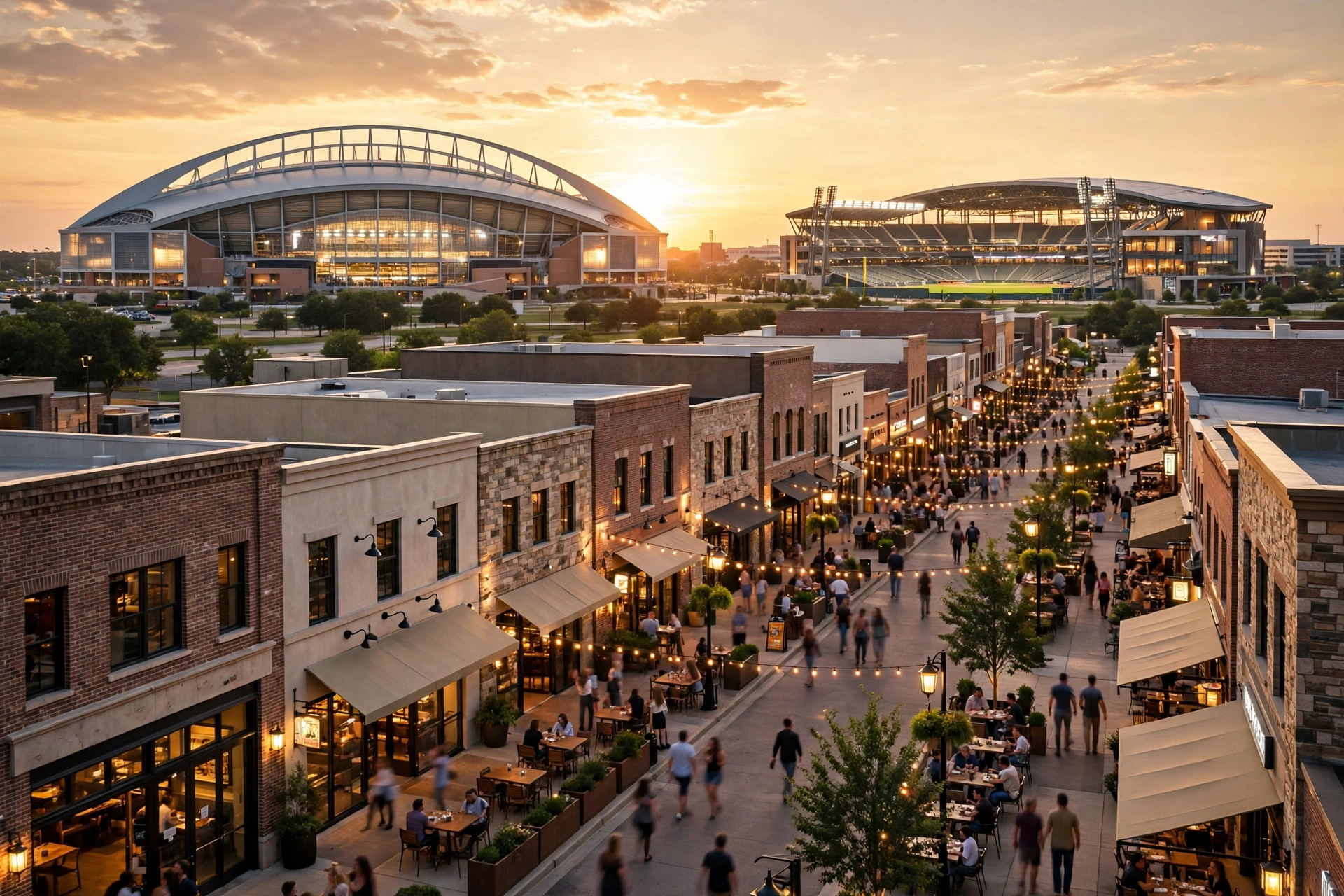
Key Takeaways
- Arlington reached 402,134 residents in the July 1, 2025 Census estimate, up 2.0% from the April 2020 base — a big city that still behaves like a collection of distinct business districts, each with its own funding needs.
- Manufacturing is the old anchor: General Motors announced its Arlington assembly plant in 1951, its first in Texas, and the ten-square-mile Great Southwest Industrial District followed in 1956. Suppliers, logistics firms, and warehouses still cluster along the I-20 corridor.
- The entertainment district is the volatile engine: AT&T Stadium, Globe Life Field, and Six Flags Over Texas turn home games and summer weekends into revenue spikes — and the weeks between them into troughs that punish fixed daily payments.
- Fast funding in Arlington means 24 to 72 hours to money in hand for revenue-based products: a short application, a same-day decision, and three months of business bank statements. Photo ID and a voided check are optional verification items, never upfront requirements.
Arlington is easy to misread from the stadium lights. The postcards say Cowboys and Rangers, roller coasters and sold-out Sundays — but the money underneath says something else: a General Motors assembly plant and its supplier chain, three million square feet of distribution and warehousing along I-20, the University of Texas at Arlington, a health care and retail economy serving more than 402,000 residents, and a hospitality strip that lives or dies by the event calendar. The city sits almost exactly between Dallas and Fort Worth on I-20, I-30, and State Highway 360, close enough to DFW Airport to serve both metros and distinct enough to have its own business cycle. Funding in Arlington works when the product matches the engine behind the business — and it stalls when a generic offer ignores how that business actually gets paid.
This post maps the city's three funding economies, matches products to business types, gives the real 2026 timelines, and shows how to compare offers in a city where a slow week can follow a record weekend without warning.
The three engines that borrow differently
The stadium economy. Bars, restaurants, hotels, merch shops, parking operators, and the services around them — cleaning, security, transport, catering — earn in spikes. A home game, a concert, a playoff run, or a summer Saturday at the theme park can produce a week's revenue in a day, and the following Tuesday can be dead. These businesses borrow for the spike itself: extra staff and inventory before a big weekend, a patio build-out before the season, a second location near the district. The funding that fits is fast and flexible — a revenue-based advance or a line of credit that can be drawn ahead of the event and repaid from the surge. The funding that hurts is a fixed daily debit sized to the spike week and still debiting through the dead weeks.
The factory and warehouse economy. The GM plant and the Great Southwest Industrial District support a deep bench of suppliers, machine shops, packaging firms, trucking outfits, and third-party logistics warehouses. These businesses bill on contracts and purchase orders, often net-30 or net-60, and their cash-flow problem is the gap between delivering the work and getting paid for it. The funding that fits is invoice factoring or a term loan for equipment — products priced on receivables and assets rather than daily card sales. Their files are usually the strongest in the city: steady deposits, long operating histories, and contracts a funder can read.
The Main Street and campus economy. Downtown Arlington, the Cooper Street corridor, the neighborhoods around UTA, and the medical and retail districts serve residents, students, and patients day in and day out. Restaurants, clinics, salons, auto shops, contractors, and professional services here have the steadiest deposits in the city — and the most ordinary funding needs: a slow-season bridge, a renovation, a new hire, a second truck. Term loans and lines of credit usually win here, because the business can carry a monthly payment and benefits from the lower total cost.
What funding fits which Arlington business
| Business type | Cash-flow shape | Usually fits best |
|---|---|---|
| Stadium-area restaurant, bar, or hotel | Sharp event spikes, dead weeks between | Revenue-based advance or line of credit, drawn ahead of big weekends |
| GM supplier, machine shop, or warehouse | Contract billing, net-30 to net-60 receivables | Invoice factoring or equipment term loan |
| Main Street retail, salon, or auto shop | Steady daily deposits, seasonal dips | Term loan or line of credit with a monthly payment |
| Contractor or trades company | Lumpy project payments, material costs upfront | Line of credit for materials plus a term loan for vehicles and equipment |
| New location or startup (under a year) | Short deposit history, thin file | Revenue-based advance once deposits exist; bank term loans usually need more history |
The table is a starting point, not a verdict. A stadium-area restaurant with three strong years of deposits may qualify for a cheaper term loan than a new warehouse with six months of history. The file decides — which is why comparing offers on total dollars, not on the product label, matters more than any table.
The timeline: what fast actually means in Arlington
Every lender says fast. The word means different things by product, and the difference is the whole decision when payroll or a supplier payment has a date on it.
| Product | Decision | Funding |
|---|---|---|
| Revenue-based advance (MCA) | Same day, often within hours | 24 to 72 hours |
| Business line of credit (online lender) | 1 to 2 days | 1 to 5 days |
| Term loan (online lender) | 1 to 3 days | 2 to 7 days |
| Term loan or line (bank or credit union) | 1 to 4 weeks | 2 to 6 weeks |
| SBA-backed loan | Weeks to months | 1 to 3 months |
Those are typical ranges, not promises — a clean file with complete statements moves at the fast end, and a file with missing pages or unexplained deposits moves at the slow end regardless of product. The fastest path is also the most document-sensitive: the same three months of bank statements that every revenue-based funder asks for are the file, so having complete PDFs ready before you apply is worth more than applying to five lenders at once.
How to compare offers in a stadium city
Total dollars first. Every offer, converted to the same advance amount: how much do you receive, how much do you repay in total, and what is the difference? A factor rate, a daily payment, or a monthly payment alone tells you nothing comparable. Two offers on the same $50,000 can differ by thousands of dollars in total cost, and the cheaper-looking daily debit is often the more expensive total.
Run the dead-week test. Arlington's event calendar is the stress test no generic comparison includes. Take the proposed payment — daily, weekly, or monthly — and check it against your worst recent week, not your best. A fixed daily debit sized to a home-game weekend will still debit on a dead Tuesday in January. If the payment only works in spike weeks, the product is wrong for the business, whatever the total cost says.
Prepayment terms in writing. With a revenue-based advance, the total is usually fixed at signing — paying early does not reduce it unless a discount is negotiated and written into a payoff letter before the money moves. With a term loan, early repayment usually does save interest. Ask the question explicitly on every offer, and never assume the answer from the product name.
The lien and the exit. Most advances and many loans file a UCC lien on business assets. The lien is normal; a lien that is never released after payoff is the problem, because it blocks cheaper financing later. The payoff letter should commit the funder to the release and a timeframe, and you should verify the filing was actually terminated after payment.
What lenders actually ask for
The document list is short, and that is the point. For a revenue-based product, the core requirement is three months of business bank statements — complete PDFs, every page, from the business account. Everything else is secondary: a photo ID and a voided check are optional verification items that some funders request, never upfront requirements that should stop you from applying. Tax returns, profit-and-loss statements, and business plans belong to bank and SBA processes, not to a 24-hour advance.
What slows an Arlington file down is rarely a missing exotic document. It is the ordinary stuff: a statement PDF missing its last page, a month where deposits dropped without explanation, a stack of existing daily debits the underwriter discovers on their own instead of hearing about from you, or a business account mixed with personal spending. Clean files fund fast; the fastest thing you can do before applying is download complete statements, separate the business account, and be ready to explain any one-off month in one sentence.
Arlington rewards businesses that match the money to the calendar: fast, flexible capital ahead of the spike, patient capital for the build-out, and receivables financing for the contract gap. The city's economy has been compounding since the GM plant arrived in 1951 — the businesses that borrow well here are the ones that treat funding as a calendar decision, not a desperation one. Get the statements ready, compare total dollars, run the dead-week test, and let the written numbers decide.
Arlington business? Get funded in 24–72 hours.
One application, competing offers, total cost in writing. Bank statements are the main document — gather three months before you start.
Apply Now or call (352) 809-3201
Ready to Get Funded?
Apply now and get a funding decision within hours. No hard credit pull for pre-approval — see your options risk-free.