Fast Business Funding in Chula Vista, CA: 275,533 People, Otay Mesa's $38B Border Trade & the $1.3B Gaylord Pacific (2026)
Chula Vista held 275,533 people on July 1, 2025 — San Diego County's second-largest city, essentially flat since 2020 after a big 2010s run-up — with Otay Mesa moving more than $38 billion in cross-border trade a year, the $1.3 billion Gaylord Pacific resort opening on the bayfront in May 2025, and Chula Vista borrowers taking 233 SBA 7(a) approvals worth $90.9 million over FY2020–FY2026. Here is how business funding actually works in the Chula Vista market: the product map by business type, real timelines, the public programs that exist, and how to compare offers.
Need funding fast? Apply in about 2 minutes — get a decision within hours, with no hard credit pull for pre-approval.
Apply Now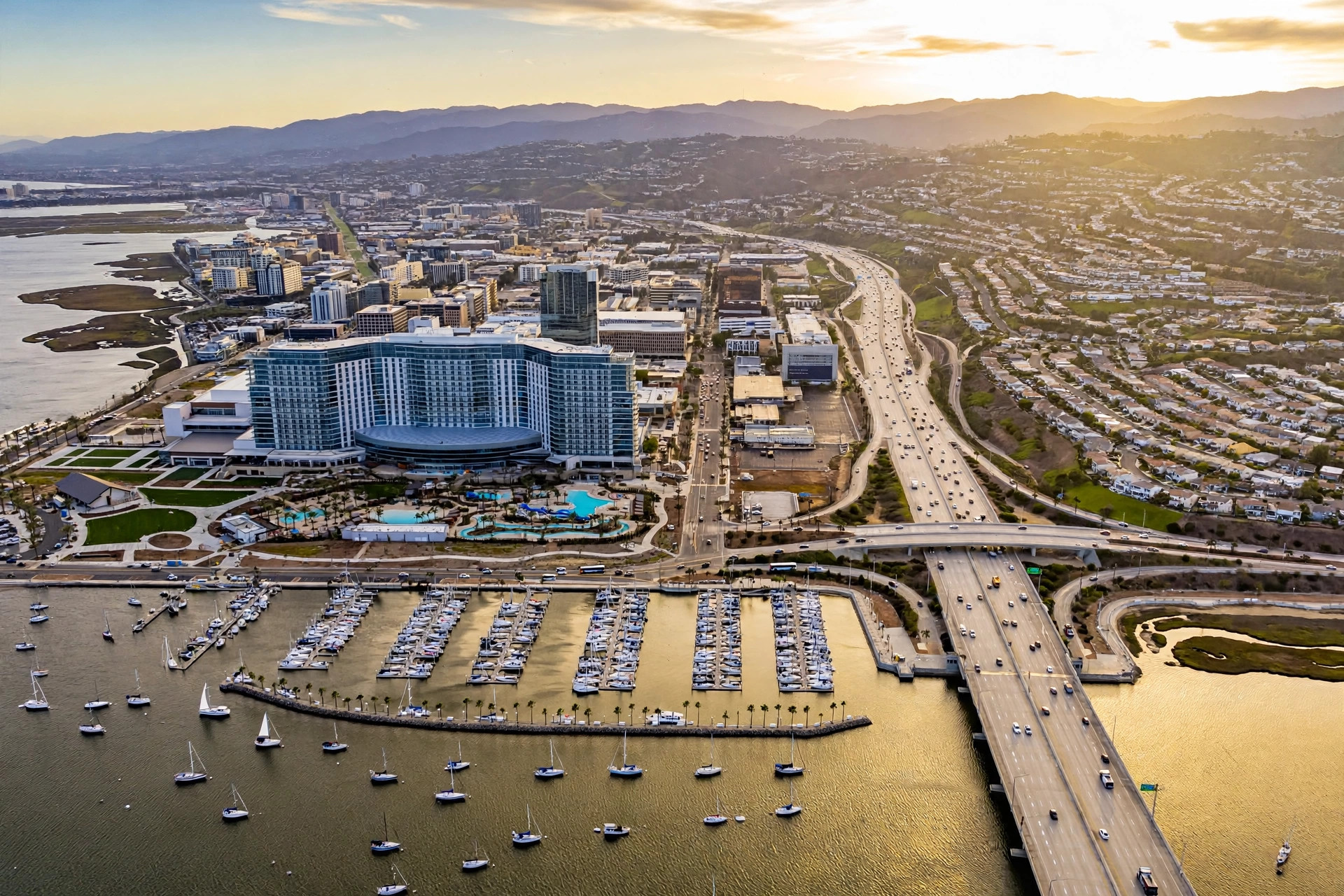
Key Takeaways
- Chula Vista is San Diego County's second-largest city at 275,533 people on July 1, 2025, per the Census Bureau's Vintage 2025 estimates — essentially flat since the 2020 Census count of 275,487, after growing 12.9 percent in the 2010s from 243,916 — and the San Diego-Chula Vista-Carlsbad metro holds 3,282,248 people, the 18th-largest in the country. Median household income is $108,032, with a poverty rate of 8.7 percent and 33.2 percent of adults holding a bachelor's degree. The median home value is $758,700, and 59.8 percent of homes are owner-occupied. Chula Vista covers 49.64 square miles of land, so its density is 5,550 people per square mile.
- Two anchors define the Chula Vista economy. Otay Mesa is San Diego County's largest industrial area, and its port of entry is California's largest commercial land port of entry at more than $38 billion in trade a year — roughly two-thirds of all cross-border trade between California and Mexico, with more than one million northbound trucks in 2023. And the $1.3 billion Gaylord Pacific Resort & Convention Center opened on the bayfront on May 15, 2025, with 1,600 rooms and 477,000 square feet of event space — the largest hotel in California — with city and regional officials estimating $475 million in annual new economic impact.
- Chula Vista is a city of homeowners and border logistics. With 85,710 households, 59.8 percent owner-occupied, a $758,700 median home value, and master-planned communities from Eastlake to Rancho del Rey and Otay Ranch, the steady funding demand comes from plumbing, HVAC, electrical, roofing, and landscaping firms, plus the customs brokers, freight forwarders, and warehouse operators feeding Otay Mesa. The city's retail sales were $4.46 billion in 2022, with accommodation and food services of $766.9 million and health-care receipts of $2.05 billion.
- Funding demand here is documented, not guessed. Chula Vista borrowers took 233 SBA 7(a) approvals worth $90.9 million over FY2020–FY2026, with the biggest year by loan count and dollars FY2023 at 42 loans and $19.4 million. FY2024 had the most loans at 54 but the smallest dollars at $9.1 million — many small loans. The largest single approval was a $5 million loan at the program maximum to Rerogi LLC. FY2026 came in lower at 24 loans and $5.8 million, partly because no 7(a) approvals were recorded nationally during the federal shutdown gap from October 1 to November 12, 2025.
- The cheapest money in Chula Vista is public and specific: California's State Small Business Credit Initiative carries a $1,182.0 million allocation across seven programs — a $561.0 million loan guarantee program, $227.8 million in collateral support, $165.0 million in loan participation, $28.2 million in capital access, and $200.0 million across three venture and co-investment initiatives — run through IBank and the California Pollution Control Financing Authority; the San Diego & Imperial SBDC Network offers free one-on-one advising, including loan-package assembly, with over 100 advisors. The City's only small-business grant programs were pandemic relief — Chula Vista CARES at $1.5 million in 2020 and an ARPA program at $3.6 million in 2022 — both closed. The City itself runs no direct small-business loan program — do not plan around the City as a lender.
Why Chula Vista borrows differently
Chula Vista is a city built on lemons and a border, and that is the first thing to understand about its funding market. It was laid out in 1888 by the Santa Fe Land Improvement Company as a citrus colony — 4,000 acres of lemon groves among 15,000 acres of agricultural land — and the citizens voted to incorporate on October 17, 1911, with the state approving it that November. The groves are gone, but the geography that named the city — Spanish for "beautiful view," between San Diego Bay and the coastal foothills — still defines it. In 1985 Chula Vista made the largest annexation in California history, taking in Castle Park and Otay, and the master-planned communities east of I-805 — Eastlake, Rancho del Rey, and Otay Ranch — turned a farm town into San Diego County's second-largest city at 275,533 people. Funders read that as a market of dense, high-income South Bay demand — median household income $108,032, poverty 8.7 percent, 59.8 percent owner-occupied homes, median home value $758,700 — plus a deep base of border logistics firms, home-services companies, and hospitality businesses serving a metro of 3.28 million people.
The economy runs on four anchors. The first is the border. Otay Mesa is San Diego County's largest industrial area, a roughly 16-million-square-foot market of warehouses, manufacturers, and distribution centers pressed against the busiest commercial crossing on the California border. The Otay Mesa Port of Entry moves more than $38 billion in trade a year — about two-thirds of all cross-border trade between California and Mexico — with more than one million northbound trucks in 2023, and the Cross Border Xpress pedestrian bridge puts Tijuana International Airport about seven miles away. JLL arranged $102.4 million in construction financing in September 2025 for the first phase of Otay Business Park — 612,240 square feet across four buildings, with 1.78 million square feet at full buildout — and the new Otay Mesa East Port of Entry is under construction and scheduled to open in late 2027. The second is the bayfront. The Gaylord Pacific opened in May 2025 after more than twenty years of planning, and the 535-acre Bayfront Master Plan around it is the largest piece of oceanfront land still available for development on the West Coast — Sweetwater Park, 39 acres, opened in April 2025 as the Port's largest park, and Pacifica Companies' $1 billion Amara Bay project, 1,500 condos in seven towers, is underway next to the resort. The third is health care and education. Sharp Chula Vista Medical Center holds 449 licensed beds, Scripps Mercy Hospital's Chula Vista campus dates to 1964, and Southwestern College runs its Higher Education Center at Otay Mesa. The fourth is the home. East Chula Vista's master-planned communities — Eastlake, Rancho del Rey, and Otay Ranch, a 22,899-acre development planned for 49,648 homes and a projected population above 110,000 — generate constant demand for plumbers, HVAC techs, electricians, roofers, and landscapers, and every one of those firms is a funding file: vans, tools, a second crew, a slow-pay commercial invoice.
The third Chula Vista is the one arriving now, and it is the build-out of both ends of the city at once. On the west, the bayfront is filling in around the Gaylord with parks, condos, retail, and at least two more hotels planned by other developers. On the east, Otay Ranch keeps building villages — Millenia, the Eastern Urban Center, and Escaya — and the City plans a 375-acre University Park and Innovation District overlooking Lower Otay Lake, designed at full buildout for a four-year university campus serving up to 20,000 students with about 6,000 faculty and staff. That district is planned, not built, so do not underwrite it as if the students are already here — but the direction is plain: a city that was flat in population since 2020 is building the housing, the industrial space, and the convention base for the next leg. Every contractor, supplier, staffing firm, and home-services company feeding that build-out is a file a funder wants to see.
One thing to get straight before you borrow on a Chula Vista address: this is a border market inside a high-cost coastal metro, and funders know it. A logistics firm's revenue rides cross-border volume and the peso, a restaurant on the bayfront rides convention bookings, and a home-services firm rides the housing cycle in communities where the median home is $758,700. A file that shows the twelve-month pattern — the busy season, the slow shoulder, the plan for the trough — prices better than a file that shows only the good quarter. And one caution on the numbers themselves: Chula Vista's only verified unemployment figure is the San Diego County rate — 4.7 percent in September 2026, not seasonally adjusted — and that county is the metro. Do not let anyone quote you a Chula Vista city unemployment rate; none has been published. Likewise, the Census Bureau publishes no city-level count of Chula Vista businesses at all — its QuickFacts page lists employer establishments as not applicable for the city — so anyone quoting a Chula Vista business count is quoting the county.
The Chula Vista funding map: which product fits which business
Funding is not one product. The right one depends on what the money is for, how fast it comes back, and what your revenue looks like month to month. Here is the map for Chula Vista:
Merchant cash advance — for card-heavy businesses with a short-term gap. Restaurants and bars near the bayfront and the Gaylord, retailers in Otay Ranch Town Center and Eastlake, and hospitality firms with steady card sales borrow against future receipts and repay daily or weekly as a share of sales. A $50,000 advance at an illustrative 1.20 factor rate repays $60,000 in total — $10,000 of cost — or about $2,308 a week over 26 weeks. The advance is fast, usually funded in 24 to 72 hours, and it fits a payroll gap or an inventory buy that pays back in a season. It is the most expensive money on this map, and it is the right call only when the money comes back within months. Read what actually happens if you default on an advance before you sign one, and read whether a merchant cash advance is legal for the state-by-state picture.
Term loan — for a known cost with a fixed payoff date. A second service van for a plumbing crew, a build-out in a new ground-floor space in Millenia, a hire that pays for itself over a year, a down payment on a warehouse lease in Otay Mesa. Fixed daily, weekly, or monthly payments over months to years, priced on a rate or a factor depending on the lender. If the spend has a clear return date, match the term to it — borrowing for 12 months to pay for something that returns in three is overpaying for speed you do not need.
Business line of credit — for the seasonal business. An HVAC contractor between the summer rush and the winter lull, a landscaper waiting on a Net 45 invoice from a master-planned community's HOA, a customs broker waiting on a client settlement, or a restaurant stocking up before a big convention week at the Gaylord draws only what it needs and pays interest only on what it draws. The line is the right tool when the gap is timing — a contract 60 days out, a season that pays in July — rather than a single purchase. Draws after approval are usually same-day.
Equipment financing — for the thing itself. A service van, a commercial HVAC install rig, a forklift and racking for an Otay Mesa warehouse, a delivery truck for a cross-border run, kitchen equipment for a restaurant, medical equipment for a clinic. The equipment secures the loan, so the pricing is usually the cheapest money on this map for an asset purchase, and the term can run two to five years. If the money buys a thing, price the equipment product first. And if you already own the equipment outright, you can borrow against it instead — an equipment refinance or sale-leaseback turns a paid-off machine into working capital without taking it out of service.
Purchase-order and invoice financing — for the contract economy. A freight forwarder with a signed purchase order from a maquiladora supplier, a staffing firm waiting on Net 45 payment from a warehouse operator, or a contractor with outstanding invoices on a bayfront or Otay Ranch build can borrow against the order or the receivable instead of against future card sales. The advance is sized on the contract, not on last month's deposits, which is exactly the profile a contract business needs. Ask about it before you take a general-purpose advance.
SBA and guaranteed loans — for the cheapest money, if you can wait. SBA 7(a) loans run up to $5 million through SBA lenders, and SBA 504 loans run up to $5 million for owner-occupied real estate and long-life equipment. SBA microloans run up to $50,000. The underwriting is real and the clock runs in weeks, sometimes six to eight, but the rate is the lowest on this map — and Chula Vista businesses have actually used them: 233 SBA 7(a) approvals worth $90.9 million over FY2020–FY2026, with the biggest year by loan count and dollars FY2023 at 42 loans and $19.4 million. For the full comparison method, see which funding product fits which business.
Grants and loan programs: what actually exists in Chula Vista
Before you borrow, check the money that does not need repaying — and be honest about what is open right now. The public money that actually exists for Chula Vista businesses is state and regional, not a general city cash grant. The San Diego & Imperial SBDC Network offers free one-on-one advising, including business-plan help and loan-package assembly, with over 100 expert advisors and subcenters including the South San Diego SBDC — start there before you apply anywhere else, because it costs nothing and it is the fastest way to a fundable file. And if your business is in San Diego, just up I-5, the same state programs apply — the difference is the local channel, not the state one.
The state channel is California's State Small Business Credit Initiative (SSBCI), a $1,182.0 million portfolio across seven programs, updated by the U.S. Treasury in September 2026 and administered by IBank and the California Pollution Control Financing Authority; California received its final SSBCI tranche in December 2025. The Small Business Loan Guarantee Program at $561.0 million guarantees up to 80 percent of a loan or $5.0 million, whichever is less, with a $20 million loan cap — you work through a lender and a non-profit Financial Development Corporation. The Collateral Support Program at $227.8 million pledges cash to a lender to cover a collateral shortfall, up to 40 percent of the loan amount (plus 10 percent more if the business is in a Severely Affected Community), with maximum support of $2.5 million per loan on loans from $50,000 to $20 million. The Loan Participation Program at $165.0 million buys or co-lends up to 50 percent of a loan package, mostly short-term lines of credit, with a maximum participation of $10 million. The California Capital Access Program at $28.2 million provides portfolio insurance to enrolled lenders. The remaining $200.0 million runs through three venture and co-investment initiatives — Inclusive California at $125.0 million, Emerging California at $50.0 million, and the California Co-Investment Initiative at $25.0 million — for high-growth companies, not Main Street loans. You apply through a participating lender, not directly to the state — these are credit supports, not grants.
The local channel is the City of Chula Vista's own history, and it is closed history. The City ran two pandemic-relief grant programs and nothing since: Chula Vista CARES, a $1.5 million program approved in July 2020 with grants up to $6,000 for businesses forced to close, and an American Rescue Plan program of $3.6 million in 2022, administered by The San Diego Foundation, with grants up to $10,000. Both are closed. The City's own economic development arm publishes no direct small-business loan program with published volume — do not plan around the City as a direct lender.
One honest note about grants: grants are slow and competitive, and none of them cover payroll next Friday. Use them for the project they fit, and borrow for the gap they leave — not the other way around. And one honest note about Chula Vista specifically: the expensive part of doing business here is space and labor, not demand. A warehouse lease in Otay Mesa, a storefront near the bayfront, and a licensed tech all cost real money in a metro where the median home is $758,700 — and a logistics or hospitality business that borrows against a busy quarter without a plan for the slow one is borrowing against the wrong month. The funding should be priced on the total repayment across the full year, not the headline rate in the good quarter. California levies a state income tax — do not expect a Nevada-style tax advantage here, and do not let anyone sell you one.
What to watch before you sign
There is no substitute for the total repayment in dollars, in writing, before you sign. Compare offers on that number, not on the headline rate or the monthly payment. If a funder will not put the total in writing, that is your answer about the funder.
The second thing to watch is the repayment rhythm. Daily debits against a restaurant's account in a slow week between conventions, or against a freight forwarder's account while a client settlement is still in transit, can drain the account before the next weekend or the next shipment lands. If your revenue swings with the convention calendar or the border, ask for weekly payments instead of daily, and ask what happens if a debit fails. A funder that answers clearly is a funder that has done this before.
The third is concentration. Chula Vista's economy is anchored — one border crossing, one resort, a handful of master-planned communities — and your business may be far more concentrated than the city is. A customs broker with one maquiladora client at 60 percent of revenue, a supplier living off one Gaylord purchase order, or a restaurant depending on one hotel's guests is a different file from ten customers at 6 percent each. Bring the contract, the payment history, and the plan for a second customer. A file that explains the concentration prices better than a file that leaves the funder to discover it.
The fourth is stacking. A second advance taken to cover the first one's payments is how a manageable file becomes a default. If you already hold an advance, read how to refinance one before you stack another, and read how the early-payoff discount works if you are weighing paying one off early.
Frequently asked questions
How fast can a Chula Vista business get funded? A merchant cash advance typically funds in 24 to 72 hours after approval with three months of bank statements. Term loans run a similar clock, lines of credit decide in minutes to a day, equipment financing takes days to a couple of weeks, and SBA loans take weeks. The public programs run slower, because they move through review rounds and partner referrals.
What do I need to apply? Three months of business bank statements are the core document. A photo ID and a voided check are usually optional verification, not requirements — but having them ready removes stalls. Logistics firms should also bring the client contracts and shipment history; contractors should bring the draw schedule and signed purchase orders; home-services firms should bring the seasonal sales pattern; restaurants should bring the card-sales history.
Does the border trade or the Gaylord resort help my approval chances? It helps, if the file shows it. Funders underwrite your business, not the headline. A freight forwarder or a restaurant with twelve months of deposits showing steady work from a 275,533-person city plus $4.46 billion in annual retail sales prices far better than a file that leaves the funder to guess — but border and convention revenue is contract revenue, so show the contracts, the payment history, and the twelve-month pattern, not just the customer names, and name the concentration honestly.
Can a restaurant, retailer, logistics firm, or contractor get funded in Chula Vista? Yes — restaurants, retailers, logistics firms, and trades are among the most common Chula Vista profiles, because the border, the bayfront, and the master-planned communities keep them busy most of the year. An advance fits a short-term payroll or inventory gap; a line of credit fits the seasonal business; equipment financing is usually the cheapest route for a truck, a forklift, or a kitchen; and an SBA loan can fill a gap a bank will not cover on its own.
What if my revenue depends on one big customer? Say so up front, and show the concentration honestly. Funders price concentration risk — one customer at 60 percent of revenue is a different file from ten customers at 6 percent each — but a signed multi-year contract with a creditworthy buyer is also a strength. Bring the contract, the payment history, and the plan for a second customer. A file that explains the concentration prices better than a file that leaves the funder to discover it.
Ready to fund your Chula Vista business?
One application, competing offers, total cost in writing. Bank statements are the main document — gather three months before you start, and bring the full twelve months if your revenue is seasonal, or the client contracts and shipment history if you are a logistics firm or a contractor.
Apply Now or call (352) 809-3201
Ready to Get Funded?
Apply now and get a funding decision within hours. No hard credit pull for pre-approval — see your options risk-free.