Fast Business Funding in Colorado Springs, CO: the $15.16 Wage Floor, Five Military Bases & 25.6 Million Visitors (2026)
Colorado Springs pairs five military installations with the third-largest tourism employer in the Pikes Peak region — 25.6 million visitors who spent $3.1 billion in 2025 — and a metro unemployment rate of 4.5 percent in September 2026. The city held 494,743 people on July 1, 2025, with a median household income of $84,818. Here is how business funding actually works in the Colorado Springs market: the product map by business type, real timelines, the grants and loan programs that exist, and how to compare offers.
Need funding fast? Apply in about 2 minutes — get a decision within hours, with no hard credit pull for pre-approval.
Apply Now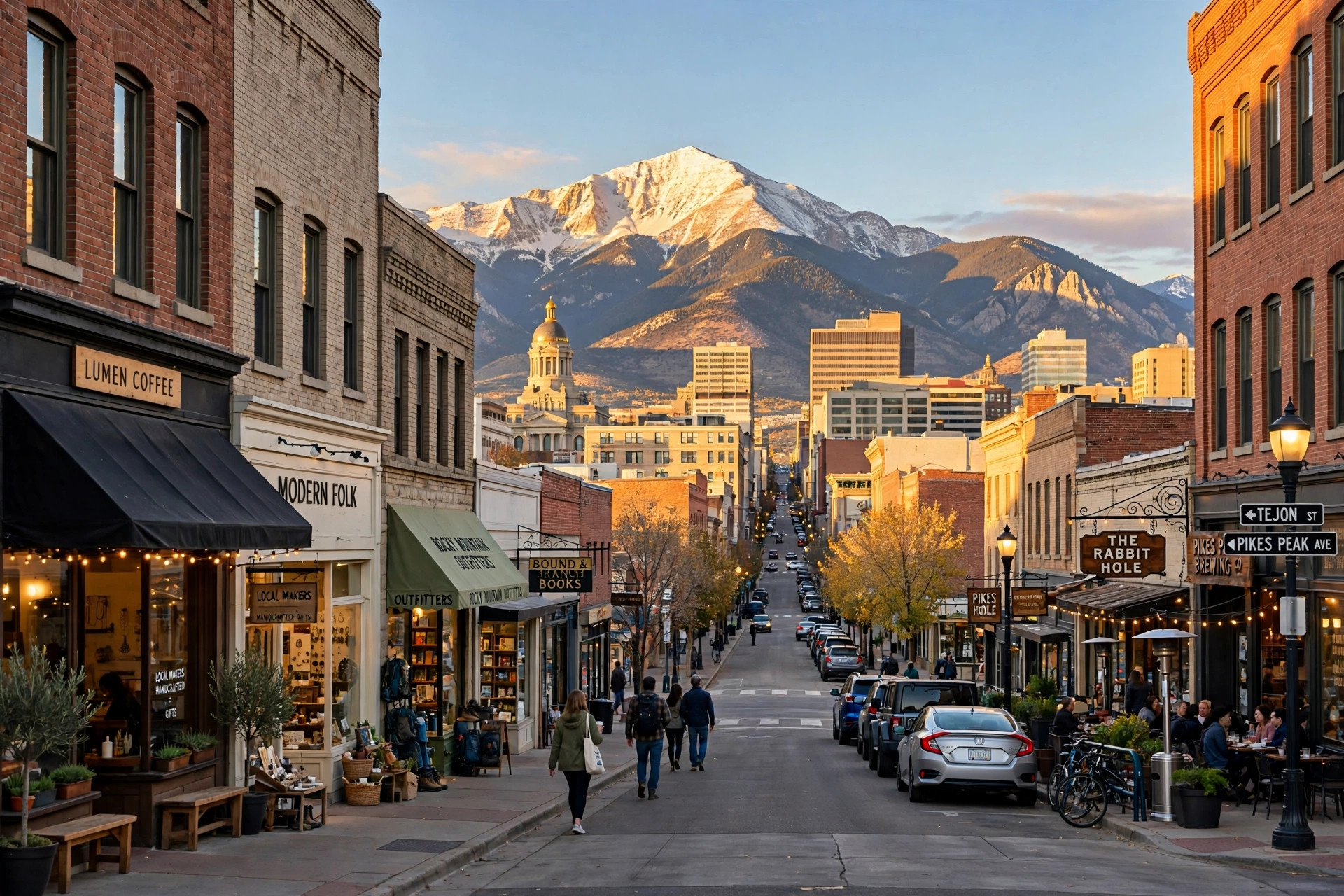
Key Takeaways
- Colorado sets its own wage floor: $15.16 an hour from January 1, 2026, up from $14.81 in 2025. Colorado Springs has no local minimum wage, so the state rate applies — unlike Denver at $19.29. Twelve staff at the state floor cost $7,276.80 a week; the tipped cash wage is $12.14 an hour, and the 2027 rate is already announced at $15.71.
- The Colorado Springs metro unemployment rate was 4.5 percent in September 2026, up from 3.9 percent a year earlier. The city held 494,743 people on July 1, 2025 — up 3.1 percent since the 2020 census count of 478,961 — with a median household income of $84,818, above the national figure of $80,734.
- Defense is the dominant economy: five major installations — Fort Carson, Peterson Space Force Base, Schriever Space Force Base, Cheyenne Mountain, and the U.S. Air Force Academy — plus more than 250 defense and aerospace employers and 70-plus aerospace and defense companies, including Lockheed Martin, Northrop Grumman, Boeing, Raytheon, Ball Aerospace, L3Harris, SAIC, and Jacobs.
- Tourism is the third-largest employer in the Pikes Peak region at more than 40,000 jobs: 25.6 million visitors in 2025 spent $3.1 billion, both records, and downtown has drawn about $2.66 billion in completed, under-construction, and announced investment since 2013.
- The cheapest money in Colorado Springs is public and specific: the state's CLIMBER working-capital loans run $10,000 to $500,000 and were made permanent in May 2026, the Colorado Startup Loan Fund runs $10,000 to $150,000, and Cash Collateral Support covers up to 25 percent of a loan or $500,000. The Pikes Peak Small Business Development Center offers free advising, and SBA 7(a) and 504 loans run to $5 million each — combinable to $10 million since July 2026.
Why Colorado Springs borrows differently
Most American cities have one economy. Colorado Springs has three, stacked on top of each other. The first is defense. Five major installations — Fort Carson, Peterson Space Force Base, Schriever Space Force Base, Cheyenne Mountain Space Force Station, and the U.S. Air Force Academy — make this one of the most concentrated military regions in the country, and more than 250 defense and aerospace employers and 70-plus aerospace and defense companies operate here. Defense contractors, machine shops, IT services firms, and logistics companies borrow against government contracts in a rhythm set by the federal fiscal year, not the calendar quarter. A contract that starts in October gets paid in arrears, and the funders that know Colorado Springs price those files on the contract and the deposit history, not on one slow month.
The second economy is tourism and hospitality. The Pikes Peak region welcomed 25.6 million visitors in 2025 who spent $3.1 billion — both records — and tourism is the third-largest employer in the region at more than 40,000 jobs. Hotels, restaurants, outfitters, and retailers on the tourism calendar borrow for the season: a rafting company, a gift shop on Tejon Street, or a restaurant near Garden of the Gods needs the money in April and pays it back by October. A funder that prices the file on one dead winter month alone will quote you like a failing business. A file that shows twelve months of deposits, the seasonal pattern, and the explanation for the slow month gets priced like the business it is.
The third economy is the growth economy. Colorado Springs ranked 15th among the 25 fastest-growing U.S. metros for jobs and new talent in LinkedIn's Cities on the Rise 2025, the city added 2,288 residents between July 2024 and July 2025 — more than any other Colorado city — and downtown has drawn about $2.66 billion in investment since 2013. Swire Coca-Cola announced a 620,000-square-foot plant at Peak Innovation Park in December 2025, and industrial and flex vacancy sits around 5.2 percent, below Denver's 8.6 percent. Growth businesses borrow for the build-out, the hire, and the equipment — and a funder that reads the city number alone will quote you like a market that is standing still. It is not.
The second defining number is the customer base. A median household income of $84,818 — above the national figure of $80,734 — means Colorado Springs restaurants, retailers, and service firms sell into a large, working market of 494,743 people, inside a metro of about 781,796. The honest counterweight is the unemployment trend: the metro rate rose from 3.9 percent in September 2025 to 4.5 percent in September 2026, so a lender that reads the trend alone will quote you like a softening market. A file that shows steady deposits prices on the business, not the trend.
One headline deserves a straight answer, because it worries every defense contractor in town. U.S. Space Command headquarters is moving to Huntsville, Alabama — announced in September 2025, about 1,800 personnel, completion by 2032. Colorado Springs keeps NORAD, U.S. Northern Command, Peterson and Schriever Space Force Bases, and Cheyenne Mountain, and local leaders have pivoted to a partnership with Huntsville around the Golden Dome missile-defense program, with a new operations center slated to open by 2030 and projected to add about 5,700 military and civilian positions. Defense and aerospace demand remains strong, and Colorado is also bidding to host a proposed U.S. Space Academy in the city — the federal commission's recommendations are not due until late December 2026 and Congress has not approved it. Borrow on the contract you hold, not the headline you read.
The Colorado Springs funding map: which product fits which business
Funding is not one product. The right one depends on what the money is for, how fast it comes back, and what your revenue looks like month to month. Here is the map for Colorado Springs:
Merchant cash advance — for card-heavy businesses with a short-term gap. Restaurants, retailers, and tourism firms with steady card sales borrow against future receipts and repay daily or weekly as a share of sales. A $50,000 advance at an illustrative 1.20 factor rate repays $60,000 in total — $10,000 of cost — or about $2,308 a week over 26 weeks. The advance is fast, usually funded in 24 to 72 hours, and it fits a payroll gap or an inventory buy that pays back in a season. It is the most expensive money on this map, and it is the right call only when the money comes back within months. Read what actually happens if you default on an advance before you sign one, and read whether a merchant cash advance is legal for the state-by-state picture.
Term loan — for a known cost with a fixed payoff date. A work truck, a production line, a restaurant build-out, a hire that pays for itself over a year. Fixed daily, weekly, or monthly payments over months to years, priced on a rate or a factor depending on the lender. If the spend has a clear return date, match the term to it — borrowing for 12 months to pay for something that returns in three is overpaying for speed you do not need.
Business line of credit — for the lumpy business. A defense subcontractor waiting on a contract payment, a tourism business between seasons, or a contractor with revenue that arrives in bursts draws only what it needs and pays interest only on what it draws. The line is the right tool when the gap is timing — a contract 60 days out, a season that pays in summer — rather than a single purchase. Draws after approval are usually same-day.
Equipment financing — for the thing itself. A CNC machine, a delivery fleet, a commercial kitchen, a tour vehicle. The equipment secures the loan, so the pricing is usually the cheapest money on this map for an asset purchase, and the term can run two to five years. If the money buys a thing, price the equipment product first.
Purchase-order and invoice financing — for the defense and supply economy. A subcontractor with a signed government contract or a supplier with outstanding invoices can borrow against the order or the receivable instead of against future card sales. The advance is sized on the contract, not on last month's deposits, which is exactly the profile a contract business needs. Ask about it before you take a general-purpose advance.
SBA and guaranteed loans — for the cheapest money, if you can wait. SBA 7(a) loans run up to $5 million through SBA lenders, and SBA 504 loans run up to $5 million for owner-occupied real estate and long-life equipment — and since July 4, 2026, a borrower can combine the two programs for up to $10 million in total SBA-backed financing. SBA microloans run up to $50,000. The underwriting is real and the clock runs in weeks, sometimes six to eight, but the rate is the lowest on this map. For the full comparison method, see which funding product fits which business.
Grants and loan programs: what actually exists in Colorado Springs
Before you borrow, check the money that does not need repaying — and be honest about what is open right now. Colorado Springs pays real money, but it is narrow and specific, not a general cash grant. The Pikes Peak Small Business Development Center, hosted by the Colorado Springs Chamber & EDC at Catalyst Campus, 559 East Pikes Peak Avenue, Suite 101, offers free and confidential advising plus no- and low-cost training, including help with loan preparation, business plans, financial forecasting, and government contracts and certifications. Start there before you apply anywhere else — it costs nothing and it is the fastest way to a fundable file.
The state channel is the CLIMBER program — Colorado Loans to Increase Mainstreet Business Economic Resiliency — working capital loans of $10,000 to $500,000 for businesses with 1 to 99 employees, at below-market rates, with a one-year deferred payment option, applied for through a participating bank, CDFI, credit union, or nonprofit lender. In fiscal year 2023-24 the program loaned more than $17 million statewide and helped create or support about 1,900 jobs, and House Bill 26-1003, signed May 29, 2026, made the program permanent and expanded eligibility. The Colorado Startup Loan Fund lends $10,000 to $150,000, with terms up to 10 years, to Colorado for-profit businesses with 25 or fewer full-time-equivalent employees and $2 million or less in annual revenue that cannot obtain traditional financing — applied for directly with a mission-based lender such as B:Side Fund, CEDS Finance, or the Colorado Enterprise Fund. Cash Collateral Support lets the state, through the Colorado Housing and Finance Authority, put up a cash deposit to supplement your collateral — up to 25 percent of the loan amount or $500,000, whichever is less. The Colorado Enterprise Fund, a nonprofit community lender, lends up to $1,000,000 to small businesses that do not meet traditional financing guidelines.
The local channel is Accelerate COS, the city's small business loan fund run with Exponential Impact: micro-loans of $1,000 to $10,000 for Colorado Springs businesses registered in El Paso County with fewer than 50 employees and under $2 million in annual revenue, and growth loans of $10,000 to $50,000 for businesses at least two years old, on a 3-year term at 5 percent interest. Check the current cycle status before you count on it — the 2026 micro-loan application cycle closed October 31, 2025. SCORE Colorado Springs offers free business mentoring and educational programs. And one thing that used to be on lists like this is not anymore: the Pikes Peak Enterprise Zone Business Relief Fund was a COVID-era program from 2020 and is closed, though businesses in the Enterprise Zone may still qualify for state tax credits.
One honest note about grants: the state is clear that there are no cash grants for everyday small businesses under its federal SSBCI programs. Grants for ordinary small businesses come from cities, nonprofits, or national programs and change frequently. Grants are slow and competitive, and none of them cover payroll next Friday. Use them for the project they fit, and borrow for the gap they leave — not the other way around.
Colorado regulation: what a Colorado Springs borrower should know
Colorado has no California- or New York-style commercial financing disclosure law for merchant cash advances — there is no state requirement that MCA funders register or give standardized disclosures with an estimated APR. What Colorado does have is House Bill 23-1229, signed in June 2023 with key provisions effective January 1, 2024, which opted Colorado out of the federal DIDMCA rate-exportation rules, so out-of-state state-chartered banks lending to Coloradans are subject to Colorado's Uniform Consumer Credit Code rate caps — an opt-out the 10th Circuit upheld. Separately, Colorado law caps periodic interest on commercial credit plans at 45 percent per year. None of that changes the practical rule: get the total repayment in dollars, in writing, before you sign, and compare offers on that number. If a funder will not put the total in writing, that is your answer about the funder.
Frequently asked questions
What is the minimum wage in Colorado Springs in 2026? Colorado Springs has no local minimum wage, so the Colorado statewide rate applies: $15.16 an hour from January 1, 2026, up from $14.81 in 2025. The tipped cash wage is $12.14 an hour, with tips required to bring the total to $15.16. The 2027 rate is already announced at $15.71 an hour, effective January 1, 2027. Twelve full-time staff at the 2026 floor cost $7,276.80 a week in base wages, or $31,532.80 a year each.
How fast can a Colorado Springs business get funded? A merchant cash advance typically funds in 24 to 72 hours after approval with three months of bank statements. Term loans run a similar clock, lines of credit decide in minutes to a day, equipment financing takes days to a couple of weeks, and SBA loans take weeks. The state programs — CLIMBER, the Startup Loan Fund — run slower, because they move through participating lenders.
Are there grants for Colorado Springs small businesses in 2026? Yes — but narrow ones. The Pikes Peak SBDC offers free advising, CLIMBER lends $10,000 to $500,000 in working capital, the Colorado Startup Loan Fund lends $10,000 to $150,000, and Accelerate COS runs local micro- and growth loans — check its current cycle, since the 2026 micro-loan cycle closed October 31, 2025. There is no general city or state cash grant for operating costs.
What do I need to apply? Three months of business bank statements are the core document. A photo ID and a voided check are usually optional verification, not requirements — but having them ready removes stalls. Defense subcontractors should also bring the contract or purchase order; tourism businesses should bring the seasonal revenue pattern; restaurants and retailers should bring the lease.
Does the Space Command move hurt my approval chances? Funders underwrite your business, not the headline. The headquarters move is about 1,800 personnel over several years, while NORAD, U.S. Northern Command, Peterson and Schriever Space Force Bases, and Cheyenne Mountain stay in Colorado Springs, and the Golden Dome program is projected to add about 5,700 military and civilian positions by 2030. A file with a signed contract, steady deposits, and an explanation for any slow month prices far better than a file that leaves the funder to guess. Show the contract and twelve months of deposits, not just the last quarter.
Can a defense contractor or a tourism business get funded in Colorado Springs? Yes — defense subcontractors, machine shops, IT services firms, hotels, restaurants, outfitters, and retailers are among the most common Colorado Springs profiles, because the installations and the visitor economy keep orders and contracts moving year-round. An advance fits a short-term payroll or inventory gap; purchase-order financing fits a contract; equipment financing is usually the cheapest route for a machine or a fleet; and a state loan or an SBA loan can fill a gap a bank will not cover on its own. If you are weighing an early payoff, read how the early-payoff discount works, and if you already hold an advance, read how to refinance one before you stack another.
Ready to fund your Colorado Springs business?
One application, competing offers, total cost in writing. Bank statements are the main document — gather three months before you start, and bring the contract or purchase order if you are a defense subcontractor, or the lease if you are a restaurant or retailer.
Apply Now or call (352) 809-3201
Ready to Get Funded?
Apply now and get a funding decision within hours. No hard credit pull for pre-approval — see your options risk-free.