Fast Business Funding in Fort Lauderdale, FL: 188,677 People, Port Everglades' $48.3B Engine & the $1.79B Boat Show (2026)
Fort Lauderdale held 188,677 people on July 1, 2025 — the county seat and largest city in Broward County — with Port Everglades generating $48.3 billion in economic activity in FY2025, the world's largest in-water boat show drawing 100,000 visitors, and Fort Lauderdale borrowers taking 655 SBA 7(a) approvals worth $377.6 million over FY2020–FY2026. Here is how business funding actually works in the Fort Lauderdale market: the product map by business type, real timelines, the public programs that exist, and how to compare offers.
Need funding fast? Apply in about 2 minutes — get a decision within hours, with no hard credit pull for pre-approval.
Apply Now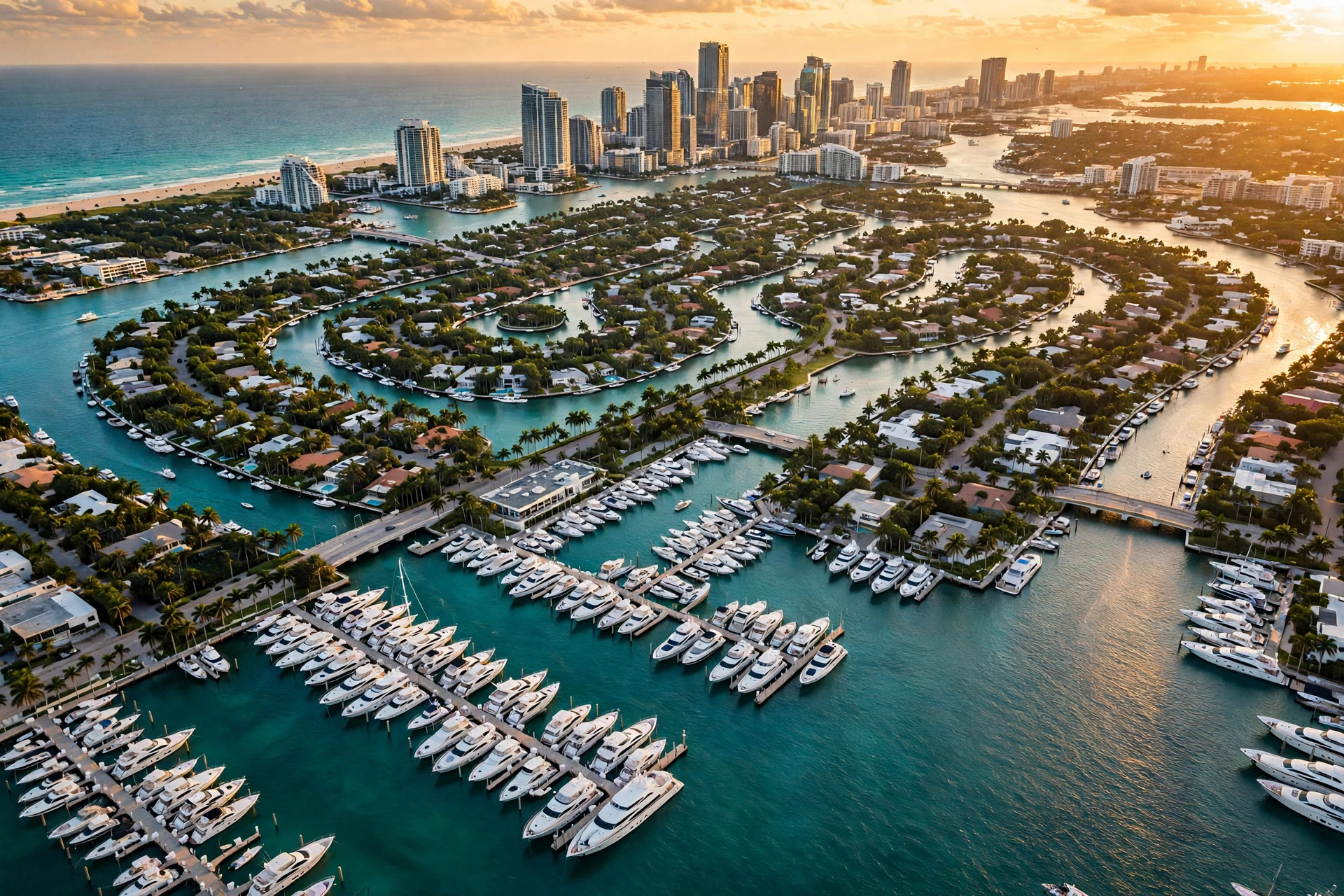
Key Takeaways
- Fort Lauderdale is the county seat and largest city in Broward County at 188,677 people on July 1, 2025, per the Census Bureau's Vintage 2025 estimates, up 3.3 percent from the 2020 Census count of 182,760 — and the Miami-Fort Lauderdale-West Palm Beach metro holds 6,391,072 people, the 8th-largest in the country. Median household income is $83,130, with a poverty rate of 15.0 percent and 40.8 percent of adults holding a bachelor's degree. The median home value is $486,700, and 27.0 percent of residents were born outside the United States. Fort Lauderdale covers 34.59 square miles of land, so its density is 5,284 people per square mile.
- One port dominates the economy. Port Everglades generated $48.3 billion in economic activity in FY2025 and supports 13,139 direct local jobs and 295,166 jobs statewide, per the Martin Associates study — with a record 4.7 million cruise guests and a record 1.167 million TEUs of container cargo. It is also Florida's leading fuel port, moving 5.5 billion gallons in FY2025 to 12 counties and five international airports. Note the methodology: FY2025 is the first report to fully capture the petroleum trade's related-user impact, so the 72 percent jump from FY2024 is mostly a measurement change, not one year of growth.
- The marine industry is the city's signature economy. Greater Fort Lauderdale is the "Yachting Capital of the World": the marine industry contributes about $9 billion in Broward County per the Marine Industries Association of South Florida, supports 111,000 jobs in the county, and draws about 2,000 mega-yachts of 80 feet or more each year. The Fort Lauderdale International Boat Show — the world's largest in-water boat show, with more than 1,300 boats, 1,000 exhibitors and 100,000 visitors from 52 countries — contributes $1.79 billion to the state's economy, and its 67th edition ran October 28 through November 1, 2026.
- Funding demand here is documented, not guessed. Fort Lauderdale borrowers took 655 SBA 7(a) approvals worth $377.6 million over FY2020–FY2026, with the biggest year by loan count FY2024 at 133 loans and $65.7 million, and the biggest year by dollars FY2021 at $72.1 million. The largest single approvals were $5 million loans at the program maximum — Southern Cross Aviation, Orange Ave Hospitality, and FBR Aviation among them. The city's retail sales were $6.63 billion in 2022, with accommodation and food services of $2.21 billion and health-care receipts of $3.48 billion.
- The cheapest money in Fort Lauderdale is public and specific: Florida's State Small Business Credit Initiative carries a $488.5 million allocation across five programs — collateral support, loan participation, loan guarantee, capital access, and venture capital — for businesses with 500 or fewer employees; the Microfinance Guarantee Program can guarantee up to 50 percent of loans up to $250,000 for businesses with 25 or fewer employees; the South Florida Regional Planning Council's revolving loan fund lends $25,000 to $500,000 in Broward County; and the Florida SBDC Network offers free one-on-one advising, including loan-package assembly. The City itself runs no direct small-business loan program — do not plan around the City as a lender.
Why Fort Lauderdale borrows differently
Fort Lauderdale is a city built on water, and that is the first thing to understand about its funding market. It was incorporated on March 27, 1911, became the county seat of the newly formed Broward County in 1915, and is known as the "Venice of America" for its 165 miles of inland waterways and 7 miles of Atlantic beach. It is the 10th-largest city in Florida at 188,677 people on July 1, 2025, up 3.3 percent since the 2020 Census, and the third-most populous city in the Miami metro area after Miami and Hialeah. Funders read that as a market of dense, high-cost coastal demand — median household income $83,130, poverty 15.0 percent, 54.1 percent owner-occupied homes, median home value $486,700 — plus a deep base of marine trades, hospitality businesses, aviation suppliers, and contractors serving a county of more than 2 million people.
The economy runs on four anchors. The first is the port. Port Everglades generated $48.3 billion in economic activity in FY2025 and supports 13,139 direct local jobs and 295,166 jobs statewide, per the Martin Associates study — a record 4.7 million cruise guests, up 21.7 percent on the year, and a record 1.167 million TEUs of container cargo on 27.7 million short tons. It is the third-busiest cruise homeport in the world and Florida's leading fuel port, moving 5.5 billion gallons in FY2025 to 12 counties and five international airports. The second is the marine industry itself: about $9 billion of economic impact in Broward County per the Marine Industries Association of South Florida, 111,000 county jobs, roughly 2,000 mega-yachts visiting each year, and the Lauderdale Marine Center — the largest shipyard in the world, home to more than 60 marine contractors. The third is the airport and the visitor economy. Fort Lauderdale-Hollywood International Airport handled 32.2 million passengers in 2025, and Greater Fort Lauderdale welcomed more than 20.9 million travelers the same year, generating $124 million in Tourist Development Tax revenue; hotels posted 85 percent occupancy in March 2026 with an average daily rate of $240.49. The fourth is the corporate base: AutoNation, the largest automotive retailer in the United States, is headquartered here, along with Citrix Systems, Kaplan, the U.S. headquarters of MSC Cruises and Embraer, and HEICO Corporation. Broward County as a whole held 68,191 employer establishments with 780,632 employees and $47.8 billion in annual payroll in 2023 — those are county figures: Fort Lauderdale is not a county-equivalent, so no city-level business counts exist.
The third Fort Lauderdale is the one arriving now, and it is the post-Spirit reshuffle. Spirit Airlines — the dominant carrier at FLL, with over 9 million passengers in 2025 — filed for Chapter 11 a second time on August 29, 2025 and ceased all scheduled flight operations on May 2, 2026. JetBlue planned about 130 daily departures at FLL after the shutdown, up about 75 percent from 2025, and FLL's Terminal 5 is under construction with completion expected in 2030. Next to it, the waterfront is being rebuilt in plain sight: Tavistock Development proposed a second phase for the 32-acre Pier Sixty-Six redevelopment — four 23-story towers with 339 residences, a grocery, and a new one-acre boat basin; the 40-acre Bahia Mar site is being redeveloped as the St. Regis Resort and Residences with a 122-key hotel and 106 residences, vertical construction targeted for 2027; the 31-acre Galleria site is proposed for roughly 3,100 apartments under the state's Live Local Act; and the City Commission unanimously approved two downtown towers with 773 units at 317 N Federal on October 20, 2026. The 67th Fort Lauderdale International Boat Show ran October 28 through November 1, 2026, and the city hosted IPW — the U.S. travel industry's largest inbound-travel trade show — May 17–21, 2026, expected to generate more than $14.2 billion in future travel over three years. Every marine contractor, charter operator, restaurant, and construction supplier feeding those projects is a file a funder wants to see.
One thing to get straight before you borrow on a Fort Lauderdale address: this is a seasonal market, and funders know it. The boat show spikes the last week of October, cruise season runs the winter, and hurricane season runs June through November — a restaurant on Las Olas, a charter operator, or a marine-trades shop can do a third of its year in a few months and then go quiet. A file that shows the twelve-month pattern — the spike, the trough, and the plan for the trough — prices better than a file that shows only the good quarter. And one caution on the numbers themselves: Fort Lauderdale's only verified unemployment figure is the Fort Lauderdale-Pompano Beach-Sunrise division rate — 4.1 percent in September 2026, preliminary — and that division is Broward County, not the city. The metro rate was 3.2 percent the same month. Do not let anyone quote you a Fort Lauderdale city unemployment rate; none has been published.
The Fort Lauderdale funding map: which product fits which business
Funding is not one product. The right one depends on what the money is for, how fast it comes back, and what your revenue looks like month to month. Here is the map for Fort Lauderdale:
Merchant cash advance — for card-heavy businesses with a short-term gap. Restaurants and bars on Las Olas Boulevard and the beach, retailers, charter operators, and hospitality firms with steady card sales borrow against future receipts and repay daily or weekly as a share of sales. A $50,000 advance at an illustrative 1.20 factor rate repays $60,000 in total — $10,000 of cost — or about $2,308 a week over 26 weeks. The advance is fast, usually funded in 24 to 72 hours, and it fits a payroll gap or an inventory buy that pays back in a season. It is the most expensive money on this map, and it is the right call only when the money comes back within months. Read what actually happens if you default on an advance before you sign one, and read whether a merchant cash advance is legal for the state-by-state picture.
Term loan — for a known cost with a fixed payoff date. A restaurant build-out in a new ground-floor space downtown, a second charter boat's refit, a fit-out for a marine supplier's shop, a hire that pays for itself over a year. Fixed daily, weekly, or monthly payments over months to years, priced on a rate or a factor depending on the lender. If the spend has a clear return date, match the term to it — borrowing for 12 months to pay for something that returns in three is overpaying for speed you do not need.
Business line of credit — for the seasonal business. A marine contractor between draws on a Pier Sixty-Six or Bahia Mar build-out, a restaurant stocking up before boat-show week, a retailer before the winter cruise season, or a supplier waiting on a Net 45 invoice draws only what it needs and pays interest only on what it draws. The line is the right tool when the gap is timing — a contract 60 days out, a season that pays in January — rather than a single purchase. Draws after approval are usually same-day.
Equipment financing — for the thing itself. A commercial kitchen, a delivery fleet, a travel lift or a haul-out trailer for a boatyard, marine electronics and engines, medical equipment for a clinic. The equipment secures the loan, so the pricing is usually the cheapest money on this map for an asset purchase, and the term can run two to five years. If the money buys a thing, price the equipment product first. And if you already own the equipment outright, you can borrow against it instead — an equipment refinance or sale-leaseback turns a paid-off machine into working capital without taking it out of service.
Purchase-order and invoice financing — for the contract economy. A marine supplier with a signed purchase order from a shipyard or a cruise line, a staffing firm waiting on Net 45 payment, or a contractor with outstanding invoices on a downtown tower can borrow against the order or the receivable instead of against future card sales. The advance is sized on the contract, not on last month's deposits, which is exactly the profile a contract business needs. Ask about it before you take a general-purpose advance.
SBA and guaranteed loans — for the cheapest money, if you can wait. SBA 7(a) loans run up to $5 million through SBA lenders, and SBA 504 loans run up to $5 million for owner-occupied real estate and long-life equipment. SBA microloans run up to $50,000. The underwriting is real and the clock runs in weeks, sometimes six to eight, but the rate is the lowest on this map — and Fort Lauderdale businesses have actually used them: 655 SBA 7(a) approvals worth $377.6 million over FY2020–FY2026, with the biggest year by loan count FY2024 at 133 loans and $65.7 million. For the full comparison method, see which funding product fits which business.
Grants and loan programs: what actually exists in Fort Lauderdale
Before you borrow, check the money that does not need repaying — and be honest about what is open right now. The public money that actually exists for Fort Lauderdale businesses is state and regional, not a general city cash grant. The Florida SBDC Network offers free one-on-one advising, including business-plan help and loan-package assembly — start there before you apply anywhere else, because it costs nothing and it is the fastest way to a fundable file. And if your business is in Miami, just down I-95, the same state programs apply — the difference is the local channel, not the state one.
The state channel is Florida's State Small Business Credit Initiative (SSBCI), administered by the Florida Department of Commerce with a $488.5 million total allocation across five programs — collateral support, venture capital support, loan participation, loan guarantee, and capital access — for businesses with 500 or fewer employees. You apply through a participating lender, not directly to the state. The Microfinance Guarantee Program, run through Enterprise Florida, guarantees up to 50 percent of a loan up to $250,000 for businesses with 25 or fewer employees and average gross revenues of $1.5 million or less over the previous two years. The Florida Black Business Loan Program serves businesses at least 51 percent Black-owned, generally $5,000 to $75,000 and up to $250,000. The Rebuild Florida Business Loan Fund lends $25,000 to $2.5 million. And the Florida Small Business Emergency Bridge Loan Program offers disaster bridge loans up to $50,000 for businesses with 2 to 100 employees hit by a declared disaster — including the Broward County flooding. These work through lenders; they are not grants.
The regional channel is the South Florida Regional Planning Council's Revolving Loan Fund, which lends $25,000 to $500,000 to small and mid-sized businesses in Broward, Miami-Dade, and Monroe counties that add jobs, retain jobs, expand, or relocate. The Central County Community Development Corporation's Small Business Loan Fund lends $10,000 to $250,000 for machinery, equipment, supplies, working capital, and leasehold improvements, with a focus on South Florida and on minority- and women-owned businesses. Broward County's own Office of Economic and Small Business Development is the county's small-business resource office. The City's own economic development arm publishes no direct small-business loan program with published volume — do not plan around the City as a direct lender.
One honest note about grants: grants are slow and competitive, and none of them cover payroll next Friday. Use them for the project they fit, and borrow for the gap they leave — not the other way around. And one honest note about Fort Lauderdale specifically: the expensive part of doing business here is space and seasonality, not demand. A lease on Las Olas or the beach is a big commitment, and a marine or hospitality business that borrows against a boat-show-week spike without a plan for the summer trough is borrowing against the wrong month. The funding should be priced on the total repayment across the full year, not the headline rate in the good quarter.
What to watch before you sign
There is no substitute for the total repayment in dollars, in writing, before you sign. Compare offers on that number, not on the headline rate or the monthly payment. If a funder will not put the total in writing, that is your answer about the funder.
The second thing to watch is the repayment rhythm. Daily debits against a restaurant's account in a slow summer week, or against a charter operator's account between seasons, can drain the account before the next weekend or cruise sailing lands. If your revenue swings with the cruise calendar or the boat show, ask for weekly payments instead of daily, and ask what happens if a debit fails. A funder that answers clearly is a funder that has done this before.
The third is concentration. Fort Lauderdale's economy is anchored — one port, one airport, one boat show — and your business may be far more concentrated than the city is. A marine supplier with one shipyard customer at 60 percent of revenue, a charter operator living off one booking platform, or a restaurant depending on one hotel's guests is a different file from ten customers at 6 percent each. Bring the contract, the payment history, and the plan for a second customer. A file that explains the concentration prices better than a file that leaves the funder to discover it. The Spirit shutdown is the live lesson: FLL's dominant carrier vanished in 2026, and every business that fed off its passengers had to re-price overnight.
The fourth is stacking. A second advance taken to cover the first one's payments is how a manageable file becomes a default. If you already hold an advance, read how to refinance one before you stack another, and read how the early-payoff discount works if you are weighing paying one off early.
Frequently asked questions
How fast can a Fort Lauderdale business get funded? A merchant cash advance typically funds in 24 to 72 hours after approval with three months of bank statements. Term loans run a similar clock, lines of credit decide in minutes to a day, equipment financing takes days to a couple of weeks, and SBA loans take weeks. The public programs run slower, because they move through review rounds and partner referrals.
What do I need to apply? Three months of business bank statements are the core document. A photo ID and a voided check are usually optional verification, not requirements — but having them ready removes stalls. Marine businesses should also bring the service contracts and refit orders; restaurants should bring the seasonal sales pattern; contractors should bring the draw schedule.
Does the port and marine economy help or hurt my approval chances? It helps, if the file shows it. Funders underwrite your business, not the headline. A marine supplier or a restaurant with twelve months of deposits showing steady traffic from a 188,677-person city plus $6.63 billion in annual retail sales prices far better than a file that leaves the funder to guess — but marine and tourism revenue is seasonal and contract revenue, so show the contracts, the booking history, and the twelve-month pattern, not just the customer names, and name the concentration honestly.
Can a restaurant, retailer, or marine business get funded in Fort Lauderdale? Yes — restaurants, retailers, and marine trades are among the most common Fort Lauderdale profiles, because the port, the airport, the boat show, and the year-round visitor base keep them busy most of the year. An advance fits a short-term payroll or inventory gap; a line of credit fits the seasonal business; equipment financing is usually the cheapest route for a kitchen or a boatyard machine; and an SBA loan can fill a gap a bank will not cover on its own.
What if my revenue depends on one big customer? Say so up front, and show the concentration honestly. Funders price concentration risk — one customer at 60 percent of revenue is a different file from ten customers at 6 percent each — but a signed multi-year contract with a creditworthy buyer is also a strength. Bring the contract, the payment history, and the plan for a second customer. A file that explains the concentration prices better than a file that leaves the funder to discover it.
Ready to fund your Fort Lauderdale business?
One application, competing offers, total cost in writing. Bank statements are the main document — gather three months before you start, and bring the full twelve months if your revenue is seasonal, or the service contracts and refit orders if you are a marine business or a contractor.
Apply Now or call (352) 809-3201
Ready to Get Funded?
Apply now and get a funding decision within hours. No hard credit pull for pre-approval — see your options risk-free.