Fast Business Funding in Garland, TX: 249,625 People, 300+ Manufacturers & the $176.8M SBA Record (2026)
Garland held 249,625 people on July 1, 2025 — up 1.4 percent since 2020 inside the Dallas–Fort Worth metro of 8,477,157, the fourth-largest in the country. More than 300 manufacturers work here, Kraft Heinz runs its largest Lunchables plant with about 1,500 employees, and Garland borrowers took 204 SBA 7(a) approvals worth $176.8 million over FY2020–FY2026. Here is how business funding actually works in the Garland market: the product map by business type, real timelines, the public programs that exist, and how to compare offers.
Need funding fast? Apply in about 2 minutes — get a decision within hours, with no hard credit pull for pre-approval.
Apply Now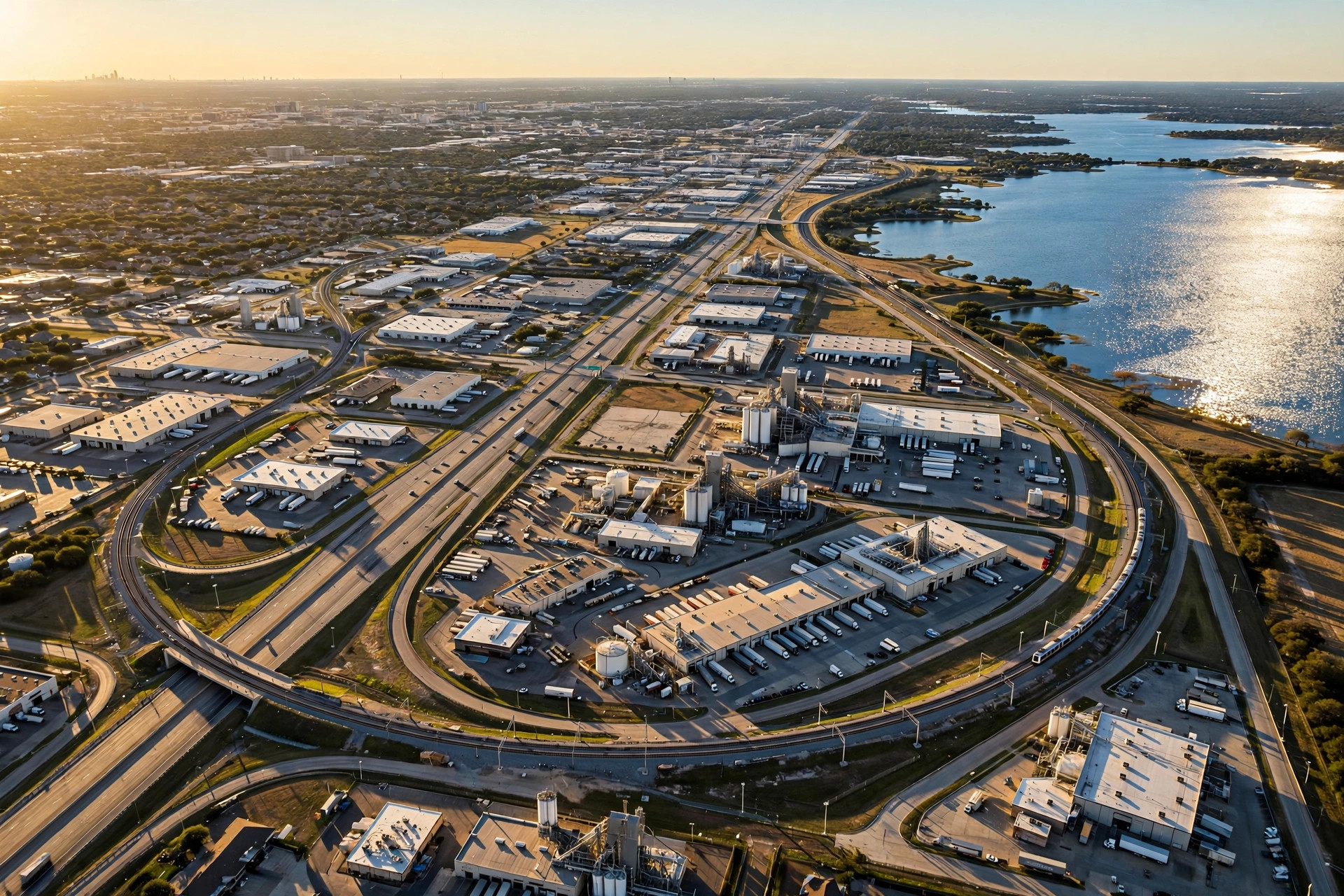
Key Takeaways
- Garland is the 13th-largest city in Texas at 249,625 people on July 1, 2025, per the Census Bureau's Vintage 2025 estimates — up 1.4 percent since the 2020 Census count of 246,018, after growing 8.4 percent in the 2010s from 226,876 — and it sits inside the Dallas–Fort Worth–Arlington metro of 8,477,157 people, the fourth-largest in the country and the fastest-growing big metro, up 10.6 percent since 2020. Median household income is $76,320, slightly below the Texas statewide figure of $78,476, with a poverty rate of 13.0 percent and 25.4 percent of adults holding a bachelor's degree. Garland is an owner-majority city — 61.6 percent of homes are owner-occupied — with a median home value of $270,800. Garland covers 57.13 square miles of land, so its density is 4,306 people per square mile.
- Two anchors define the Garland economy. Manufacturing: more than 300 manufacturers work in the city, led by Kraft Heinz, the city's largest employer with about 1,500 employees at its Forest Lane plant — in operation since 1949 and the company's largest manufacturer of Lunchables, Oscar Mayer Naturals, Kraft barbecue sauce and Velveeta Skillets — plus Sherwin-Williams, Epiroc, U.S. Foodservice and Daisy Brand. And the lake: Lake Ray Hubbard, a 22,745-acre reservoir on Garland's eastern border, where the city is planning redevelopment of about 820 acres along the shore.
- Garland is a city of makers, suppliers, and trades. With 81,954 households, 45.7 percent Hispanic residents and 31.7 percent foreign-born residents, and $3.64 billion in retail sales in 2022, the steady funding demand comes from the machine shops, packaging firms, food-production plants and logistics companies feeding the big plants, the contractors and trades serving a quarter-million residents, and the retailers and restaurants around Firewheel Town Center and the downtown square. Transportation and warehousing receipts were $425.3 million in 2022, with accommodation and food services at $548.8 million and health-care receipts at $733.8 million.
- Funding demand here is documented, not guessed. Garland borrowers took 204 SBA 7(a) approvals worth $176.8 million over FY2020–FY2026, with the biggest year by loan count FY2024 at 40 loans and $26.4 million, and the biggest year by dollars FY2026 at 34 loans and $39.7 million — the strongest dollar year in the series, and the most recent. One Garland borrower, Treffinger Inc., took the $5 million program-maximum loan in September 2023.
- The cheapest money in Garland is public and specific: Texas' State Small Business Credit Initiative carries a $472.1 million allocation — a $160.5 million loan guarantee program, a $306.9 million loan participation program, and a $4.7 million capital access program after a 2026 restructuring — run through the Governor's office with 33 approved lenders; the Texas Workforce Commission's Skills for Small Business program pays for employee training at businesses with fewer than 100 employees; and PeopleFund's accelerator pays $3,000 to $5,000 grants to qualifying businesses. The North Texas SBDC Network, led by Dallas College, offers free one-on-one advising across 49 counties. Texas levies no state income tax — a real margin advantage, not a funding program — and Garland's own city-owned electric utility, Garland Power & Light, founded in 1923, is a genuine cost advantage for energy-intensive manufacturers.
Why Garland borrows differently
Garland is a city that was invented to settle an argument, and that is the first thing to understand about its funding market. Immigrants began arriving in the Peters Colony area around 1850, but no community took shape until 1874, when two rival settlements sprang up along two different railroad lines: Embree, named for physician K.H. Embree, on the Santa Fe line, and Duck Creek, named for the local stream, on the Dallas and Greenville line. The two towns feuded for years over which would host the post office. A fire consumed much of Duck Creek's business district in early 1887, the post office moved to Embree, Embree tried to incorporate and was accused of counting part of Duck Creek's population to meet the minimum, and the fight wound through the courts until Congressman Joseph Abbott settled it by creating an entirely new town between the two — named for Augustus H. Garland, the sitting U.S. attorney general, chosen in part because he was a neutral name — and putting the post office there. The town incorporated on April 21, 1891, with 478 people, four churches, three gristmills, three steam cotton gins and a roller flour mill. By 1904 it had 819 people. As a station on two railroads it became a major onion-shipping point in the 1940s, and after the postwar boom its population nearly quadrupled by 1960 to about 38,500. Funders read that as a market of dense, diverse, working demand — median household income $76,320, poverty 13.0 percent, 25.4 percent of adults with a bachelor's degree, 31.7 percent foreign-born — plus a deep base of manufacturers, food producers, and the trades and retailers that serve them, inside a metro of 8.48 million people.
The economy runs on three anchors. The first is manufacturing. Garland's economic development office counts more than 300 manufacturers in the city, and the names tell the story of a working industrial base rather than a headquarters town. Kraft Heinz is the city's largest employer, with about 1,500 people at its Forest Lane plant, which has run since 1949 and is the company's largest manufacturer of Lunchables, Oscar Mayer Naturals, Kraft barbecue sauce and Velveeta Skillets, shipping across the country from a 266,000-square-foot plant on more than 50 acres. In 2019 the company announced a $25 million expansion adding about 250 jobs and two production lines, nominated by the city under the Texas Enterprise Zone Program. U.S. Foodservice, with about 500 workers, and Daisy Brand, with about 200, join Kraft Heinz as the top three food-industry employers. Sherwin-Williams and Epiroc anchor the industrial side, and the city's Enterprise Zone track record is real: from 2008 to 2019, city-nominated projects created over 1,800 jobs and captured $58 million in capital spending. The newest chapter is Nutribiotech, a South Korean nutritional-supplement manufacturer expanding its 60,000-square-foot facility by 625,000 square feet over five years at the old Raytheon campus — 250,000 square feet of new construction plus 375,000 square feet renovated from the old Raytheon buildings, over $100 million in investment and 1,600 new jobs, per a City of Garland press release. One former anchor is gone, and it matters to say so plainly: Raytheon moved its Garland operations to a new office complex at CityLine in Richardson, announced in 2014, with the move beginning in late 2015. Do not let anyone pitch you Garland as the home of a Raytheon campus — the old campus is now the Nutribiotech and industrial-park story, not a defense contractor's.
The second anchor is the lake and the retail that follows it. Lake Ray Hubbard is a 22,745-acre reservoir on Garland's eastern border, shared with Rowlett and Rockwall, and the city is planning redevelopment of about 820 acres along its shore. Firewheel Town Center, a Main Street-style outdoor mall owned by Simon Property Group, opened in October 2005 with more than 100 businesses and an AMC theater, anchoring newer retail growth toward the lake. Downtown, the historic Garland Square — added to the National Register of Historic Places in 2017, anchored by the Atomic-Age Plaza Theatre — is being rebuilt around the DART station, with the 5th Street Crossing development adding 189 apartments, 11,000 square feet of flex retail and six live-work units cater-corner to City Hall. Hawaiian Falls waterpark opened in 2003, and the Curtis Culwell Center arena opened in 2005. And two pieces of Garland trivia that tell you what kind of town this is: Byer-Rolnick's hat factory, later Resistol, moved to Garland in 1938, and the city earned an official Cowboy Hat Capital of Texas designation in 2013; and Wingstop was founded in Garland in 1994, in a city that still runs its first location.
The third anchor is the workforce itself. Garland's labor market is tight but not frozen. Metro unemployment was 4.1 percent in September 2026, not seasonally adjusted, and the Dallas–Plano–Irving metropolitan division — Garland's own slice of the metro — was also 4.1 percent. The metro added 43,900 payroll jobs over the year, the largest gain of any U.S. metro, and the Dallas–Plano–Irving division alone added 29,700. Hiring is competitive, turnover is expensive, and a business that loses a trained machine operator or a licensed tech pays to replace them at market rates. Owners borrow to keep the team they have rather than to grow headcount, and the funding request that bridges a payroll cycle is normal here. Two DART Blue Line stations — Downtown Garland and Forest/Jupiter — have connected the city to downtown Dallas by rail since 2002, so the workforce moves on trains as well as on highways 66 and 78.
One thing to get straight before you borrow on a Garland address: this is a manufacturing town inside the fastest-growing big metro in the country, and funders know it. A machine shop's revenue rides the production schedules of a few big plants, a food supplier's revenue rides the production runs at Forest Lane, and a contractor's revenue rides the housing and build-out cycle across 81,954 households. A file that shows the twelve-month pattern — the busy season, the slow shoulder, the plan for the trough — prices better than a file that shows only the good quarter. And one caution on the numbers themselves: Garland's only verified unemployment figure is the metro and division rate — 4.1 percent in September 2026 — and Dallas County's 4.2 percent. Do not let anyone quote you a Garland city unemployment rate; none has been published. Likewise, the Census Bureau publishes no city-level count of Garland businesses at all — its QuickFacts page lists employer establishments as not applicable for the city — so anyone quoting a Garland business count is quoting the metro or the county. The "more than 300 manufacturers" figure is a manufacturer count from the city's economic development office, not a total business count. And the Telecom Corridor belongs to Richardson, along Telecom Parkway — Garland's corridor is the Forest Lane and Miller Road manufacturing belt, and anyone selling you a Garland telecom story has the wrong city.
The Garland funding map: which product fits which business
Funding is not one product. The right one depends on what the money is for, how fast it comes back, and what your revenue looks like month to month. Here is the map for Garland:
Merchant cash advance — for card-heavy businesses with a short-term gap. Restaurants and bars around Firewheel Town Center and the downtown square, retailers near the lakefront, and hospitality firms with steady card sales borrow against future receipts and repay daily or weekly as a share of sales. A $50,000 advance at an illustrative 1.20 factor rate repays $60,000 in total — $10,000 of cost — or about $2,308 a week over 26 weeks. The advance is fast, usually funded in 24 to 72 hours, and it fits a payroll gap or an inventory buy that pays back in a season. It is the most expensive money on this map, and it is the right call only when the money comes back within months. Read what actually happens if you default on an advance before you sign one, and read whether a merchant cash advance is legal for the state-by-state picture.
Term loan — for a known cost with a fixed payoff date. A second service van for a plumbing crew, a build-out in a new ground-floor space downtown, a hire that pays for itself over a year, a down payment on a warehouse lease along Miller Road. Fixed daily, weekly, or monthly payments over months to years, priced on a rate or a factor depending on the lender. If the spend has a clear return date, match the term to it — borrowing for 12 months to pay for something that returns in three is overpaying for speed you do not need.
Business line of credit — for the seasonal business. A food supplier between a big customer's Net 45 payment and its own Friday payroll, a manufacturer waiting on a production-run settlement, a landscaper waiting on a Net 45 invoice from a property manager, or a restaurant stocking up before a big weekend at the lake draws only what it needs and pays interest only on what it draws. The line is the right tool when the gap is timing — a contract 60 days out, a season that pays in July — rather than a single purchase. Draws after approval are usually same-day.
Equipment financing — for the thing itself. A production line, a forklift and racking for a warehouse off Forest Lane, a box truck for a delivery run, a CNC machine for a machine shop, kitchen equipment for a restaurant, cold storage for a food producer. The equipment secures the loan, so the pricing is usually the cheapest money on this map for an asset purchase, and the term can run two to five years. If the money buys a thing, price the equipment product first. And if you already own the equipment outright, you can borrow against it instead — an equipment refinance or sale-leaseback turns a paid-off machine into working capital without taking it out of service.
Purchase-order and invoice financing — for the contract economy. A packaging firm with a signed purchase order from a big food plant, a staffing firm with a signed order from a manufacturer, or a supplier waiting on Net 45 payment from a large buyer can borrow against the order or the receivable instead of against future card sales. The advance is sized on the contract, not on last month's deposits, which is exactly the profile a contract business needs. Ask about it before you take a general-purpose advance.
SBA and guaranteed loans — for the cheapest money, if you can wait. SBA 7(a) loans run up to $5 million through SBA lenders, and SBA 504 loans run up to $5 million for owner-occupied real estate and long-life equipment. SBA microloans run up to $50,000. The underwriting is real and the clock runs in weeks, sometimes six to eight, but the rate is the lowest on this map — and Garland businesses have actually used them: 204 SBA 7(a) approvals worth $176.8 million over FY2020–FY2026, with the biggest year by loan count FY2024 at 40 loans and $26.4 million, and the biggest year by dollars FY2026 at 34 loans and $39.7 million. For the full comparison method, see which funding product fits which business.
Grants and loan programs: what actually exists in Garland
Before you borrow, check the money that does not need repaying — and be honest about what is open right now. The public money that actually exists for Garland businesses is state and regional, not a general city cash grant. The North Texas SBDC Network, led by Dallas College, offers free one-on-one advising, including business-plan help and loan-package assembly, across 49 counties in North Central Texas, with the Dallas Metropolitan SBDC in downtown Dallas — start there before you apply anywhere else, because it costs nothing and it is the fastest way to a fundable file. And if your business is in Dallas, just southwest on the highway, or in Plano, up the Tollway in the same Dallas–Plano–Irving division, the same state programs apply — the difference is the local channel, not the state one.
The state channel is Texas' State Small Business Credit Initiative (SSBCI), a $472.1 million allocation from the U.S. Treasury, restructured in 2026 into three programs run through the Governor's office with 33 approved lenders — 14 banks and 19 CDFIs. The Loan Guarantee Program at $160.5 million guarantees up to 80 percent of the unpaid principal on loans from $5,000 to $20 million — you work through a participating lender. The Loan Participation Program at $306.9 million is new in the 2026 restructuring and buys or co-lends alongside a lender. The Capital Access Program at $4.7 million provides portfolio insurance to enrolled lenders. One honest caveat: deployment has been slow. As of June 30, 2026, Treasury had disbursed $134.5 million to Texas and the state had deployed only $39.6 million — 8.4 percent of the allocation. The programs are real, but they are thinly drawn so far, so do not plan a closing date around them. These are credit supports, not grants, and you apply through a participating lender, not directly to the state.
The training channel is the Texas Workforce Commission's Skills for Small Business program, which pays for employee training at businesses with fewer than 100 employees, delivered through a public community or technical college — up to $2,000 per new employee and $1,000 per incumbent employee, with up to $2 million available statewide. Training money, not cash — but a trained crew that stays is worth more than the invoice it replaces. For a manufacturer, that is the program that fits best: the machine operator who stays is the margin.
The grant channel is small and specific. PeopleFund, a Texas CDFI, runs a BIPOC Small Business Accelerator that pairs a loan with a $3,000 to $5,000 grant for qualifying businesses in low- to moderate-income areas. The Amber Grant pays up to $75,000 a year to women-owned businesses — $15,000 monthly and $75,000 at year end. Neither is a general Garland business grant, and neither covers payroll next Friday. Use them for the project they fit, and borrow for the gap they leave — not the other way around.
One honest note about Garland specifically: the expensive part of doing business here is labor and space, not demand. A warehouse lease along Miller Road, a storefront near Firewheel, and a licensed tech all cost real money in a metro where hiring is competitive — and a manufacturer or food supplier that borrows against a busy production quarter without a plan for the slow one is borrowing against the wrong month. The funding should be priced on the total repayment across the full year, not the headline rate in the good quarter. Texas levies no state income tax — a genuine margin advantage for a Garland business — but do not let anyone sell it as a funding program; property and franchise taxes still apply. And Garland Power & Light, the city-owned electric utility founded in 1923 that serves roughly 85 percent of the city, is a real cost advantage for an energy-intensive plant — again a margin fact, not a funding program.
What to watch before you sign
There is no substitute for the total repayment in dollars, in writing, before you sign. Compare offers on that number, not on the headline rate or the monthly payment. If a funder will not put the total in writing, that is your answer about the funder.
The second thing to watch is the repayment rhythm. Daily debits against a restaurant's account in a slow week between lake weekends, or against a supplier's account while a big customer's Net 45 payment is still in transit, can drain the account before the next weekend or the next payroll lands. If your revenue swings with the production calendar or the season, ask for weekly payments instead of daily, and ask what happens if a debit fails. A funder that answers clearly is a funder that has done this before.
The third is concentration. Garland's economy is anchored — a handful of big plants, one lakefront, one retail center — and your business may be far more concentrated than the city is. A packaging firm with one food-plant customer at 60 percent of revenue, a machine shop living off one manufacturer's orders, or a supplier depending on one big buyer is a different file from ten customers at 6 percent each. Bring the contract, the payment history, and the plan for a second customer. A file that explains the concentration prices better than a file that leaves the funder to discover it.
The fourth is stacking. A second advance taken to cover the first one's payments is how a manageable file becomes a default. If you already hold an advance, read how to refinance one before you stack another, and read how the early-payoff discount works if you are weighing paying one off early.
Frequently asked questions
How fast can a Garland business get funded? A merchant cash advance typically funds in 24 to 72 hours after approval with three months of bank statements. Term loans run a similar clock, lines of credit decide in minutes to a day, equipment financing takes days to a couple of weeks, and SBA loans take weeks. The public programs run slower, because they move through review rounds and partner referrals — and Texas' SSBCI deployment has been slow, so do not plan a closing date around it.
What do I need to apply? Three months of business bank statements are the core document. A photo ID and a voided check are usually optional verification, not requirements — but having them ready removes stalls. Manufacturers should also bring the customer contracts and the aging receivables; food producers should bring the production schedule and buyer contracts; contractors should bring the draw schedule and signed purchase orders; restaurants should bring the card-sales history.
Does the manufacturing base or Lake Ray Hubbard help my approval chances? It helps, if the file shows it. Funders underwrite your business, not the headline. A supplier or a machine shop with twelve months of deposits showing steady work from a 249,625-person city plus $3.64 billion in annual retail sales prices far better than a file that leaves the funder to guess — but plant and lakefront revenue is contract revenue, so show the contracts, the payment history, and the twelve-month pattern, not just the customer names, and name the concentration honestly.
Can a restaurant, retailer, manufacturer, or contractor get funded in Garland? Yes — restaurants, retailers, manufacturers, and trades are among the most common Garland profiles, because the plants, the lakefront, and Firewheel keep them busy most of the year. An advance fits a short-term payroll or inventory gap; a line of credit fits the seasonal business; equipment financing is usually the cheapest route for a machine, a truck, or a kitchen; and an SBA loan can fill a gap a bank will not cover on its own.
What if my revenue depends on one big customer? Say so up front, and show the concentration honestly. Funders price concentration risk — one customer at 60 percent of revenue is a different file from ten customers at 6 percent each — but a signed multi-year contract with a creditworthy buyer is also a strength. Bring the contract, the payment history, and the plan for a second customer. A file that explains the concentration prices better than a file that leaves the funder to discover it.
Ready to fund your Garland business?
One application, competing offers, total cost in writing. Bank statements are the main document — gather three months before you start, and bring the full twelve months if your revenue is seasonal, or the customer contracts and production schedule if you are a manufacturer, a food producer, or a supplier.
Apply Now or call (352) 809-3201
Ready to Get Funded?
Apply now and get a funding decision within hours. No hard credit pull for pre-approval — see your options risk-free.