Fast Business Funding in Glendale, AZ: 260,572 People, Luke AFB's 9,180 Jobs & the Loop 303 Industrial Boom (2026)
Glendale held 260,572 people on July 1, 2025 — Arizona's 6th-largest city — with a median household income of $73,530, the lowest of the large Valley cities. Luke Air Force Base employs 9,180 people, Nestlé opened a $675 million beverage factory in January 2025, and Walmart paid $152.2 million for a 1.28-million-square-foot warehouse in November 2025. Glendale borrowers took 298 SBA 7(a) approvals worth $145.0 million over FY2020–FY2026. Here is how business funding actually works in the Glendale market: the product map by business type, real timelines, the public programs that exist, and how to compare offers.
Need funding fast? Apply in about 2 minutes — get a decision within hours, with no hard credit pull for pre-approval.
Apply Now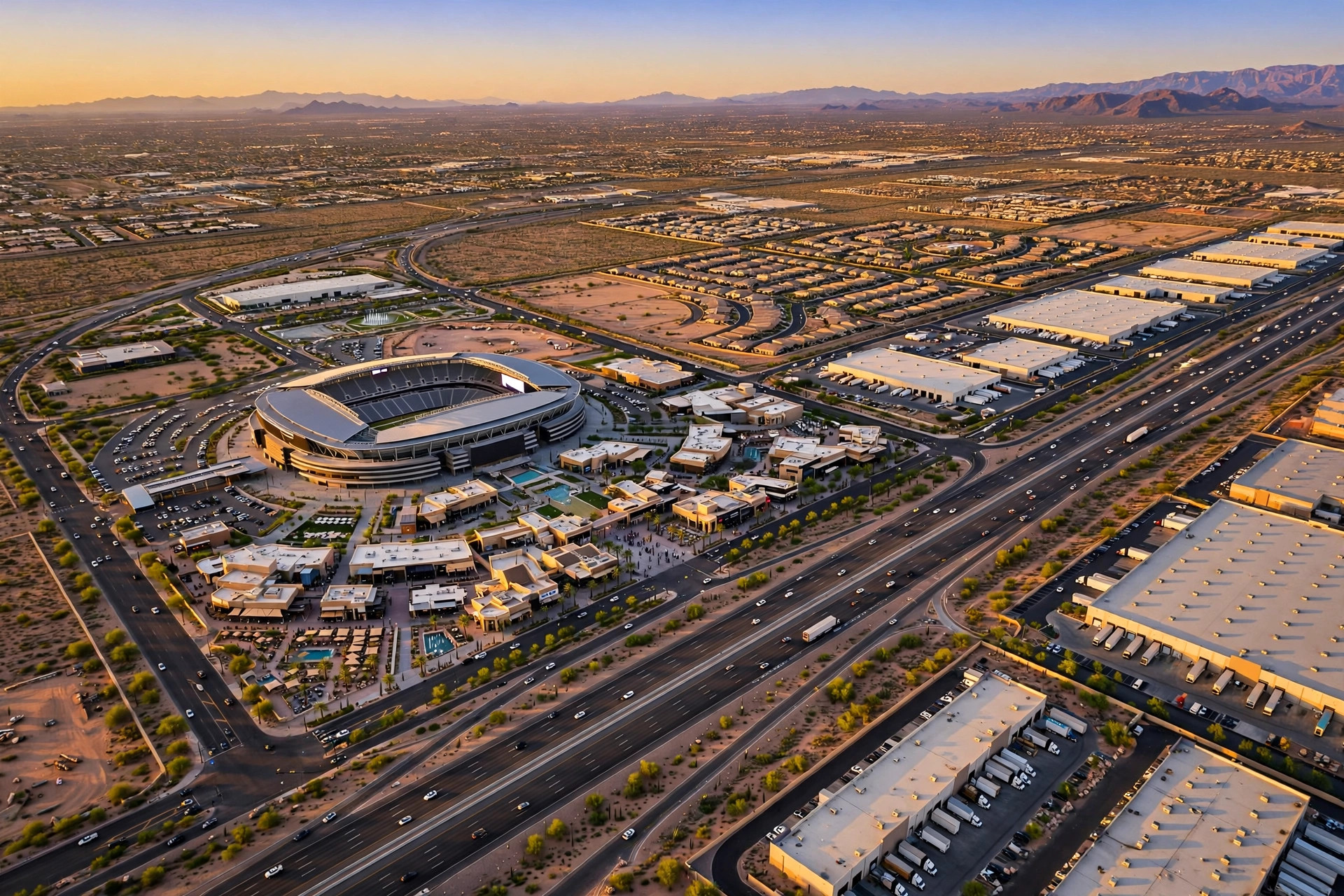
Key Takeaways
- Glendale is the 6th-largest municipality in Arizona at 260,572 people on July 1, 2025, per the Census Bureau's Vintage 2025 estimates, up 4.9 percent from the 2020 Census count of 248,325 — ahead of Scottsdale (243,006). Median household income is $73,530 — the lowest of the large Valley cities — with a poverty rate of 15.1 percent and 24.3 percent of adults holding a bachelor's degree or higher.
- Luke Air Force Base is the anchor by a wide margin. It employs 9,180 people — 6.72 percent of total city employment — nearly double its 5,100 in 2015, as the F-35A pilot-training mission built up. About 600 personnel separate from service each year and typically stay in the West Valley, a skilled-labor pipeline for local employers.
- The Loop 303 corridor is the growth engine. Nestlé opened a 630,000-square-foot beverage factory in January 2025 after investing more than $675 million, Mark Anthony Brewing runs a 916,000-square-foot brewery, and Walmart paid $152.2 million in November 2025 for a 1.28-million-square-foot building at Luke Field — the largest Arizona industrial sale of 2025. Dollar Tree followed with a $147 million-plus purchase at Park303 in October 2025.
- Funding demand here is documented, not guessed. Glendale borrowers took 298 SBA 7(a) approvals worth $145.0 million over FY2020–FY2026, with the biggest dollar year FY2024 at $28.0 million across 62 loans and the biggest count year FY2022 at 48 loans.
- The cheapest money in Glendale is public and specific: the Arizona Competes Fund has awarded $131.8 million across 235 grants since FY2012, the Angel Investment Tax Credit returns 30 percent of a qualifying investment, the Arizona Microbusiness Loan Program lends $2,000 to $50,000 to businesses with five or fewer employees, and the City's GrowGlendaleSB hub connects small businesses to free advising, recruiting help, and CDFI lending.
Why Glendale borrows differently
Glendale is a working-class city, and that is the first thing to understand about its funding market. Incorporated in 1910 in the northwest Valley, it grew 9.5 percent in the 2010s and another 4.9 percent since the 2020 Census, reaching 260,572 people on July 1, 2025 — the sixth-largest municipality in Arizona, ahead of Scottsdale. But its median household income of $73,530 is the lowest of the large Valley cities (Phoenix $81,332, Peoria $95,815, Chandler $108,095, Gilbert $122,551), its poverty rate of 15.1 percent is the highest of that group, and only 24.3 percent of adults hold a bachelor's degree. The median home value is $387,500. Funders read that as a market of established small businesses serving a workforce economy — contractors, suppliers, restaurants, retailers, and service firms — not a market of high-margin professional services. A file that shows steady deposits from real customers prices well here; a file that leans on the city's headlines does not.
The economy runs on three anchors. The first is Luke Air Force Base, seven miles west of the business district: home of the 56th Fighter Wing, the Air Force's largest fighter wing and its F-35A Lightning II pilot-training center, with 9,180 employees in the city's FY2024 count — more than three times the next entry. The base's presence shapes everything west of the city: the Loop 303 industrial corridor exists in part because of it, Nestlé introduced itself to base leadership early and now hires transitioning airmen and spouses through the DoD SkillBridge program, and roughly 600 personnel a year leave the service and stay in the West Valley. The second anchor is health care: Banner Thunderbird Medical Center, the city's fourth-largest employer at 2,720 people and a Level I trauma center, and the Phoenix Children's Arrowhead Campus, which created more than 400 jobs. The third is the sports and entertainment district: Westgate, anchored by State Farm Stadium and Desert Diamond Arena, welcomes more than 30 million visitors a year, and the 2022 Economic Census put Glendale's retail sales at $5.52 billion, accommodation and food services at $774 million, and health-care receipts at $2.47 billion.
The third Glendale is the one arriving now, and it is industrial. The City Council's 2019 vision earmarked the Loop 303 corridor for manufacturing and industrial development instead of residential, and the corridor has delivered: Nestlé's 630,000-square-foot beverage factory and distribution center opened January 28, 2025, producing Coffee mate, natural bliss, and Starbucks creamers with 300 jobs at opening and 400 planned at full capacity; Mark Anthony Brewing's 916,000-square-foot White Claw and Mike's Hard Lemonade facility has run since fall 2020; 3Z Brands completed a 280,000-square-foot expansion of its mattress-manufacturing campus on October 7, 2026, bringing it to 965,821 square feet; and the Luke Field logistics park — 2.4 million square feet across three buildings — saw Walmart buy Building C for $152,161,730 in November 2025, the largest Arizona industrial building sale of the year, while Dollar Tree bought 1.25 million square feet at Park303 for just over $147 million the month before. Every warehouse, supplier, machine shop, staffing firm, and trucking company feeding that corridor is a file a funder wants to see.
One thing to get straight before you borrow on a Glendale address: this is a concentrated market, and funders know it. The top ten employers together hold 19.49 percent of city employment, and the single largest — Luke AFB — holds 6.72 percent by itself. A supplier whose revenue depends on one defense contractor, one big-box distribution center, or one stadium-district landlord is a different file from ten customers at 6 percent each. Bring the contract, the payment history, and the plan for a second customer. A file that explains the concentration prices better than a file that leaves the funder to discover it. And the honest caution on timing: Glendale's only verified unemployment figure is the June 2024 monthly rate of 3.6 percent against 3.9 percent statewide — a monthly snapshot, not an annual average and not a current rate. Do not let anyone quote you a Glendale rate for 2026; none has been published.
The Glendale funding map: which product fits which business
Funding is not one product. The right one depends on what the money is for, how fast it comes back, and what your revenue looks like month to month. Here is the map for Glendale:
Merchant cash advance — for card-heavy businesses with a short-term gap. Restaurants and bars around Westgate and Arrowhead Towne Center, retailers, and hospitality firms with steady card sales borrow against future receipts and repay daily or weekly as a share of sales. A $50,000 advance at an illustrative 1.20 factor rate repays $60,000 in total — $10,000 of cost — or about $2,308 a week over 26 weeks. The advance is fast, usually funded in 24 to 72 hours, and it fits a payroll gap or an inventory buy that pays back in a season. It is the most expensive money on this map, and it is the right call only when the money comes back within months. Read what actually happens if you default on an advance before you sign one, and read whether a merchant cash advance is legal for the state-by-state picture.
Term loan — for a known cost with a fixed payoff date. A restaurant build-out in a new ground-floor space downtown, a second delivery van, a fit-out for a supplier's office near the Loop 303 corridor, a hire that pays for itself over a year. Fixed daily, weekly, or monthly payments over months to years, priced on a rate or a factor depending on the lender. If the spend has a clear return date, match the term to it — borrowing for 12 months to pay for something that returns in three is overpaying for speed you do not need.
Business line of credit — for the seasonal business. A contractor between draws on a warehouse build-out, a retailer stocking up before the holidays or a big stadium weekend, a restaurant between seasons, or a supplier waiting on a Net 45 invoice draws only what it needs and pays interest only on what it draws. The line is the right tool when the gap is timing — a contract 60 days out, a season that pays in December — rather than a single purchase. Draws after approval are usually same-day.
Equipment financing — for the thing itself. A commercial kitchen, a delivery fleet, a CNC machine for a precision shop serving the Loop 303 corridor, medical equipment for a clinic. The equipment secures the loan, so the pricing is usually the cheapest money on this map for an asset purchase, and the term can run two to five years. If the money buys a thing, price the equipment product first. And if you already own the equipment outright, you can borrow against it instead — an equipment refinance or sale-leaseback turns a paid-off machine into working capital without taking it out of service.
Purchase-order and invoice financing — for the contract economy. A supplier with a signed purchase order from a manufacturer or defense contractor, a staffing firm waiting on Net 45 payment, or a vendor with outstanding invoices can borrow against the order or the receivable instead of against future card sales. The advance is sized on the contract, not on last month's deposits, which is exactly the profile a contract business needs. Ask about it before you take a general-purpose advance.
SBA and guaranteed loans — for the cheapest money, if you can wait. SBA 7(a) loans run up to $5 million through SBA lenders, and SBA 504 loans run up to $5 million for owner-occupied real estate and long-life equipment. SBA microloans run up to $50,000. The underwriting is real and the clock runs in weeks, sometimes six to eight, but the rate is the lowest on this map — and Glendale businesses have actually used them: 298 SBA 7(a) approvals worth $145.0 million over FY2020–FY2026. For the full comparison method, see which funding product fits which business.
Grants and loan programs: what actually exists in Glendale
Before you borrow, check the money that does not need repaying — and be honest about what is open right now. The public money that actually exists for Glendale businesses is state and local, not a general city cash grant. The Arizona Small Business Development Center network offers free business advising and loan-packaging assistance — start there before you apply anywhere else, because it costs nothing and it is the fastest way to a fundable file. The City's own GrowGlendaleSB hub links Glendale businesses to the SBDC, Arizona@Work (free recruiting and on-the-job training reimbursements), the Arizona Commerce Authority's small-business programs, Chicanos Por La Causa / Prestamos CDFI business lending, and the Glendale Chamber of Commerce. And if your business is in Gilbert, just across the Valley, the same state programs apply — the difference is the local channel, not the state one.
The state channel is the Arizona Commerce Authority. The Arizona Competes Fund is the discretionary deal-closing fund for larger projects: since FY2012 it has awarded $131.8 million across 235 grants, with $91.4 million paid, and the Legislature continued the fund to July 1, 2028 — though no deal-closing grants were made in FY2025, so treat it as a negotiated tool for projects that meet performance targets, not a standing application. The Angel Investment Tax Credit returns 30 percent of a qualifying investment in a certified Arizona small business — 35 percent for a rural or bioscience company — claimed over three years, with a $25,000 minimum investment and up to $2.5 million in credits authorized per fiscal year through June 30, 2031. The Arizona Innovation Challenge awards $100,000 in non-dilutive funding plus three months of tailored support to selected early-stage tech startups; the fall 2026 round was SaaS-only, with five awardees named November 4, 2026. The Arizona Microbusiness Loan Program lends $2,000 to $50,000 to microbusinesses with five or fewer employees through CDFI and nonprofit lending partners.
One honest note about grants: grants are slow and competitive, and none of them cover payroll next Friday. Use them for the project they fit, and borrow for the gap they leave — not the other way around. And one honest note about Glendale specifically: the city was named 2025 Best City for Business by the Arizona Chamber of Commerce & Industry on June 3, 2025, and its downtown civic campus — a nearly $100 million renovation of City Hall, Council Chambers, Murphy Park, and the amphitheatre — cut its ribbon on June 18, 2026. Those are real signals that the city is investing in its business districts, but neither one is a grant program with an application form.
What to watch before you sign
There is no substitute for the total repayment in dollars, in writing, before you sign. Compare offers on that number, not on the headline rate or the monthly payment. If a funder will not put the total in writing, that is your answer about the funder.
The second thing to watch is the repayment rhythm. Daily debits against a restaurant's account in the slow weeks between stadium events, or against a contractor's account between draws, can drain the account before the next event or draw lands. If your revenue swings with the sports calendar or a construction schedule, ask for weekly payments instead of daily, and ask what happens if a debit fails. A funder that answers clearly is a funder that has done this before.
The third is concentration. Glendale's economy is anchored — no single employer holds more than about 6.7 percent of city employment, but Luke AFB at 9,180 people is three times the next entry, and your business may be far more concentrated than the city is. A supplier with one defense customer at 60 percent of revenue, or a restaurant living off one stadium district's event nights, is a different file from ten customers at 6 percent each. Bring the contract, the payment history, and the plan for a second customer. A file that explains the concentration prices better than a file that leaves the funder to discover it.
The fourth is stacking. A second advance taken to cover the first one's payments is how a manageable file becomes a default. If you already hold an advance, read how to refinance one before you stack another, and read how the early-payoff discount works if you are weighing paying one off early.
Frequently asked questions
How fast can a Glendale business get funded? A merchant cash advance typically funds in 24 to 72 hours after approval with three months of bank statements. Term loans run a similar clock, lines of credit decide in minutes to a day, equipment financing takes days to a couple of weeks, and SBA loans take weeks. The public programs run slower, because they move through review rounds and partner referrals.
What do I need to apply? Three months of business bank statements are the core document. A photo ID and a voided check are usually optional verification, not requirements — but having them ready removes stalls. Suppliers serving the Loop 303 corridor should also bring the purchase orders and contracts; restaurants should bring the seasonal sales pattern, including event-weekend spikes; contractors should bring the draw schedule.
Does the stadium district help or hurt my approval chances? It helps, if the file shows it. Funders underwrite your business, not the headline. A restaurant with twelve months of deposits showing steady traffic from a 260,572-person city plus more than 30 million annual Westgate visitors prices far better than a file that leaves the funder to guess — but event-driven revenue is lumpy, so show the full year of deposits, not just the last quarter, and name the contracts, not just the customers.
Can a restaurant, retailer, or supplier get funded in Glendale? Yes — restaurants, retailers, and supply-chain suppliers are among the most common Glendale profiles, because the base, the hospitals, the retail corridors, and the Loop 303 factories keep them busy most of the year. An advance fits a short-term payroll or inventory gap; a line of credit fits the seasonal business; equipment financing is usually the cheapest route for a kitchen or a machine; and an SBA loan can fill a gap a bank will not cover on its own.
What if my revenue depends on one big customer? Say so up front, and show the concentration honestly. Funders price concentration risk — one customer at 60 percent of revenue is a different file from ten customers at 6 percent each — but a signed multi-year contract with a creditworthy buyer is also a strength. Bring the contract, the payment history, and the plan for a second customer. A file that explains the concentration prices better than a file that leaves the funder to discover it.
Ready to fund your Glendale business?
One application, competing offers, total cost in writing. Bank statements are the main document — gather three months before you start, and bring the full twelve months if your revenue is seasonal, or the purchase orders and contracts if you are a supplier or a contractor.
Apply Now or call (352) 809-3201
Ready to Get Funded?
Apply now and get a funding decision within hours. No hard credit pull for pre-approval — see your options risk-free.