Fast Business Funding in Houston, Texas: Energy, the Port & Main Street Capital (2026)
Houston pairs 27 Fortune 500 headquarters with the busiest container port on the Gulf Coast, the world's largest medical center, and 7.9 million metro residents — and each engine borrows differently. Here is how funding actually works for Houston businesses in 2026.
Need funding fast? Apply in about 2 minutes — get a decision within hours, with no hard credit pull for pre-approval.
Apply Now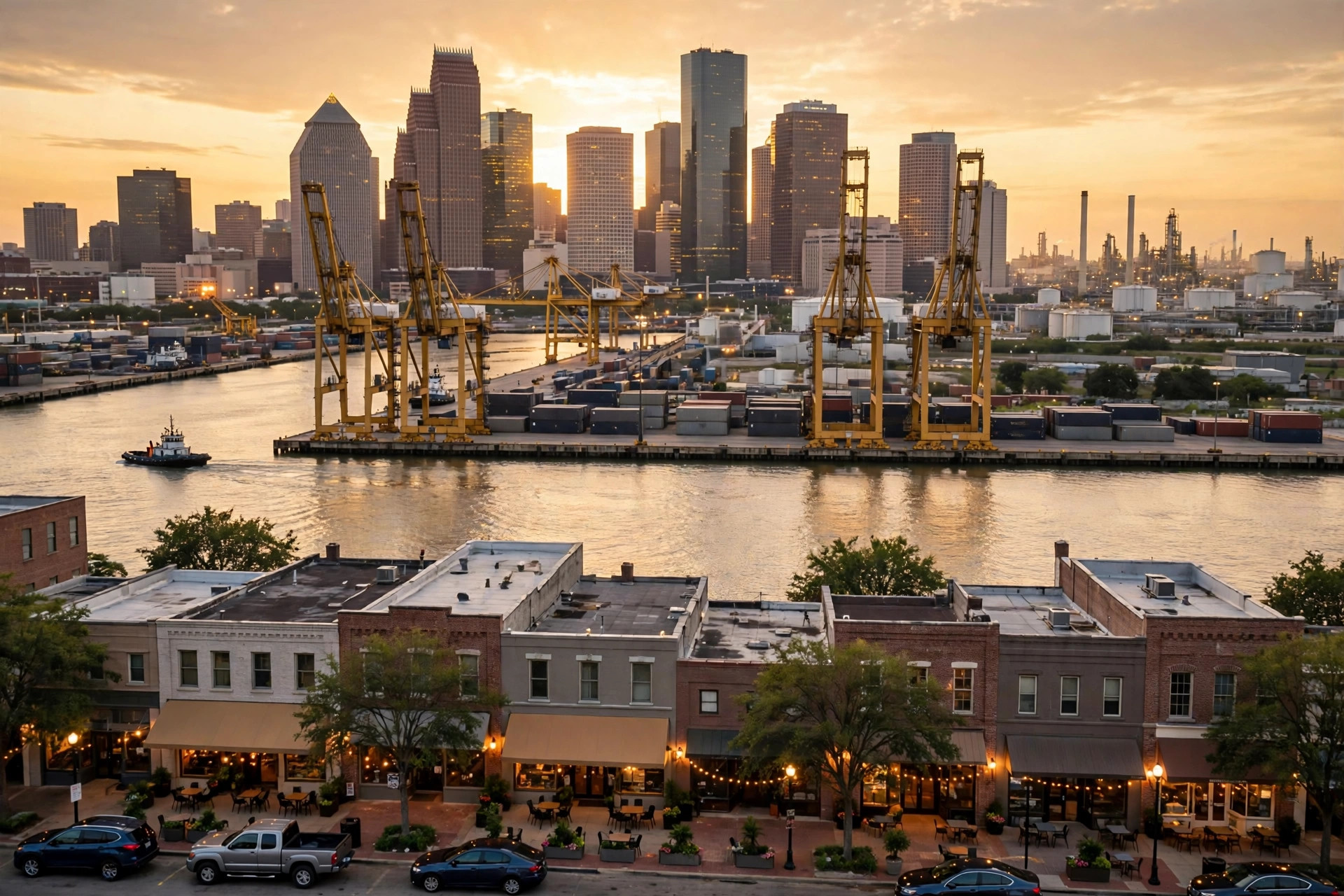
Houston is easy to misread as one economy. Behind the skyline sit 27 Fortune 500 headquarters, the busiest container port on the Gulf Coast, the Texas Medical Center, NASA's Johnson Space Center, one of the largest petrochemical complexes in the world, and neighborhood business districts from the Heights to Montrose to the Galleria that run on completely different cash-flow rhythms. The 10-county Houston-Pasadena-The Woodlands metro holds 7.9 million people, the fifth most populous metro in the country, and the city itself has 2.4 million residents. Funding in Houston works when the product matches the engine behind the business — and it stalls when a generic offer ignores it.
The energy engine. Energy is still Houston's anchor, even after decades of diversification: ExxonMobil, Chevron, Phillips 66, ConocoPhillips, Halliburton, Baker Hughes, and more than 20 other Fortune 500 companies are headquartered in the Houston area, and the region's real GDP has grown at a 3.8 percent compound annual rate since 2019. That concentration feeds a deep bench of suppliers, engineering firms, staffing agencies, caterers, and industrial services that bill large clients on long payment terms. If your receivables sit 30 to 90 days out from an energy major or a midstream operator, a working capital line or invoice-timed advance fits better than a daily-debit product priced for card volume you do not have. Energy cycles matter too: a funder reading three months of statements can see whether a slow quarter is a cycle or a decline, and the businesses that borrow best in Houston are the ones that can explain the difference in one sentence.
The port and logistics engine. Port Houston is the busiest container port on the Gulf Coast, cargo activity on the Houston Ship Channel supports 1.5 million jobs across Texas, and the Houston-Galveston Customs District handled $353.7 billion in trade in 2025, including $242.6 billion in exports. That trade flows through warehouses, trucking companies, freight forwarders, customs brokers, and packaging firms from the East End to Baytown to Katy — businesses that pay for fuel, drivers, and equipment before the freight invoice clears. Trucking and warehouse operators borrow against equipment and receivables: equipment financing for tractors and trailers, a line sized to the fuel-and-payroll float, and an advance only when a load has to move this week. The port also makes Houston a hurricane city, and the honest funding question for any logistics operator is the same one funders ask: what happens to cash flow when the channel closes for three days.
The medical and aerospace engine. The Texas Medical Center is the largest medical complex in the world, and Johnson Space Center anchors a space and advanced-manufacturing corridor on the southeast side. Medical suppliers, home health agencies, clinics, and aerospace contractors borrow against contracts and insurance reimbursements that pay on institutional schedules, not retail ones. A home health agency waiting on payer reimbursements and an aerospace machine shop waiting on a prime contractor's milestone payment have the same problem — payroll is weekly, payment is quarterly — and the same answer: a product that bridges a known, documented gap, sized to the gap rather than to a round number. Funders weigh signed contracts and collection history heavily here, and a full month of booked work with deposits in hand typically qualifies for more than the same deposits with an empty schedule.
The Main Street engine. Most Houston businesses are not energy companies. Restaurants in the Heights and Montrose, retailers in the Galleria and Rice Village, auto shops along the Southwest Freeway, contractors building out Katy and Cypress, and service companies across Sugar Land and The Woodlands borrow against card sales, seasonal demand, and local foot traffic. Summer heat, back-to-school, the rodeo season, and the holiday retail run each move a different slice of the city's cash flow, and a restaurant that does its best month during rodeo season should not be underwritten on its slowest August week. Card-heavy Main Street businesses are the ones a daily-debit advance actually fits — because the repayment rhythm matches the collection rhythm — while a contractor paid by check on 45-day terms needs a different shape entirely.
The product map, by need. A working capital line or advance fits the float between paying for a job and getting paid for it. Equipment financing fits tractors, trailers, work trucks, medical and shop equipment, and restaurant build-outs, because the asset itself secures the loan and terms follow the asset's life. A term loan fits a planned, one-time investment repaid on a fixed schedule: a second location, a leased space build-out, a new division. A merchant cash advance fits a card-heavy business that needs money in days, sized to a specific gap with the total repayment dollars in writing before signing. The wrong product is rarely a mystery in hindsight — it is usually a daily debit against 60-day receivables, or a long term loan for a Friday payroll emergency.
Need capital to bridge the gap between a signed contract and the check?
Houston businesses borrow against energy contracts, port freight, medical reimbursements, and Main Street card sales. Get an offer matched to the engine behind your business — not a generic number.
Apply Now or call (352) 809-3201
How funders underwrite a Houston business. Average monthly deposits over the last 3 to 6 months, and their consistency, dominate the decision. A flat line beats a spike, and a spike with a story — a signed contract, a seasonal surge, a new location opening — beats a spike with no explanation. Concentration matters: one customer supplying most of the revenue is a risk funders price in, whether that customer is an energy major or a single general contractor. Seasonality and storm exposure matter too: funders ask how the slow season and a storm shutdown are covered, and the honest answer is a reserve built in the busy season or a line drawn only in the slow months. Clean statements, a diversified customer list, and a backlog that is booked rather than hoped for are what move a Houston file from average to strong.
Documents and timeline. The core document is the last 3 months of business bank statements, because funders underwrite from deposits. A photo ID and a voided check are optional, not required. Most Houston files that arrive with clean statements and a clear use of funds get an offer within 24 hours and funding in 24 to 72 hours; files that stall usually stall on one of three things — statements with large unexplained transfers, a second advance already debiting daily, or a use of funds described as "growth" with no number attached. Name the gap in dollars, name the date it closes, and the file moves.
Mistakes Houston owners make. Borrowing for a hurricane-season gap with a product priced for peak-season volume. Taking a second advance on top of a first without a payoff plan — the combined daily debit, not either advance alone, is what payroll has to survive. Pricing a quote on the contract total instead of the draw schedule, and discovering the retainage only after the crew is paid. And waiting until the account is overdrawn to apply: funders read the last three months, and the month you apply in becomes part of that story. Apply while the statements still show the business you want funded.
What to do this week. Pull the last 3 months of business bank statements and read them the way a funder will: average monthly deposits, the biggest single deposit, the thinnest week, and every existing equipment payment. Then match the need to the product — float, machine, or expansion — and get two quotes compared on total repayment dollars. The Houston business that knows its gap in dollars, and the engine that created it, negotiates from strength; the business that asks for a round number negotiates from hope.
Houston businesses: get your numbers in 24 hours
From the Energy Corridor to the Ship Channel to the Heights, Houston businesses borrow against contracts, freight, reimbursements, and seasonal demand. See what your deposits actually qualify for — one application, multiple funders, total repayment dollars in writing before you sign.
Apply Now or call (352) 809-3201
Ready to Get Funded?
Apply now and get a funding decision within hours. No hard credit pull for pre-approval — see your options risk-free.