Fast Business Funding in Irving, TX: 257,076 People, Las Colinas' 25M Sq Ft of Headquarters & the $252M SBA Record (2026)
Irving held 257,076 people on July 1, 2025 — essentially flat since 2020 after an 18.7 percent run-up in the 2010s — inside the Dallas–Fort Worth metro of 8,477,157, the fourth-largest in the country. Las Colinas holds 25 million square feet of office space and more than 2,000 companies, DFW Airport moved 85.7 million passengers in 2025, and Irving borrowers took 303 SBA 7(a) approvals worth $252.4 million over FY2020–FY2026. Here is how business funding actually works in the Irving market: the product map by business type, real timelines, the public programs that exist, and how to compare offers.
Need funding fast? Apply in about 2 minutes — get a decision within hours, with no hard credit pull for pre-approval.
Apply Now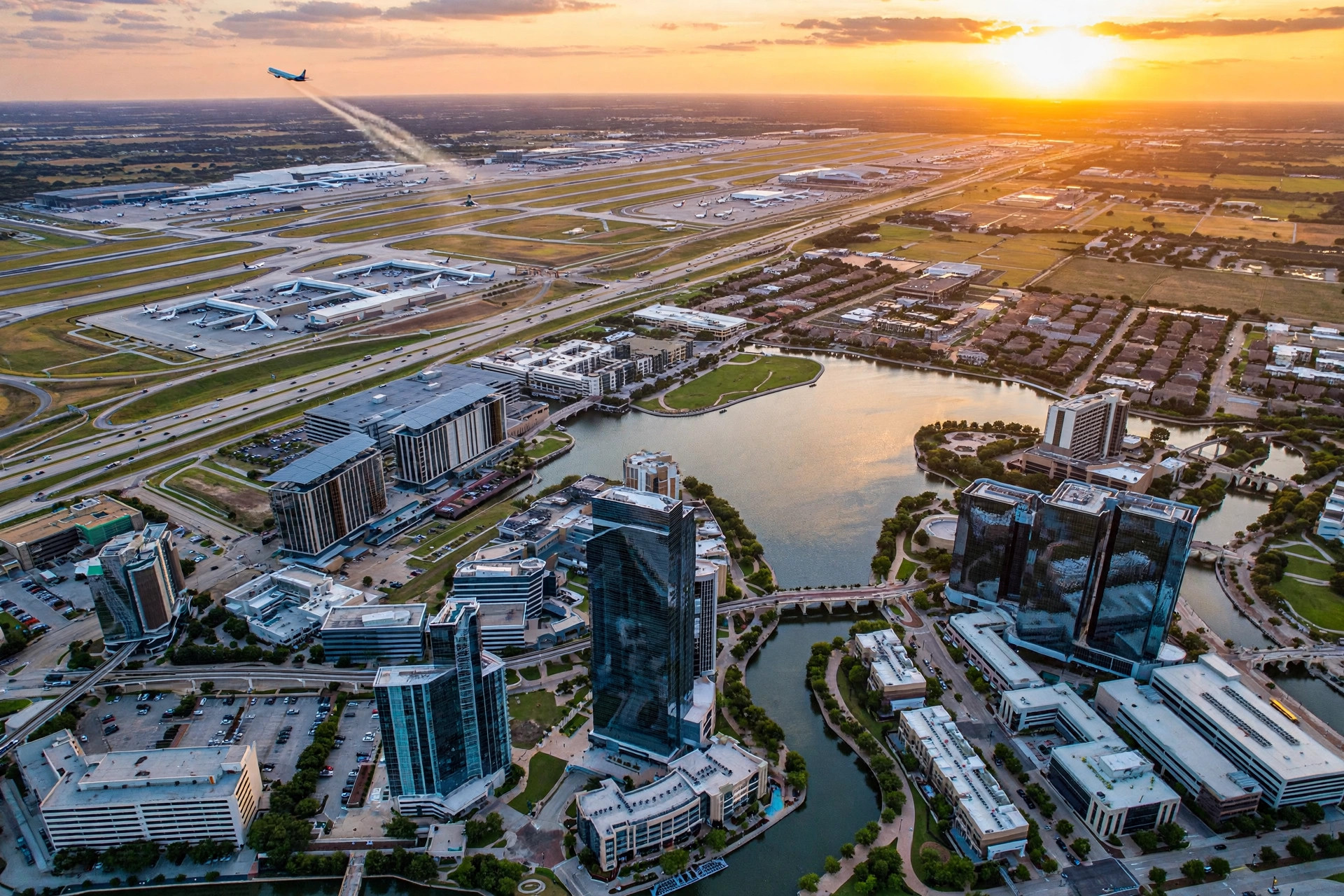
Key Takeaways
- Irving is the 12th-largest city in Texas at 257,076 people on July 1, 2025, per the Census Bureau's Vintage 2025 estimates — essentially flat since the 2020 Census count of 256,684, after growing 18.7 percent in the 2010s from 216,290 — and it sits inside the Dallas–Fort Worth–Arlington metro of 8,477,157 people, the fourth-largest in the country and the fastest-growing big metro, up 10.6 percent since 2020. Median household income is $81,830, with a poverty rate of 11.0 percent and 42.4 percent of adults holding a bachelor's degree. Irving is a renter-majority city — only 38.1 percent of homes are owner-occupied — with a median home value of $315,600. Irving covers 66.98 square miles of land, so its density is 3,832 people per square mile.
- Two anchors define the Irving economy. Las Colinas is a master-planned business district with 25 million square feet of office space — nearly equivalent to the Dallas central business district — and more than 2,000 companies, including the global headquarters of Caterpillar, McKesson, Kimberly-Clark, Fluor, Celanese, and Commercial Metals. And Dallas Fort Worth International Airport, part of which sits inside Irving's city limits, handled 85,660,127 passengers in 2025 — the world's fourth-busiest airport — on 17,207 acres, the second-largest airport by land area in the United States.
- Irving is a city of commuters, contractors, and airport services. With 94,845 households, 42.5 percent foreign-born residents, and $7.30 billion in retail sales in 2022, the steady funding demand comes from the staffing, catering, cleaning, facilities, and IT firms feeding Las Colinas' corporate campuses, the cargo handlers, ground-support, and logistics firms clustered along SH-114 and SH-183, and the hotels, restaurants, and retailers serving 85.7 million annual airport passengers. Transportation and warehousing receipts alone were $2.46 billion in 2022, with accommodation and food services at $1.40 billion and health-care receipts at $2.87 billion.
- Funding demand here is documented, not guessed. Irving borrowers took 303 SBA 7(a) approvals worth $252.4 million over FY2020–FY2026, with the biggest year by loan count FY2025 at 64 loans and $44.8 million, and the biggest year by dollars FY2021 at 46 loans and $57.1 million. Five separate Irving borrowers took the $5 million program-maximum loan — a hotel, a procurement and logistics firm, a metal specialties manufacturer, a medspa, and a hotel group. FY2026 came in lower at 37 loans and $32.5 million, partly because no 7(a) approvals were recorded nationally during the federal shutdown gap from October 1 to November 12, 2025.
- The cheapest money in Irving is public and specific: Texas' State Small Business Credit Initiative carries a $472.1 million allocation — a $160.5 million loan guarantee program, a $306.9 million loan participation program, and a $4.7 million capital access program after a 2026 restructuring — run through the Governor's office with 33 approved lenders; the Texas Workforce Commission's Skills for Small Business program pays for employee training at businesses with fewer than 100 employees; and PeopleFund's accelerator pays $3,000 to $5,000 grants to qualifying businesses. The North Texas SBDC Network, led by Dallas College, offers free one-on-one advising across 49 counties. Texas levies no state income tax — a real margin advantage, not a funding program.
Why Irving borrows differently
Irving is a city built on a railroad survey and an airport, and that is the first thing to understand about its funding market. Two surveyors, J.O. Schulze and Otis Brown, platted the townsite in 1903 along the Rock Island railroad between Dallas and Fort Worth, auctioned the first lots on December 19, 1903, and named the town for author Washington Irving — a favorite of Brown's wife, Netta. The town incorporated on April 14, 1914, with Brown as its first mayor, and for decades it grew as a modest railroad and farming suburb west of Dallas. Then two things happened in the last quarter of the twentieth century: Dallas–Fort Worth Airport opened on Irving's northern edge, and Dallas businessman Ben H. Carpenter began turning his private ranch into Las Colinas, a self-contained "city within a city" of offices, canals, and towers. Funders read that as a market of dense, diverse, working demand — median household income $81,830, poverty 11.0 percent, 42.4 percent of adults with a bachelor's degree, 42.5 percent foreign-born — plus a deep base of corporate suppliers, airport services firms, and hospitality businesses serving a metro of 8.48 million people.
The economy runs on three anchors. The first is Las Colinas. The district holds 25 million square feet of office space and more than 2,000 companies, and it has earned its nickname, the "Headquarters of Headquarters." Caterpillar moved its global headquarters from Deerfield, Illinois to its existing Irving office in 2022. McKesson moved its headquarters from San Francisco to Irving in 2019 and is now the largest company headquartered in Dallas County, with $403.43 billion in revenue in the fiscal year to March 2026. Kimberly-Clark, Fluor, Celanese, Commercial Metals, Vistra, Builders FirstSource, Darling Ingredients, Nexstar Media Group, and Flowserve are all headquartered in Irving too — 11 of the 25 biggest companies headquartered in Dallas County sit in Irving, with $570.65 billion of combined revenue. One former anchor is gone, and it matters to say so plainly: ExxonMobil moved its corporate headquarters from Irving to its Spring, Texas campus north of Houston in mid-2023 and sold its longtime Las Colinas campus in a sale-leaseback. Do not let anyone pitch you Irving as the home of ExxonMobil's headquarters — it was, for more than three decades, and it is not anymore. The district's landmarks tell the same story of a built-from-scratch business city: Lake Carolyn and the Mandalay Canal, the Mustangs of Las Colinas — nine bronze mustangs by Robert Glen, installed in Williams Square in 1984 and described as the largest equestrian sculpture in the world — and the Toyota Music Factory, which opened in September 2017 with a pavilion that converts from a 4,000-seat indoor hall to an 8,000-seat outdoor amphitheater.
The second anchor is the airport. Irving includes part of Dallas Fort Worth International Airport, and DFW handled 85,660,127 passengers in 2025 — the world's fourth-busiest airport by passengers and third-busiest by aircraft movements, with 743,394 takeoffs and landings — on 17,207 acres, the second-largest airport by land area in the United States after Denver. It is American Airlines' largest hub, with nonstop service to 193 U.S. and 78 international destinations. The airport economy is not just the terminals: it is the cargo handlers, ground-support crews, caterers, maintenance shops, hotels, parking operators, and logistics firms clustered along SH-114 and SH-183, all of them businesses whose revenue rides flight schedules, contracts, and seasons. The DART Orange Line runs through Las Colinas Urban Center to downtown Dallas and to the airport, so the whole district is tied to the region by rail as well as by road.
The third anchor is the workforce itself. Irving's labor market is tight but not frozen. Metro unemployment was 4.1 percent in September 2026, not seasonally adjusted, and the Dallas–Plano–Irving metropolitan division — Irving's own slice of the metro — was also 4.1 percent. The metro added 43,900 payroll jobs over the year, the largest gain of any U.S. metro, and the Dallas–Plano–Irving division alone added 29,700. Hiring is competitive, turnover is expensive, and a business that loses a trained worker pays to replace them at market rates. Owners borrow to keep the team they have rather than to grow headcount, and the funding request that bridges a payroll cycle is normal here.
One thing to get straight before you borrow on an Irving address: this is a headquarters town inside the fastest-growing big metro in the country, and funders know it. A staffing firm's revenue rides the hiring cycles of a dozen corporate campuses, a caterer's revenue rides the convention and concert calendar at the Toyota Music Factory, and a logistics firm's revenue rides flight volumes at DFW. A file that shows the twelve-month pattern — the busy season, the slow shoulder, the plan for the trough — prices better than a file that shows only the good quarter. And one caution on the numbers themselves: Irving's only verified unemployment figure is the metro and division rate — 4.1 percent in September 2026 — and Dallas County's 4.2 percent. Do not let anyone quote you an Irving city unemployment rate; none has been published. Likewise, the Census Bureau publishes no city-level count of Irving businesses at all — its QuickFacts page lists employer establishments as not applicable for the city — so anyone quoting an Irving business count is quoting the metro or the county. The "more than 2,000 companies" figure is Las Colinas specifically, not the whole city.
The Irving funding map: which product fits which business
Funding is not one product. The right one depends on what the money is for, how fast it comes back, and what your revenue looks like month to month. Here is the map for Irving:
Merchant cash advance — for card-heavy businesses with a short-term gap. Restaurants and bars around Las Colinas and the Toyota Music Factory, retailers near the airport hotels, and hospitality firms with steady card sales borrow against future receipts and repay daily or weekly as a share of sales. A $50,000 advance at an illustrative 1.20 factor rate repays $60,000 in total — $10,000 of cost — or about $2,308 a week over 26 weeks. The advance is fast, usually funded in 24 to 72 hours, and it fits a payroll gap or an inventory buy that pays back in a season. It is the most expensive money on this map, and it is the right call only when the money comes back within months. Read what actually happens if you default on an advance before you sign one, and read whether a merchant cash advance is legal for the state-by-state picture.
Term loan — for a known cost with a fixed payoff date. A second service van for a facilities crew, a build-out in a new ground-floor space in Las Colinas, a hire that pays for itself over a year, a down payment on a warehouse lease along SH-183. Fixed daily, weekly, or monthly payments over months to years, priced on a rate or a factor depending on the lender. If the spend has a clear return date, match the term to it — borrowing for 12 months to pay for something that returns in three is overpaying for speed you do not need.
Business line of credit — for the seasonal business. A staffing firm between a corporate client's Net 45 payment and its own Friday payroll, a caterer waiting on a convention settlement, a landscaper waiting on a Net 45 invoice from a Las Colinas property manager, or a restaurant stocking up before a big concert week at the Toyota Music Factory draws only what it needs and pays interest only on what it draws. The line is the right tool when the gap is timing — a contract 60 days out, a season that pays in July — rather than a single purchase. Draws after approval are usually same-day.
Equipment financing — for the thing itself. A service van, a box truck for an airport cargo run, a forklift and racking for a warehouse off SH-114, ground-support equipment, kitchen equipment for a restaurant, medical equipment for a clinic. The equipment secures the loan, so the pricing is usually the cheapest money on this map for an asset purchase, and the term can run two to five years. If the money buys a thing, price the equipment product first. And if you already own the equipment outright, you can borrow against it instead — an equipment refinance or sale-leaseback turns a paid-off machine into working capital without taking it out of service.
Purchase-order and invoice financing — for the contract economy. A staffing firm with a signed purchase order from a Fortune 500 campus, a logistics firm waiting on Net 45 payment from an airline contractor, or a facilities company with outstanding invoices on a Las Colinas build-out can borrow against the order or the receivable instead of against future card sales. The advance is sized on the contract, not on last month's deposits, which is exactly the profile a contract business needs. Ask about it before you take a general-purpose advance.
SBA and guaranteed loans — for the cheapest money, if you can wait. SBA 7(a) loans run up to $5 million through SBA lenders, and SBA 504 loans run up to $5 million for owner-occupied real estate and long-life equipment. SBA microloans run up to $50,000. The underwriting is real and the clock runs in weeks, sometimes six to eight, but the rate is the lowest on this map — and Irving businesses have actually used them: 303 SBA 7(a) approvals worth $252.4 million over FY2020–FY2026, with the biggest year by loan count FY2025 at 64 loans and $44.8 million, and the biggest year by dollars FY2021 at 46 loans and $57.1 million. For the full comparison method, see which funding product fits which business.
Grants and loan programs: what actually exists in Irving
Before you borrow, check the money that does not need repaying — and be honest about what is open right now. The public money that actually exists for Irving businesses is state and regional, not a general city cash grant. The North Texas SBDC Network, led by Dallas College, offers free one-on-one advising, including business-plan help and loan-package assembly, across 49 counties in North Central Texas, with the Dallas Metropolitan SBDC in downtown Dallas — start there before you apply anywhere else, because it costs nothing and it is the fastest way to a fundable file. And if your business is in Dallas, just east on SH-183, or in Plano, up the Tollway in the same Dallas–Plano–Irving division, the same state programs apply — the difference is the local channel, not the state one.
The state channel is Texas' State Small Business Credit Initiative (SSBCI), a $472.1 million allocation from the U.S. Treasury, restructured in 2026 into three programs run through the Governor's office with 33 approved lenders — 14 banks and 19 CDFIs. The Loan Guarantee Program at $160.5 million guarantees up to 80 percent of the unpaid principal on loans from $5,000 to $20 million — you work through a participating lender. The Loan Participation Program at $306.9 million is new in the 2026 restructuring and buys or co-lends alongside a lender. The Capital Access Program at $4.7 million provides portfolio insurance to enrolled lenders. One honest caveat: deployment has been slow. As of June 30, 2026, Treasury had disbursed $134.5 million to Texas and the state had deployed only $39.6 million — 8.4 percent of the allocation. The programs are real, but they are thinly drawn so far, so do not plan a closing date around them. These are credit supports, not grants, and you apply through a participating lender, not directly to the state.
The training channel is the Texas Workforce Commission's Skills for Small Business program, which pays for employee training at businesses with fewer than 100 employees, delivered through a public community or technical college — up to $2,000 per new employee and $1,000 per incumbent employee, with up to $2 million available statewide. Training money, not cash — but a trained crew that stays is worth more than the invoice it replaces.
The grant channel is small and specific. PeopleFund, a Texas CDFI, runs a BIPOC Small Business Accelerator that pairs a loan with a $3,000 to $5,000 grant for qualifying businesses in low- to moderate-income areas. The Amber Grant pays up to $75,000 a year to women-owned businesses — $15,000 monthly and $75,000 at year end. Neither is a general Irving business grant, and neither covers payroll next Friday. Use them for the project they fit, and borrow for the gap they leave — not the other way around.
One honest note about Irving specifically: the expensive part of doing business here is labor and space, not demand. A warehouse lease along SH-114, a storefront near the Toyota Music Factory, and a licensed tech all cost real money in a metro where hiring is competitive — and a staffing or hospitality business that borrows against a busy quarter without a plan for the slow one is borrowing against the wrong month. The funding should be priced on the total repayment across the full year, not the headline rate in the good quarter. Texas levies no state income tax — a genuine margin advantage for an Irving business — but do not let anyone sell it as a funding program; property and franchise taxes still apply.
What to watch before you sign
There is no substitute for the total repayment in dollars, in writing, before you sign. Compare offers on that number, not on the headline rate or the monthly payment. If a funder will not put the total in writing, that is your answer about the funder.
The second thing to watch is the repayment rhythm. Daily debits against a restaurant's account in a slow week between concerts, or against a staffing firm's account while a corporate client's Net 45 payment is still in transit, can drain the account before the next weekend or the next payroll lands. If your revenue swings with the concert calendar or the flight schedule, ask for weekly payments instead of daily, and ask what happens if a debit fails. A funder that answers clearly is a funder that has done this before.
The third is concentration. Irving's economy is anchored — a handful of corporate campuses, one airport, one entertainment district — and your business may be far more concentrated than the city is. A staffing firm with one campus client at 60 percent of revenue, a caterer living off one hotel's events calendar, or a logistics firm depending on one airline contract is a different file from ten customers at 6 percent each. Bring the contract, the payment history, and the plan for a second customer. A file that explains the concentration prices better than a file that leaves the funder to discover it.
The fourth is stacking. A second advance taken to cover the first one's payments is how a manageable file becomes a default. If you already hold an advance, read how to refinance one before you stack another, and read how the early-payoff discount works if you are weighing paying one off early.
Frequently asked questions
How fast can an Irving business get funded? A merchant cash advance typically funds in 24 to 72 hours after approval with three months of bank statements. Term loans run a similar clock, lines of credit decide in minutes to a day, equipment financing takes days to a couple of weeks, and SBA loans take weeks. The public programs run slower, because they move through review rounds and partner referrals — and Texas' SSBCI deployment has been slow, so do not plan a closing date around it.
What do I need to apply? Three months of business bank statements are the core document. A photo ID and a voided check are usually optional verification, not requirements — but having them ready removes stalls. Staffing firms should also bring the client contracts and the aging receivables; logistics firms should bring the carrier contracts and shipment history; contractors should bring the draw schedule and signed purchase orders; restaurants should bring the card-sales history.
Does the Las Colinas headquarters base or DFW Airport help my approval chances? It helps, if the file shows it. Funders underwrite your business, not the headline. A staffing firm or a caterer with twelve months of deposits showing steady work from a 257,076-person city plus $7.30 billion in annual retail sales prices far better than a file that leaves the funder to guess — but headquarters and airport revenue is contract revenue, so show the contracts, the payment history, and the twelve-month pattern, not just the customer names, and name the concentration honestly.
Can a restaurant, retailer, logistics firm, or contractor get funded in Irving? Yes — restaurants, retailers, logistics firms, and trades are among the most common Irving profiles, because the corporate campuses, the airport, and the entertainment district keep them busy most of the year. An advance fits a short-term payroll or inventory gap; a line of credit fits the seasonal business; equipment financing is usually the cheapest route for a truck, a forklift, or a kitchen; and an SBA loan can fill a gap a bank will not cover on its own.
What if my revenue depends on one big customer? Say so up front, and show the concentration honestly. Funders price concentration risk — one customer at 60 percent of revenue is a different file from ten customers at 6 percent each — but a signed multi-year contract with a creditworthy buyer is also a strength. Bring the contract, the payment history, and the plan for a second customer. A file that explains the concentration prices better than a file that leaves the funder to discover it.
Ready to fund your Irving business?
One application, competing offers, total cost in writing. Bank statements are the main document — gather three months before you start, and bring the full twelve months if your revenue is seasonal, or the client contracts and shipment history if you are a staffing firm, a logistics firm, or a contractor.
Apply Now or call (352) 809-3201
Ready to Get Funded?
Apply now and get a funding decision within hours. No hard credit pull for pre-approval — see your options risk-free.