Fast Business Funding in New Orleans, Louisiana: The $7.25 Wage Floor, the 19-Million-Visitor Calendar & the Port Economy (2026)
New Orleans pairs the federal $7.25 wage floor with a visitor economy that drew 19.08 million people and $10.4 billion in spending in 2024, plus a port district behind 8.3 percent of Louisiana's GDP. Here is how business funding actually works in the New Orleans market: the product map by business type, real timelines, and how to compare offers.
Need funding fast? Apply in about 2 minutes — get a decision within hours, with no hard credit pull for pre-approval.
Apply Now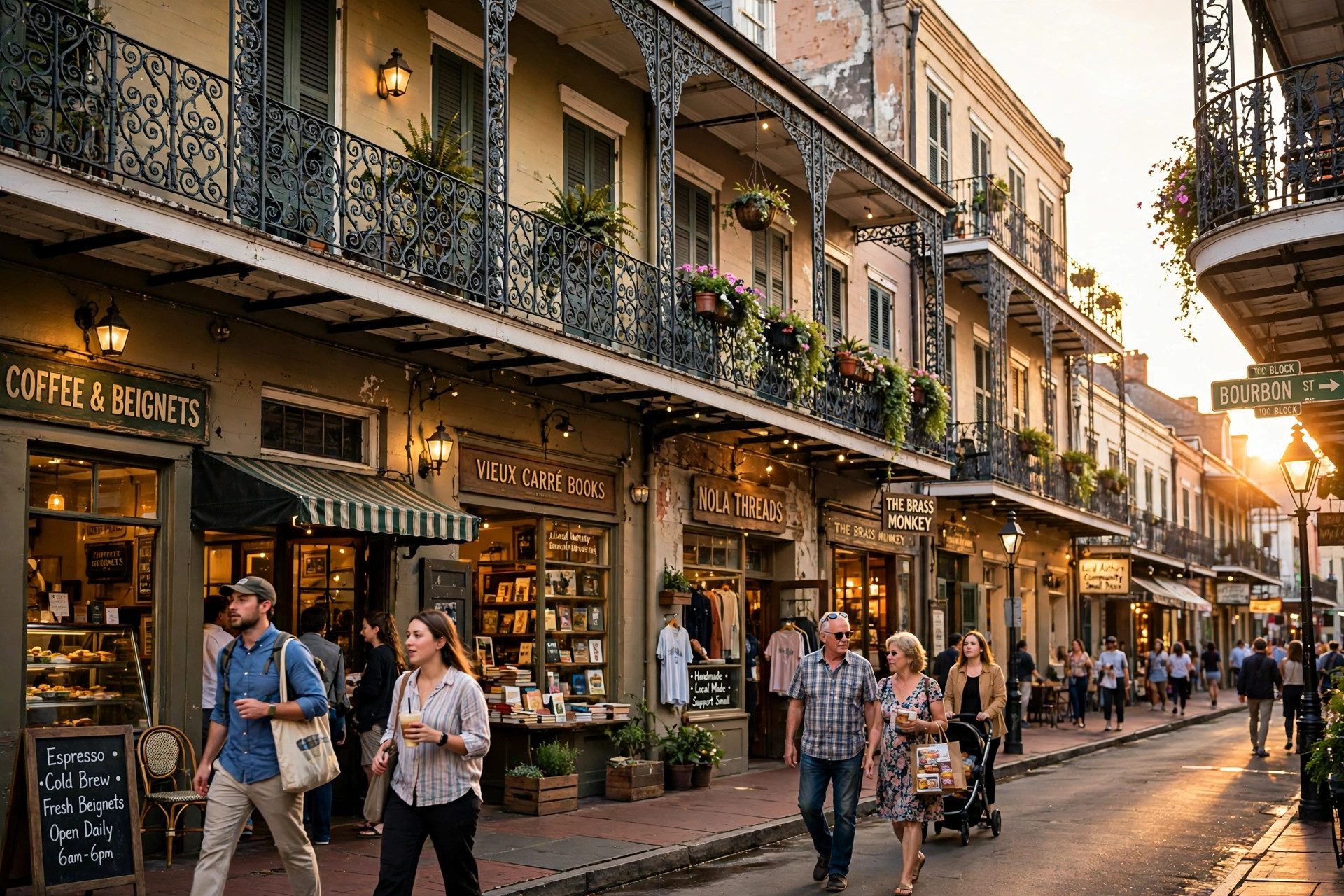
Key Takeaways
- Louisiana has no state minimum wage law, so the federal rate of $7.25 an hour applies — unchanged since 2009 — and state law bars New Orleans and every other city and parish from setting a higher local floor for private employers. Budget labor at the market rate, not the legal floor: MIT researchers put a living wage for one adult in Louisiana at $20.37 an hour.
- New Orleans welcomed 19.08 million visitors in 2024, up 6.4 percent from 2023, who spent $10.4 billion — a record that passed the pre-pandemic high. The port district's cargo activity supported $101.5 billion in total U.S. economic value in 2024, including $31.5 billion in Louisiana, about 8.3 percent of the state's GDP, and 122,386 Louisiana jobs.
- Fast funding in New Orleans means 24 to 72 hours to money in hand for revenue-based products: a short application, a same-day decision, and three months of business bank statements. Photo ID and a voided check are optional verification items, never upfront requirements.
Why New Orleans borrows differently
Most growth cities borrow like one economy. New Orleans does not. The city is a visitor town, with 19.08 million visitors in 2024 spending $10.4 billion — only the second time in recorded history the city has cleared 19 million, and within reach of the 2019 record of 19.75 million. It is a port and logistics town, with Port NOLA cargo activity supporting 122,386 Louisiana jobs and a $1.5 billion Louisiana International Terminal project on the way that is expected to create more than 18,000 jobs. It is a hospitality and culture town, where restaurants, bars, hotels, tour operators, and French Quarter retailers live or die by the event calendar. And it is a storm town, where every business with a roof and inventory prices hurricane season into its cash flow. Louisiana counts 511,235 small businesses employing 889,431 people — 99.5 percent of all businesses in the state and 54.1 percent of its private-sector employees — and a large share of them sit inside the New Orleans metro economy.
The practical consequence is timing. A French Quarter restaurant does not borrow like a Metairie contractor, and neither borrows like a Kenner logistics supplier. The restaurant's best month is February and March, when Mardi Gras and the convention calendar fill every table; its worst is the late-summer slump, when heat and hurricane risk thin the crowds. The contractor's year runs on draw schedules and storm-repair surges. The logistics supplier's year runs on port volumes and cruise-season passenger movements, which hit a record 1.2 million last year. Funding that ignores which calendar a business lives on is funding sized for the wrong month.
The wage floor, and what it actually costs to staff
Louisiana is one of only five states with no minimum wage law of its own, so the federal $7.25 an hour applies across the state — the same rate since July 2009. A 1997 state law, Louisiana Revised Statutes 23:642, specifically prohibits cities and parishes from requiring private employers to pay more, so New Orleans cannot set its own floor the way cities in other states do. The city's Living Wage Ordinance reaches only city contractors and recipients of city financial assistance, not most private-sector jobs. Bills to create a state wage have stalled repeatedly, including a 2026 proposal for $12 an hour rising to $15 by 2029 that failed in committee.
For a business owner, the legal floor is nearly irrelevant to hiring. The average hourly wage in Louisiana was about $30.61 as of early 2026, and MIT's living-wage calculation for a single adult with no children in Louisiana is $20.37 an hour. A restaurant, hotel, or tour company staffing at or near $7.25 will not hold a crew through a festival weekend, and a funding application that budgets labor at the floor will not survive a funder's review of three months of bank statements. Price the crew at the market rate, show the payroll hitting the account on schedule, and the application reads as a real business rather than a wish.
The product map by business type
Revenue-based funding — a merchant cash advance or revenue-based line — fits the visitor economy best, because repayment flexes with deposits. A restaurant that takes $90,000 in February and $45,000 in August should not carry a fixed monthly payment sized for February. Daily or weekly debits tied to revenue let the slow month breathe. Approval typically needs six months in business and steady deposits; the strongest files show $10,000 or more in average monthly revenue, though smaller files fund with tighter terms.
Equipment financing fits the port-adjacent and trades economy: a refrigerated truck for a food distributor, a work truck and tools for a contractor, kitchen equipment for a restaurant buildout. The equipment itself secures the deal, so terms run longer and the monthly payment stays fixed — the right shape for an asset that earns for years. SBA loans remain the cheapest capital for established businesses with strong books, but they run 30 to 90 days and demand full documentation; they are the wrong tool for a business that needs a walk-in cooler before Jazz Fest.
A business line of credit is the bridge product for the seasonal gap: draw it in August and September, repay it when the fall convention calendar and the holidays refill the account. The mistake New Orleans owners make most often is drawing the line to cover a permanent shortfall — a location whose rent exceeds what its slow months support — instead of a timing gap. Funders read bank statements the way a doctor reads a chart: a seasonal dip that recovers is healthy; a slow bleed that never recovers is not.
Real timelines: what 24 to 72 hours actually requires
The fast-funding timeline is real but conditional. Day one: a short application and three months of business bank statements, plus a photo ID if the funder asks. Same-day decision is standard for revenue-based products once statements are in. Funding lands in 24 to 72 hours after approval and signed documents. The delays that break the timeline are almost always document problems: statements with gaps, a business account mixed with personal spending, or a second advance the owner forgot to disclose that shows up in the debits. Clean statements — one business account, regular deposits, no unexplained large transfers in the week before applying — are worth more than a perfect credit score for these products.
Bank statements are the main document. A funder's first pass over them checks average daily balance, deposit frequency, and existing daily debits. A restaurant showing strong weekend deposits and a steady average balance funds faster than a business with one large deposit a month and a balance that touches zero. If your statements tell a seasonal story, say so in the application: note the event calendar, the convention bookings, and the months that carry the year. Underwriters fund stories they understand.
Hurricane season is a funding variable, not just weather
Every New Orleans business should treat June through November as a line item. Insurance premiums, deductibles, and the cost of a week closed for a storm land in the same months as the summer slump. Two practical moves matter more than any product choice. First, keep a reserve sized to one slow month plus the insurance deductible, not to one good week. Second, if you borrow ahead of storm season, borrow for resilience — a generator, shutters, inventory moved off the ground floor — and say so: funders prefer capital that protects the revenue stream to capital that covers last month's shortfall. After a major storm, repair and rebuild demand surges for contractors, roofers, and suppliers, and those businesses can fund growth off signed work if their statements show the surge arriving.
How to compare offers without getting burned
Compare total repayment dollars, not headline rates. A factor rate of 1.30 on $50,000 means $65,000 back — that is the number that matters, plus any origination or admin fees. Ask for the total in writing, the debit schedule (daily or weekly), the expected payoff window, and whether early payoff earns a discount. Size the debit to a slow month's deposits, not a Mardi Gras week's: the debit still comes out in August. And never stack a second advance on top of a first without telling the new funder — the first funder's daily debit is visible in your statements anyway, and the surprise costs more than the disclosure.
Watch for two New Orleans-specific traps. One: brokers pitching "guaranteed approval" against a seasonal business with thin statements — the approval arrives, the daily debit does not fit August, and the business is worse off than before. Two: borrowing a fixed monthly term loan against festival-season revenue to cover a year-round cost. If the cost is year-round, the repayment should flex or the revenue should be year-round too.
Where to start
Start with the statements. Pull the last three months, check that deposits, average balance, and existing debits tell the story you intend, and fix the easy problems first: separate personal spending, close the gaps, and document any large one-time deposit. Then apply once and compare competing offers side by side on total cost, not on speed alone — speed is table stakes in this market, and every serious funder offers it. The businesses that fund best in New Orleans are not the ones with the biggest festival weekends. They are the ones whose statements show they survive August.
Ready to fund your New Orleans business?
One application, competing offers, total cost in writing. Bank statements are the main document — gather three months before you start.
Apply Now or call (352) 809-3201
Ready to Get Funded?
Apply now and get a funding decision within hours. No hard credit pull for pre-approval — see your options risk-free.