Fast Business Funding in San Bernardino, CA: 222,044 People, 675.8M Sq Ft of Warehouses & the $193.6M SBA Record (2026)
San Bernardino held 222,044 people on July 1, 2025 — flat since 2020 inside the Riverside–San Bernardino–Ontario metro of 4,769,007, the 12th-largest in the country. The Inland Empire's logistics market runs 675.8 million square feet of warehouse space, San Bernardino International Airport's freight grew from 303 tons in 2016 to 210,500 tons in 2025, and San Bernardino borrowers took 246 SBA 7(a) approvals worth $193.6 million over FY2020–FY2026. Here is how business funding actually works in the San Bernardino market: the product map by business type, real timelines, the public programs that exist, and how to compare offers.
Need funding fast? Apply in about 2 minutes — get a decision within hours, with no hard credit pull for pre-approval.
Apply Now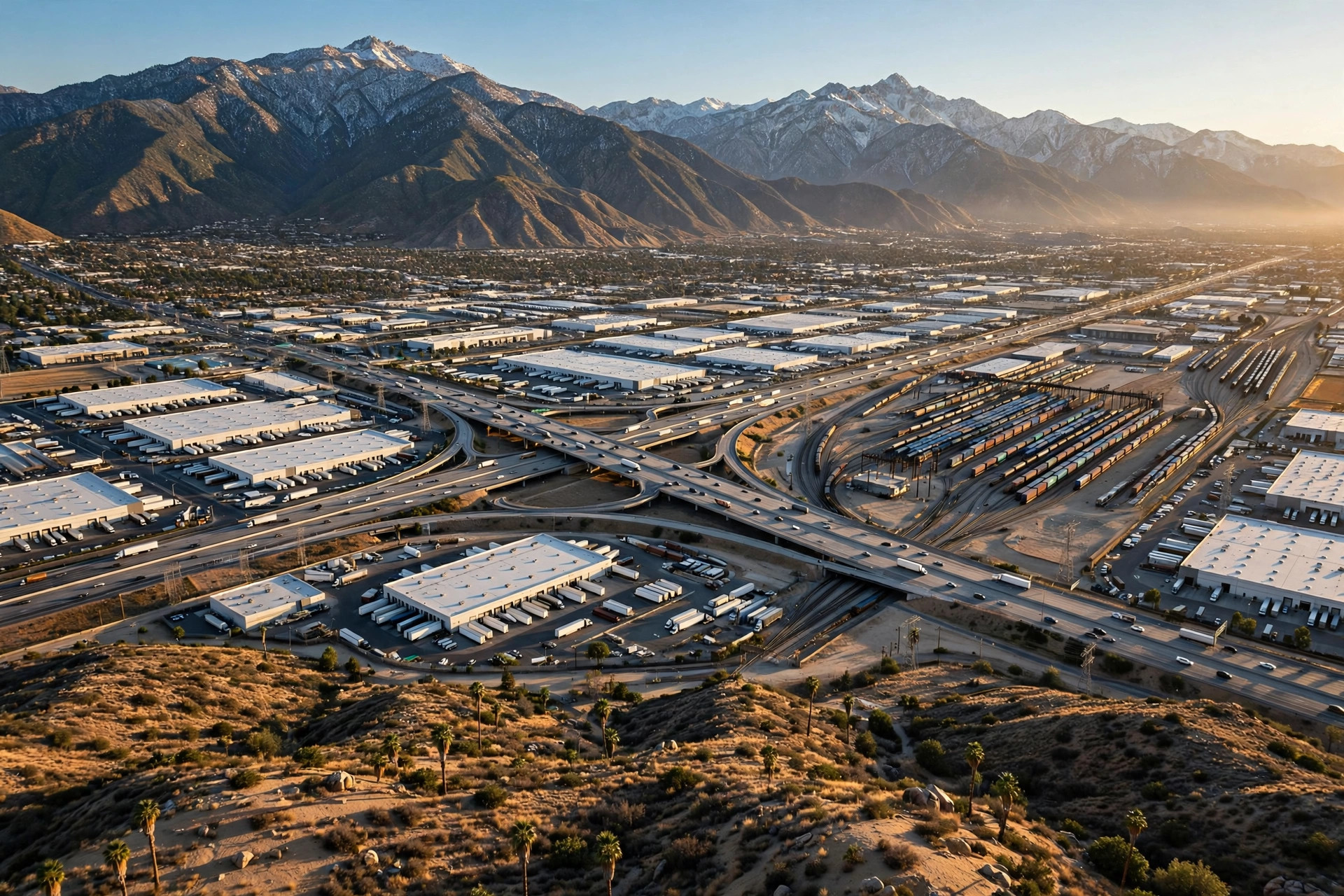
Key Takeaways
- San Bernardino is the 18th-largest city in California at 222,044 people on July 1, 2025, per the Census Bureau's Vintage 2025 estimates — flat since the 2020 Census count of 222,101, after growing 5.8 percent in the 2010s from 209,924 — and it sits inside the Riverside–San Bernardino–Ontario metro of 4,769,007 people, the 12th-largest in the country and the second-largest in California, up 3.5 percent since 2020. Median household income is $67,415, with a poverty rate of 18.6 percent and 13.1 percent of adults holding a bachelor's degree. San Bernardino is an even split on housing — 50.0 percent of homes are owner-occupied — with a median home value of $422,300. The city covers 62.13 square miles of land, so its density is 3,575 people per square mile.
- Two anchors define the San Bernardino economy. Logistics: the Inland Empire's industrial market holds 675.8 million square feet of logistics space, with vacancy at 9.4 percent and asking rent at $0.97 per square foot, and the region's logistics employment was 51 percent higher at the end of 2022 than in February 2020. And the county seat: San Bernardino is the seat of the largest county by area in the contiguous United States, with the county government, the school district, California State University, San Bernardino, and the hospitals forming a stable demand base that does not move with the freight cycle.
- San Bernardino is a city of warehouse operators, truckers, and trades. With 64,199 households, 70.2 percent Hispanic residents and 23.3 percent foreign-born residents, and $5.75 billion in retail sales in 2022, the steady funding demand comes from the 3PLs, trucking firms, pallet and packaging companies and their suppliers feeding the ports of Los Angeles and Long Beach, the contractors and trades serving a 222,044-person city, and the retailers and restaurants feeding the county-government workforce. Transportation and warehousing receipts were $900.1 million in 2022, with health-care receipts at $2.04 billion and accommodation and food services at $518.3 million.
- Funding demand here is documented, not guessed. San Bernardino borrowers took 246 SBA 7(a) approvals worth $193.6 million over FY2020–FY2026, with the biggest year by loan count FY2025 at 53 loans and $27.3 million, and the biggest year by dollars FY2021 at 35 loans and $39.1 million. Five San Bernardino borrowers took the $5 million program-maximum loan — and two of the five are pallet companies, the logistics economy in SBA form.
- The cheapest money in San Bernardino is public and specific: California's State Small Business Credit Initiative carries a $1.18 billion allocation — IBank's Small Business Loan Guarantee covers up to 80 percent of a bank loan, to $20 million, and CalCAP adds a loss reserve on loans up to $5 million — and the Inland Empire SBDC, hosted by Cal State San Bernardino, offers no-cost one-on-one advising across Riverside and San Bernardino counties. The Employment Training Panel reimburses training for small employers, and California Competes holds $819.8 million in tax credits for FY 2026-27. California's minimum wage is $16.90 an hour as of January 1, 2026 — a real cost fact, not a funding program — and the state's $800 annual LLC tax is another.
Why San Bernardino borrows differently
San Bernardino is a city that was built to move things, and that is the first thing to understand about its funding market. Mormon settlers founded the town in 1851, buying the Rancho San Bernardino and laying out a settlement at the foot of the mountains where the wagon roads came down through Cajon Pass from the desert. The city was first incorporated in 1854 and became the county seat of San Bernardino County — the largest county by area in the contiguous United States. The Santa Fe Railway made it a major rail yard and shop town in the 1880s, and the Santa Fe Depot, built in 1918 in Mission Revival style after the original burned in 1916, still serves passengers today. U.S. Route 66 was established on November 11, 1926, and ran through San Bernardino on its way to Santa Monica. In 1940, the brothers Richard and Maurice McDonald opened a drive-in restaurant on E Street, where they later developed the fast, assembly-line service that became the McDonald's system. Funders read that as a market of dense, diverse, working demand — median household income $67,415, poverty 18.6 percent, 13.1 percent of adults with a bachelor's degree, 70.2 percent Hispanic, 23.3 percent foreign-born — plus a deep base of warehouses, truckers, and the trades and retailers that serve them, inside a metro of 4.77 million people.
The economy runs on three anchors. The first is logistics, and it is the biggest story in the city. The Inland Empire is one of the country's largest logistics and distribution hubs, and San Bernardino sits at its eastern end, where the I-10, I-215 and SR-210 freeways meet near Cajon Pass. The region's logistics industry added 27,400 jobs in 2021 and 24,400 in 2022, and logistics employment was 51 percent higher at the end of 2022 than in February 2020, according to the Southern California Association of Governments. The Inland Empire's industrial market holds 675.8 million square feet of logistics space, with vacancy at 9.4 percent and asking rent at $0.97 per square foot as of early 2026, and nearly 60 million square feet of new industrial space has been completed since 2023. The air side of the story is just as steep: Ontario International Airport, about 25 miles west, handled 835,129 tons of air cargo in 2025, up 5.3 percent, and 7.1 million passengers, a record since local control began in 2016. And San Bernardino International Airport — the former Norton Air Force Base, closed in 1994 — ranked 25th in the nation in dedicated freight activity in 2023 and 2024, with freight growing nearly 700 percent over ten years, from 303 tons in 2016 to 210,500 tons in 2025. The BNSF Railway's intermodal yard is the company's main Southern California rail hub, and the scale of a single building tells the story: Gateway South Building 1, on East Central Avenue, is a 969,456-square-foot cross-dock with 148 dock-high doors, six-tenths of a mile from San Bernardino International Airport. Amazon is the region's largest private employer, and its fulfillment centers — including the KSBD Air Hub — anchor a warehouse cluster that stretches from Fontana and Rialto through San Bernardino itself.
The second anchor is the county seat, and it is the one that never moves. San Bernardino is the seat of a county of 2,224,091 people, and the county government, the San Bernardino City Unified School District, California State University, San Bernardino, and the hospitals form a demand base that does not rise and fall with the freight cycle. The county employs more than 23,000 public-service professionals county-wide. Stater Bros. Markets — California's largest privately-owned grocery chain, with 171 stores and about $3.8 billion in annual revenue — is headquartered on South Tippecanoe Avenue in San Bernardino. Loma Linda University Medical Center, a Level 1 trauma center, anchors the health economy just over the city line, and health care and social assistance is the county's largest employment sector at roughly 131,000 workers, with $2.04 billion in receipts inside the city itself in 2022. Cal State San Bernardino employs about 2,500 people and hosts the Inland Empire Center for Entrepreneurship. The Yaamava' Resort and Casino at San Manuel, in adjacent Highland, employs more than 5,000 people. The vendors, caterers, cleaners, landscapers and contractors that serve these institutions are steady borrowers — their revenue does not depend on a single shipping season, and funders price that stability.
The third anchor is the city's own history, and it cuts both ways. Norton Air Force Base, established in World War II, closed in 1994, and the closure gutted the local economy — downtown declined for years, and the base sat as a reminder of what the city had lost. Then, in August 2012, San Bernardino filed for Chapter 9 bankruptcy with more than $1 billion in debt — the largest city in the country to file at the time, a record Detroit took a year later — and did not emerge until February 2017, one of the longest municipal bankruptcies in American history. Say it plainly: the bankruptcy is over, and it is the reason the logistics build-out on the old base matters so much. The city is working its way back on warehouses, trucks, and air freight, not on city hall. A funder that knows the history will ask about it; a file that answers it — steady deposits, a contract base, a plan for the slow quarter — prices better than a file that pretends it never happened.
One thing to get straight before you borrow on a San Bernardino address: this is a logistics town inside a growing metro, and funders know both halves of that sentence. A warehouse operator's revenue rides the shipping calendar out of the ports of Los Angeles and Long Beach, a trucking firm's revenue rides the freight cycle, and a contractor's revenue rides the build-out cycle across 64,199 households. A file that shows the twelve-month pattern — the busy season, the slow shoulder, the plan for the trough — prices better than a file that shows only the good quarter. And one caution on the numbers themselves: San Bernardino's only verified unemployment figure is the metro and county rate — 5.7 percent for the Riverside–San Bernardino–Ontario metro in September 2026, not seasonally adjusted, and 5.5 percent for San Bernardino County, against 5.1 percent for California and 4.0 percent for the nation. The metro had the 5th-highest unemployment rate among the 108 large metro areas that month. Do not let anyone quote you a San Bernardino city unemployment rate; none has been published. Likewise, the Census Bureau publishes no city-level count of San Bernardino businesses at all — its QuickFacts page lists employer establishments as not applicable for the city — so anyone quoting a San Bernardino business count is quoting the metro or the county. And the city's population is flat — 0.0 percent since April 2020 — while the metro grew 3.5 percent. The growth story is the region's, not the city's, and a funder who knows the difference will underwrite the business, not the headline.
The San Bernardino funding map: which product fits which business
Funding is not one product. The right one depends on what the money is for, how fast it comes back, and what your revenue looks like month to month. Here is the map for San Bernardino:
Merchant cash advance — for card-heavy businesses with a short-term gap. Restaurants and bars downtown and along the hospitality corridors, retailers serving the county-government workforce, and food-service firms with steady card sales borrow against future receipts and repay daily or weekly as a share of sales. A $50,000 advance at an illustrative 1.20 factor rate repays $60,000 in total — $10,000 of cost — or about $2,308 a week over 26 weeks. The advance is fast, usually funded in 24 to 72 hours, and it fits a payroll gap or an inventory buy that pays back in a season. It is the most expensive money on this map, and it is the right call only when the money comes back within months. Read what actually happens if you default on an advance before you sign one, and read whether a merchant cash advance is legal for the state-by-state picture.
Term loan — for a known cost with a fixed payoff date. A second box truck for a delivery run, a build-out in a new ground-floor space downtown, a hire that pays for itself over a year, a down payment on a warehouse lease off Central Avenue. Fixed daily, weekly, or monthly payments over months to years, priced on a rate or a factor depending on the lender. If the spend has a clear return date, match the term to it — borrowing for 12 months to pay for something that returns in three is overpaying for speed you do not need.
Business line of credit — for the seasonal business. A 3PL between a big customer's Net 45 payment and its own Friday payroll, a warehouse operator waiting on a peak-season settlement, a landscaper waiting on a Net 45 invoice from a property manager, or a restaurant stocking up before a big weekend draws only what it needs and pays interest only on what it draws. The line is the right tool when the gap is timing — a contract 60 days out, a season that pays in December — rather than a single purchase. Draws after approval are usually same-day.
Equipment financing — for the thing itself. A forklift fleet and racking for a warehouse off Central Avenue, a tractor and trailer for a trucking run, a sortation line for a fulfillment operation, a CNC machine for a machine shop, kitchen equipment for a restaurant, cold storage for a food distributor. The equipment secures the loan, so the pricing is usually the cheapest money on this map for an asset purchase, and the term can run two to five years. If the money buys a thing, price the equipment product first. And if you already own the equipment outright, you can borrow against it instead — an equipment refinance or sale-leaseback turns a paid-off forklift fleet into working capital without taking it out of service.
Purchase-order and invoice financing — for the contract economy. A pallet company with a signed purchase order from a big food plant, a staffing firm with a signed order from a warehouse operator, a packaging firm with a signed order from a retailer, or a supplier waiting on Net 45 payment from a large buyer can borrow against the order or the receivable instead of against future card sales. The advance is sized on the contract, not on last month's deposits, which is exactly the profile a contract business needs. Ask about it before you take a general-purpose advance.
SBA and guaranteed loans — for the cheapest money, if you can wait. SBA 7(a) loans run up to $5 million through SBA lenders, and SBA 504 loans run up to $5 million for owner-occupied real estate and long-life equipment. SBA microloans run up to $50,000. The underwriting is real and the clock runs in weeks, sometimes six to eight, but the rate is the lowest on this map — and San Bernardino businesses have actually used them: 246 SBA 7(a) approvals worth $193.6 million over FY2020–FY2026, with the biggest year by loan count FY2025 at 53 loans and $27.3 million, and the biggest year by dollars FY2021 at 35 loans and $39.1 million. For the full comparison method, see which funding product fits which business.
Grants and loan programs: what actually exists in San Bernardino
Before you borrow, check the money that does not need repaying — and be honest about what is open right now. The public money that actually exists for San Bernardino businesses is state and regional, not a general city cash grant. The Inland Empire SBDC, hosted by Cal State San Bernardino's Inland Empire Center for Entrepreneurship, offers no-cost one-on-one advising, including business-plan help and loan-package assembly, across Riverside and San Bernardino counties, with an outreach location at the San Bernardino Entrepreneurial Resource Center — start there before you apply anywhere else, because it costs nothing and it is the fastest way to a fundable file. San Bernardino County also runs Biz-HUUB, a free online resource with personalized business planning, capital access and permitting assistance in English and Spanish. And if your business is in Dallas or Plano, the same kind of state programs apply on the Texas side — the difference is the local channel, not the idea: free advising first, then the money.
The state channel is California's State Small Business Credit Initiative (SSBCI), a $1.18 billion federal allocation run through IBank and the State Treasurer's California Capital Access Program, with the final tranche of federal funding received in December 2025. The IBank Small Business Loan Guarantee Program guarantees up to 80 percent of a bank loan — a maximum guarantee of $5 million on loans up to $20 million — for businesses with 1 to 750 employees, through one of seven Financial Development Corporations that work with your lender; 760 loans were guaranteed in fiscal year 2022-23. CalCAP for Small Business adds a loan loss reserve on microloans and loans up to $5 million, with up to $2.5 million enrolled per borrower over three years, and CalCAP Collateral Support covers $25,000 to $20 million where a borrower is short on collateral. These are credit supports, not grants, and you apply through a participating lender, not directly to the state.
The training channel is the California Employment Training Panel, which reimburses training costs for employers; its Small Business Program covers firms with 100 or fewer California employees, with single-employer contracts capped at $650,000 in FY 2026-27. Training money, not cash — but a trained forklift operator or dispatcher who stays is worth more than the invoice it replaces. For a warehouse or trucking firm, that is the program that fits best: the crew that stays is the margin.
The tax-credit channel is California Competes, which holds $819.8 million for FY 2026-27 — a tax credit for businesses that commit to job creation and investment in California, awarded competitively through GO-Biz. It is a tax credit, not a grant and not cash in hand, and it is won on a jobs-and-investment commitment, not applied for like a loan. A warehouse operator adding a shift or a manufacturer adding a line should know it exists; a business that needs payroll next Friday should not plan on it.
One honest note about San Bernardino specifically: the expensive part of doing business here is labor, not demand. California's statewide minimum wage is $16.90 an hour as of January 1, 2026, and a warehouse or trucking borrower prices payroll first — a crew of twenty at $16.90 is a real monthly number before a single truck moves. California LLCs also owe an $800 annual tax. Neither is a funding program, and neither should be sold as one, but both belong in the file a funder reads: a borrower who has priced labor and the state tax is a borrower who has done the math. And the Inland Empire's industrial rents tell the same story from the other side — logistics space at $0.97 a square foot is the cost of the floor your business stands on, and a lease signed at the peak of the 2023 build-out is a different file from a lease signed today.
What to watch before you sign
There is no substitute for the total repayment in dollars, in writing, before you sign. Compare offers on that number, not on the headline rate or the monthly payment. If a funder will not put the total in writing, that is your answer about the funder.
The second thing to watch is the repayment rhythm. Daily debits against a trucking firm's account while a broker's Net 45 payment is still in transit, or against a warehouse operator's account in the slow shoulder between peak seasons, can drain the account before the next settlement or the next payroll lands. If your revenue swings with the shipping calendar or the season, ask for weekly payments instead of daily, and ask what happens if a debit fails. A funder that answers clearly is a funder that has done this before.
The third is concentration. San Bernardino's economy is anchored — a handful of big warehouses, one airport, one county government — and your business may be far more concentrated than the city is. A pallet company with one food-plant customer at 60 percent of revenue, a trucking firm living off one broker's loads, or a supplier depending on one big buyer is a different file from ten customers at 6 percent each. Bring the contract, the payment history, and the plan for a second customer. A file that explains the concentration prices better than a file that leaves the funder to discover it.
The fourth is stacking. A second advance taken to cover the first one's payments is how a manageable file becomes a default. If you already hold an advance, read how to refinance one before you stack another, and read how the early-payoff discount works if you are weighing paying one off early.
Frequently asked questions
How fast can a San Bernardino business get funded? A merchant cash advance typically funds in 24 to 72 hours after approval with three months of bank statements. Term loans run a similar clock, lines of credit decide in minutes to a day, equipment financing takes days to a couple of weeks, and SBA loans take weeks. The public programs run slower, because they move through review rounds and partner referrals — and California's SSBCI programs run through lenders and Financial Development Corporations, so do not plan a closing date around them.
What do I need to apply? Three months of business bank statements are the core document. A photo ID and a voided check are usually optional verification, not requirements — but having them ready removes stalls. Warehouse and logistics operators should also bring the customer contracts and the aging receivables; trucking firms should bring the broker payment history and the fleet list; pallet and packaging firms should bring the purchase orders and production schedule; restaurants should bring the card-sales history.
Does the logistics base or the county seat help my approval chances? It helps, if the file shows it. Funders underwrite your business, not the headline. A 3PL or a trucking firm with twelve months of deposits showing steady work from a 222,044-person city plus $5.75 billion in annual retail sales prices far better than a file that leaves the funder to guess — but warehouse and port revenue is contract revenue, so show the contracts, the payment history, and the twelve-month pattern, not just the customer names, and name the concentration honestly.
Can a restaurant, retailer, warehouse operator, or contractor get funded in San Bernardino? Yes — restaurants, retailers, warehouse operators, trucking firms, and trades are among the most common San Bernardino profiles, because the freight corridor, the county seat, and the 64,199 households keep them busy most of the year. An advance fits a short-term payroll or inventory gap; a line of credit fits the seasonal business; equipment financing is usually the cheapest route for a forklift, a truck, or a kitchen; and an SBA loan can fill a gap a bank will not cover on its own.
What if my revenue depends on one big customer? Say so up front, and show the concentration honestly. Funders price concentration risk — one customer at 60 percent of revenue is a different file from ten customers at 6 percent each — but a signed multi-year contract with a creditworthy buyer is also a strength. Bring the contract, the payment history, and the plan for a second customer. A file that explains the concentration prices better than a file that leaves the funder to discover it.
Ready to fund your San Bernardino business?
One application, competing offers, total cost in writing. Bank statements are the main document — gather three months before you start, and bring the full twelve months if your revenue is seasonal, or the customer contracts and broker payment history if you are a warehouse operator, a trucking firm, or a supplier.
Apply Now or call (352) 809-3201
Ready to Get Funded?
Apply now and get a funding decision within hours. No hard credit pull for pre-approval — see your options risk-free.