Fast Business Funding in Tallahassee, FL: 204,902 People, 70,000+ Students & the $113.9M SBA Record (2026)
Tallahassee held 204,902 people on July 1, 2025 — up 4.4 percent since 2020 inside a metro of 397,442, the 143rd-largest in the country. State government accounts for roughly one in three local jobs, three universities enroll more than 70,000 students, and Tallahassee borrowers took 174 SBA 7(a) approvals worth $113.9 million over FY2020–FY2026. Here is how business funding actually works in the Tallahassee market: the product map by business type, real timelines, the public programs that exist, and how to compare offers.
Need funding fast? Apply in about 2 minutes — get a decision within hours, with no hard credit pull for pre-approval.
Apply Now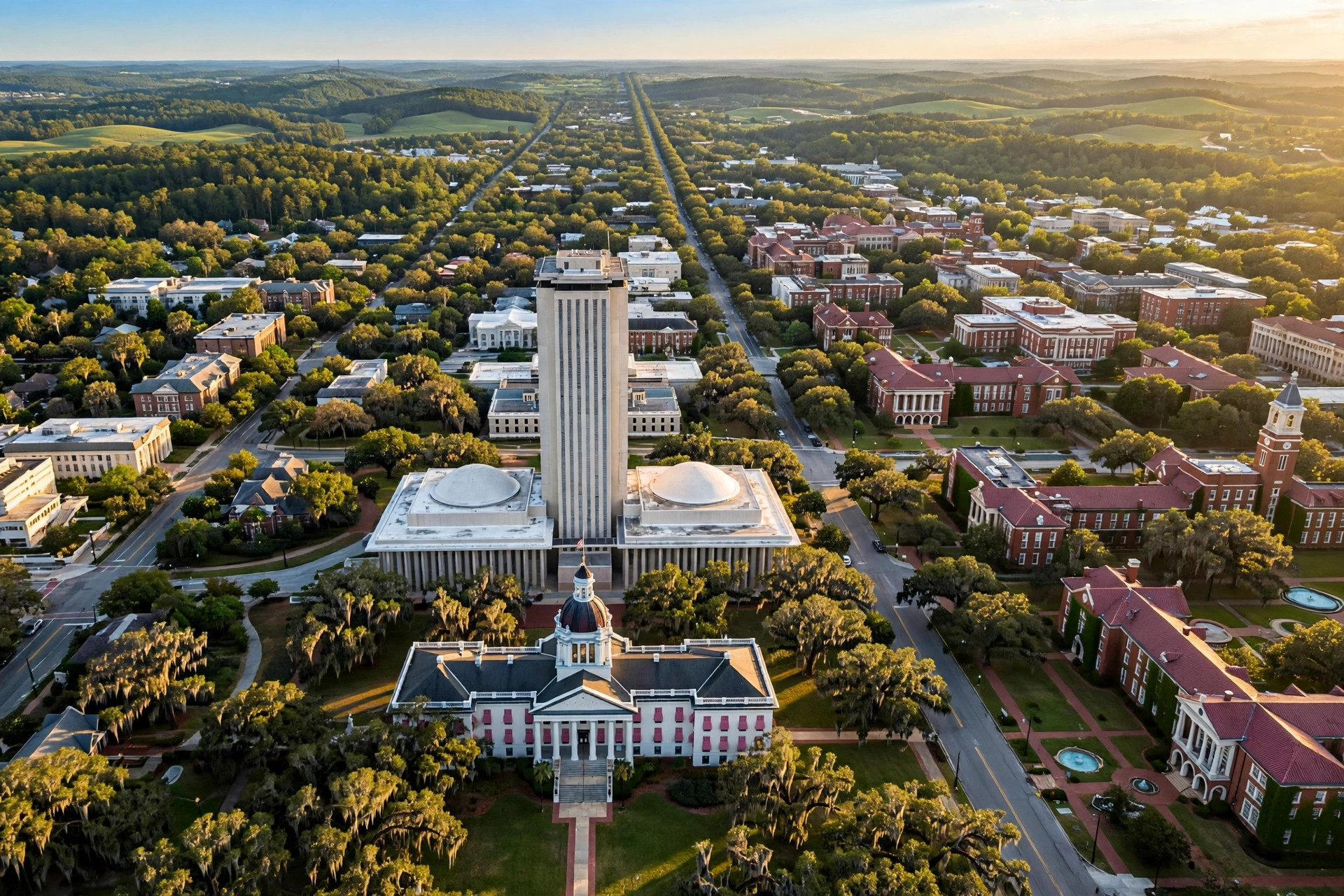
Key Takeaways
- Tallahassee is the 9th-largest city in Florida at 204,902 people on July 1, 2025, per the Census Bureau's Vintage 2025 estimates — up 4.4 percent since the 2020 Census count of 196,169, after growing 8.1 percent in the 2010s from 181,376 — and it sits inside the Tallahassee metro of 397,442 people, the 143rd-largest in the country, up 3.42 percent since 2020. Median household income is $57,409, with a poverty rate of 23.6 percent and 51.3 percent of adults holding a bachelor's degree. Tallahassee is a renter-majority city — 40.6 percent of homes are owner-occupied — with a median home value of $294,400. The city covers 100.93 square miles of land, so its density is 1,944 people per square mile.
- Two anchors define the Tallahassee economy. Government: about 60,000 to 64,000 government jobs in the metro, with state government alone at roughly 46,000 — about one in three local jobs — and business and financial operations jobs at about 11 percent of local employment against under 7 percent nationally. And the universities: Florida State University enrolled 46,184 students in fall 2025, Florida A&M University enrolls nearly 10,000, and Tallahassee State College enrolls more than 16,000 students a year — well over 70,000 students combined, more than one in three people in the city.
- Tallahassee is a city of government vendors, professional-services firms, and the businesses that feed 70,000 students. With 85,311 households, 34.4 percent Black residents and 8.9 percent Hispanic residents, and $4.37 billion in retail sales in 2022, the steady funding demand comes from the contractors, staffing firms, caterers and consultants that live off state contracts, the restaurants and retailers serving the campuses, the health-care vendors around Tallahassee Memorial HealthCare — 772 beds and more than 6,000 staff, the city's largest private employer — and the trades serving a renter-majority housing stock. Health-care receipts were $2.70 billion in 2022, with accommodation and food services at $934.5 million.
- Funding demand here is documented, not guessed. Tallahassee borrowers took 174 SBA 7(a) approvals worth $113.9 million over FY2020–FY2026, with the biggest year by loan count and dollars FY2025 at 45 loans and $30.6 million — more than double any other year's dollars and 26 percent of the seven-year total in a single year. Three Tallahassee borrowers took the $5 million program-maximum loan, and hospitality is the theme: Hospitality Leaders Inc. took three FY2020 loans totaling $9.1 million.
- The cheapest money in Tallahassee is public and specific: Florida's State Small Business Credit Initiative carries a $488.5 million allocation — loan guarantees, loan participation, collateral support and a capital access program run through participating lenders by FloridaCommerce — and the Florida SBDC at Florida A&M University offers no-cost one-on-one advising across eight North Florida counties. Florida's Job Growth Grant Fund holds a $40 million pool for FY2026-27 for infrastructure and workforce training. Florida's minimum wage is $15.00 an hour as of September 30, 2026 — a real cost fact, not a funding program — and the state levies no personal income tax.
Why Tallahassee borrows differently
Tallahassee is a city that was built to govern and to teach, and that is the first thing to understand about its funding market. The territorial Legislature chose the site in 1824 as the midway point between St. Augustine and Pensacola, the two old capitals — a 400-mile wilderness separated them, and the delegates who had traveled 59 days by water to Pensacola and 28 days around the peninsula to St. Augustine wanted a central meeting place. The governor proclaimed Tallahassee the capital on March 4, 1824, the territorial council met there for the first time that November, and the city was established in 1825. The Greek Revival capitol opened in 1845, the year Florida became a state, and it still stands as the Old Capitol in front of the 22-story capitol completed in 1977. Hernando de Soto's expedition had wintered on the same ground in 1539–40, in the Apalachee town of Anhaica, and Mission San Luis de Apalachee was Florida's western capital in the 17th century. Funders read that as a market of dense, educated, working demand — median household income $57,409, poverty 23.6 percent, 51.3 percent of adults with a bachelor's degree, 34.4 percent Black, 8.9 percent Hispanic — plus a deep base of government employees, university staff, and the businesses that serve them, inside a metro of 397,442 people.
The economy runs on three anchors. The first is state government, and it is the biggest story in the city. Government employs about 60,000 to 64,000 people in the metro, rising during the academic year and dipping in summer, with state government alone at roughly 46,000 — about one in three local jobs. The metro labor force is about 206,000, with about 196,000 employed residents. The concentration shows up in the occupational data: business and financial operations jobs — the analysts, budget officers, auditors and compliance staff who run government — account for about 11 percent of local employment, compared with under 7 percent nationally. Florida State University reported 16,069 employees in 2024 — 7,414 regular-salaried full-time, 103 regular part-time, and 8,552 OPS — and that breakdown explains why published employer lists disagree by a factor of two. The frame that matters is not the headcount but who writes the check: most large Leon County employers are funded by appropriation rather than by customers, which makes this economy remarkably insulated from recessions and unusually exposed to the political cycle. A funder that knows Tallahassee will ask about your contract base, not your foot traffic — and a file that shows state contracts, agency payment history, and a plan for the summer dip prices better than a file that shows only the good quarter.
The second anchor is the universities, and they are the city's seasonality. Florida State University enrolled 46,184 students in fall 2025 — 71.6 percent undergraduates, 23.9 percent graduate students — on a main campus of 487.6 acres, and traces its founding to 1851, the oldest continuous site of higher education in Florida. Florida A&M University, founded October 3, 1887, is a public, historically Black, 1890 land-grant university enrolling nearly 10,000 students from across the United States and more than 70 countries, with $112.4 million in research awards and $72.6 million in R&D spending in fiscal 2023-24 as it pursues Carnegie R1 status — aiming to be the first historically Black university with that designation. Tallahassee State College, renamed from Tallahassee Community College in July 2024, enrolls more than 16,000 credit and noncredit students a year and is the leading transfer institution to both FSU and FAMU. Together the three institutions report well over 70,000 students — more than one in three people in the city. The National High Magnetic Field Laboratory, headquartered at FSU, is Florida's only national laboratory and operates the world's most powerful magnets, and FSU reported about $485 million in research expenditures in fiscal 2025. Restaurants close, bars sit empty, and the energy evaporates once about 40,000 students leave for the summer — and that is the single most important underwriting fact for a Tallahassee borrower. A restaurant or retailer that shows only the fall semester is showing the funder a fiction; show the twelve-month pattern, the summer trough, and the plan for it.
The third anchor is health care, and it is the largest private employer base in the city. Tallahassee Memorial HealthCare is a 772-bed nonprofit with more than 6,000 staff — the city's largest private employer — and health care is the biggest private-sector employer in Tallahassee, serving a referral region that extends across the Big Bend and into South Georgia. Health care and social assistance receipts in the city were $2.70 billion in 2022. HCA Florida Capital Hospital is the other acute-care anchor. The vendors, home-health agencies, medical suppliers, cleaners and food-service contractors that serve these hospitals are steady borrowers — their revenue does not depend on a single semester, and funders price that stability. The genuinely market-funded base beyond government, universities and health care is small — Danfoss Turbocor, Trulieve, Capital City Bank Group, Mainline, St. Marks Powder, Georgia Pacific and a handful of others carry it — and a manufacturer or traded-sector borrower in Tallahassee is rare enough that its file stands out. Say so; it is a strength, not a weakness.
One thing to get straight before you borrow on a Tallahassee address: this is a capital city inside a small metro, and funders know both halves of that sentence. A government vendor's revenue rides the state budget cycle and the annual legislative session, when hotels, restaurants and short-term rentals fill and the businesses serving them borrow ahead of it. A campus restaurant's revenue rides the academic calendar. A contractor's revenue rides the build-out across 85,311 households. A file that shows the twelve-month pattern — the session spike, the summer trough, the fall return — prices better than a file that shows only the good quarter. And one caution on the numbers themselves: Tallahassee's only verified unemployment figure is the metro rate — 4.5 percent for the Tallahassee metro in September 2026, not seasonally adjusted, down from 4.9 percent in August and up from 4.2 percent a year earlier, against 4.4 percent for Florida and 4.0 percent for the nation. Among the 116 metro areas with more than 250,000 people in the labor force, Tallahassee had the 29th-highest rate that month. Do not let anyone quote you a Tallahassee city unemployment rate; none has been published. Likewise, the Census Bureau publishes no city-level count of Tallahassee businesses at all — its QuickFacts page lists employer establishments as not applicable for the city — so anyone quoting a Tallahassee business count is quoting the metro or the county. And the airport tells the same small-metro story from the other side: Tallahassee International Airport handled 901,353 passengers in 2025, down 6.9 percent from 2024 — still the second-highest annual total since 2007, but a spoke, not a hub, served by three airlines to seven destinations. Do not let anyone sell you Tallahassee as a logistics or tourism town; it is a capital and a college town, and a funder who knows the difference will underwrite the business, not the headline.
The Tallahassee funding map: which product fits which business
Funding is not one product. The right one depends on what the money is for, how fast it comes back, and what your revenue looks like month to month. Here is the map for Tallahassee:
Merchant cash advance — for card-heavy businesses with a short-term gap. Restaurants and bars near the campuses and downtown, retailers serving the student and government workforce, and food-service firms with steady card sales borrow against future receipts and repay daily or weekly as a share of sales. A $50,000 advance at an illustrative 1.20 factor rate repays $60,000 in total — $10,000 of cost — or about $2,308 a week over 26 weeks. The advance is fast, usually funded in 24 to 72 hours, and it fits a payroll gap or an inventory buy that pays back in a season. It is the most expensive money on this map, and it is the right call only when the money comes back within months — and in Tallahassee, that means within the semester, not across the summer trough. Read what actually happens if you default on an advance before you sign one, and read whether a merchant cash advance is legal for the state-by-state picture.
Term loan — for a known cost with a fixed payoff date. A second food truck for a campus route, a build-out in a new ground-floor space downtown, a hire that pays for itself over a year, a down payment on a small warehouse or office off Capital Circle. Fixed daily, weekly, or monthly payments over months to years, priced on a rate or a factor depending on the lender. If the spend has a clear return date, match the term to it — borrowing for 12 months to pay for something that returns in three is overpaying for speed you do not need.
Business line of credit — for the seasonal business. A government vendor between a state agency's Net 45 payment and its own Friday payroll, a campus restaurant stocking up before the fall return, a caterer waiting on a session invoice, or a retailer bridging the summer trough draws only what it needs and pays interest only on what it draws. The line is the right tool when the gap is timing — a contract 60 days out, a semester that pays in December — rather than a single purchase. Draws after approval are usually same-day. In a city where 70,000 students leave every summer, the line of credit is the product that fits the calendar best.
Equipment financing — for the thing itself. A kitchen line and POS system for a restaurant, a van fleet for a home-health agency, HVAC and diagnostic gear for a contractor, a commercial printer for a print shop serving state agencies, cold storage for a food distributor. The equipment secures the loan, so the pricing is usually the cheapest money on this map for an asset purchase, and the term can run two to five years. If the money buys a thing, price the equipment product first. And if you already own the equipment outright, you can borrow against it instead — an equipment refinance or sale-leaseback turns a paid-off kitchen or van fleet into working capital without taking it out of service.
Purchase-order and invoice financing — for the contract economy. A staffing firm with a signed order from a state agency, an IT contractor with a signed order from a university, a supplier waiting on Net 45 payment from a large buyer, or a caterer with a signed session contract can borrow against the order or the receivable instead of against future card sales. The advance is sized on the contract, not on last month's deposits, which is exactly the profile a contract business needs. Tallahassee has more of these businesses per capita than almost any Florida city — ask about it before you take a general-purpose advance.
SBA and guaranteed loans — for the cheapest money, if you can wait. SBA 7(a) loans run up to $5 million through SBA lenders, and SBA 504 loans run up to $5 million for owner-occupied real estate and long-life equipment. SBA microloans run up to $50,000. The underwriting is real and the clock runs in weeks, sometimes six to eight, but the rate is the lowest on this map — and Tallahassee businesses have actually used them: 174 SBA 7(a) approvals worth $113.9 million over FY2020–FY2026, with the biggest year by loan count and dollars FY2025 at 45 loans and $30.6 million. For the full comparison method, see which funding product fits which business.
Grants and loan programs: what actually exists in Tallahassee
Before you borrow, check the money that does not need repaying — and be honest about what is open right now. The public money that actually exists for Tallahassee businesses is state and regional, not a general city cash grant. The Florida SBDC at Florida A&M University provides confidential, no-cost one-on-one business consulting and training to entrepreneurs and business owners across Leon, Gadsden, Jefferson, Franklin, Liberty, Madison, Taylor, and Wakulla counties — business planning, access to capital, financial analysis, marketing, government contracting, disaster recovery — from its office at 625 East Tennessee Street, and it hosted the 43rd Annual Big Bend Regional Small Business Week in May 2026. It does not lend money or administer grants, and that is the point: start there before you apply anywhere else, because it costs nothing and it is the fastest way to a fundable file. The Jim Moran Institute for Global Entrepreneurship, housed at FSU, offers no-cost executive education for small business owners and nonprofit leaders. And if your business is in Jacksonville or Orlando, the same kind of state programs apply on the other side of the state — the difference is the local channel, not the idea: free advising first, then the money.
The state channel is Florida's State Small Business Credit Initiative (SSBCI), a $488.5 million federal allocation approved by the U.S. Treasury in September 2022 — the third-largest state allocation in the country, behind California and New York — run by FloridaCommerce with the Florida Opportunity Fund and Florida First Capital Finance Corporation. The first tranche of $142 million arrived in January 2023 and the second of $167 million in January 2025; as of June 30, 2026, Treasury had disbursed $463.6 million and the state had deployed $346.3 million, and by May 2026 the program had provided more than $250 million in approved loans and investments to 220 small businesses. The five sub-programs are a Capital Access Program, a Collateral Support Program, a Loan Guarantee Program, a Loan Participation Program, and a venture-capital program. These are credit supports, not grants, and you apply through a participating lender, not directly to the state. One published example of what that looks like at street level: Ascendus, a nonprofit CDFI, offers a Florida SSBCI loan product of $5,000 to $100,000 at 8.99 percent interest with terms up to 60 months for established Florida businesses operating at least one year — cite that as one lender's published terms, not as the program's rate.
The grant channel is the Job Growth Grant Fund, which holds a $40 million pool for FY2026-27, with $20 million held in reserve until January 2027, for public infrastructure and workforce training grants approved by the Governor. It funds infrastructure and training, not a business's working capital — a warehouse or manufacturer adding a line should know it exists; a business that needs payroll next Friday should not plan on it.
One honest note about Tallahassee specifically: the expensive part of doing business here is labor, not demand. Florida's statewide minimum wage is $15.00 an hour as of September 30, 2026 — the final step of the Amendment 2 schedule voters approved in 2020, with tipped employees at $11.98 — and it stays at $15.00 through December 31, 2027, with inflation adjustments starting January 1, 2028. A restaurant or retailer prices payroll first — a crew of twenty at $15.00 is a real monthly number before a single table turns. On the other side of the ledger, Florida levies no state personal income tax, so there is no state withholding to open and no state return to file, and the state's former 2 percent sales tax on commercial property leases was repealed effective October 1, 2025 — a real cost reduction for a business renting office, retail or warehouse space. Neither is a funding program, and neither should be sold as one, but all three belong in the file a funder reads: a borrower who has priced labor, the lease, and the tax picture is a borrower who has done the math.
What to watch before you sign
There is no substitute for the total repayment in dollars, in writing, before you sign. Compare offers on that number, not on the headline rate or the monthly payment. If a funder will not put the total in writing, that is your answer about the funder.
The second thing to watch is the repayment rhythm — and in Tallahassee the rhythm is the academic calendar. Daily debits against a campus restaurant's account in June, when the students are gone and the register is quiet, or against a caterer's account between the legislative session and the next contract, can drain the account before the next settlement or the next payroll lands. If your revenue swings with the semester or the session, ask for weekly payments instead of daily, and ask what happens if a debit fails. A funder that answers clearly is a funder that has done this before.
The third is concentration. Tallahassee's economy is anchored — one state government, two big universities, one hospital system — and your business may be far more concentrated than the city is. A staffing firm with one agency at 60 percent of revenue, a caterer living off one university contract, or a supplier depending on one big buyer is a different file from ten customers at 6 percent each. Bring the contract, the payment history, and the plan for a second customer. A file that explains the concentration prices better than a file that leaves the funder to discover it.
The fourth is stacking. A second advance taken to cover the first one's payments is how a manageable file becomes a default. If you already hold an advance, read how to refinance one before you stack another, and read how the early-payoff discount works if you are weighing paying one off early.
Frequently asked questions
How fast can a Tallahassee business get funded? A merchant cash advance typically funds in 24 to 72 hours after approval with three months of bank statements. Term loans run a similar clock, lines of credit decide in minutes to a day, equipment financing takes days to a couple of weeks, and SBA loans take weeks. The public programs run slower, because they move through review rounds and partner referrals — and Florida's SSBCI programs run through lenders, so do not plan a closing date around them.
What do I need to apply? Three months of business bank statements are the core document. A photo ID and a voided check are usually optional verification, not requirements — but having them ready removes stalls. Government vendors should also bring the agency contracts and the aging receivables; campus restaurants should bring the card-sales history and the twelve-month pattern showing the summer trough; hotels and hospitality firms should bring the occupancy history and the renovation quotes; staffing firms should bring the signed orders and the client payment history.
Does the government base or the universities help my approval chances? It helps, if the file shows it. Funders underwrite your business, not the headline. A vendor or a contractor with twelve months of deposits showing steady work from a 204,902-person city plus $4.37 billion in annual retail sales prices far better than a file that leaves the funder to guess — but government and university revenue is contract revenue, so show the contracts, the payment history, and the twelve-month pattern, not just the customer names, and name the concentration honestly.
Can a restaurant, retailer, hotel, or contractor get funded in Tallahassee? Yes — restaurants, retailers, hotels, and trades are among the most common Tallahassee profiles, because the campuses, the capitol, and the 85,311 households keep them busy most of the year. An advance fits a short-term payroll or inventory gap; a line of credit fits the summer trough; equipment financing is usually the cheapest route for a kitchen, a van, or a diagnostic tool; and an SBA loan can fill a gap a bank will not cover on its own.
What if my revenue depends on one big customer? Say so up front, and show the concentration honestly. Funders price concentration risk — one customer at 60 percent of revenue is a different file from ten customers at 6 percent each — but a signed multi-year contract with a creditworthy buyer is also a strength. Bring the contract, the payment history, and the plan for a second customer. A file that explains the concentration prices better than a file that leaves the funder to discover it.
Ready to fund your Tallahassee business?
One application, competing offers, total cost in writing. Bank statements are the main document — gather three months before you start, and bring the full twelve months if your revenue follows the academic calendar, or the agency contracts and receivables if you are a government vendor, a staffing firm, or a supplier.
Apply Now or call (352) 809-3201
Ready to Get Funded?
Apply now and get a funding decision within hours. No hard credit pull for pre-approval — see your options risk-free.