Fast Business Funding in Chesapeake, VA: 255,332 People, Dollar Tree's HQ & the $681M LS GreenLink Plant (2026)
Chesapeake held 255,332 people on July 1, 2025 — Virginia's 2nd-largest city — with a median household income of $95,373 and 5,867 employer establishments. Dollar Tree is headquartered here, Amazon grew its Chesapeake workforce 79 percent in two years, LS GreenLink is building a $681 million cable plant on the Elizabeth River, and Chesapeake borrowers took 207 SBA 7(a) approvals worth $103.2 million over FY2020–FY2026. Here is how business funding actually works in the Chesapeake market: the product map by business type, real timelines, the public programs that exist, and how to compare offers.
Need funding fast? Apply in about 2 minutes — get a decision within hours, with no hard credit pull for pre-approval.
Apply Now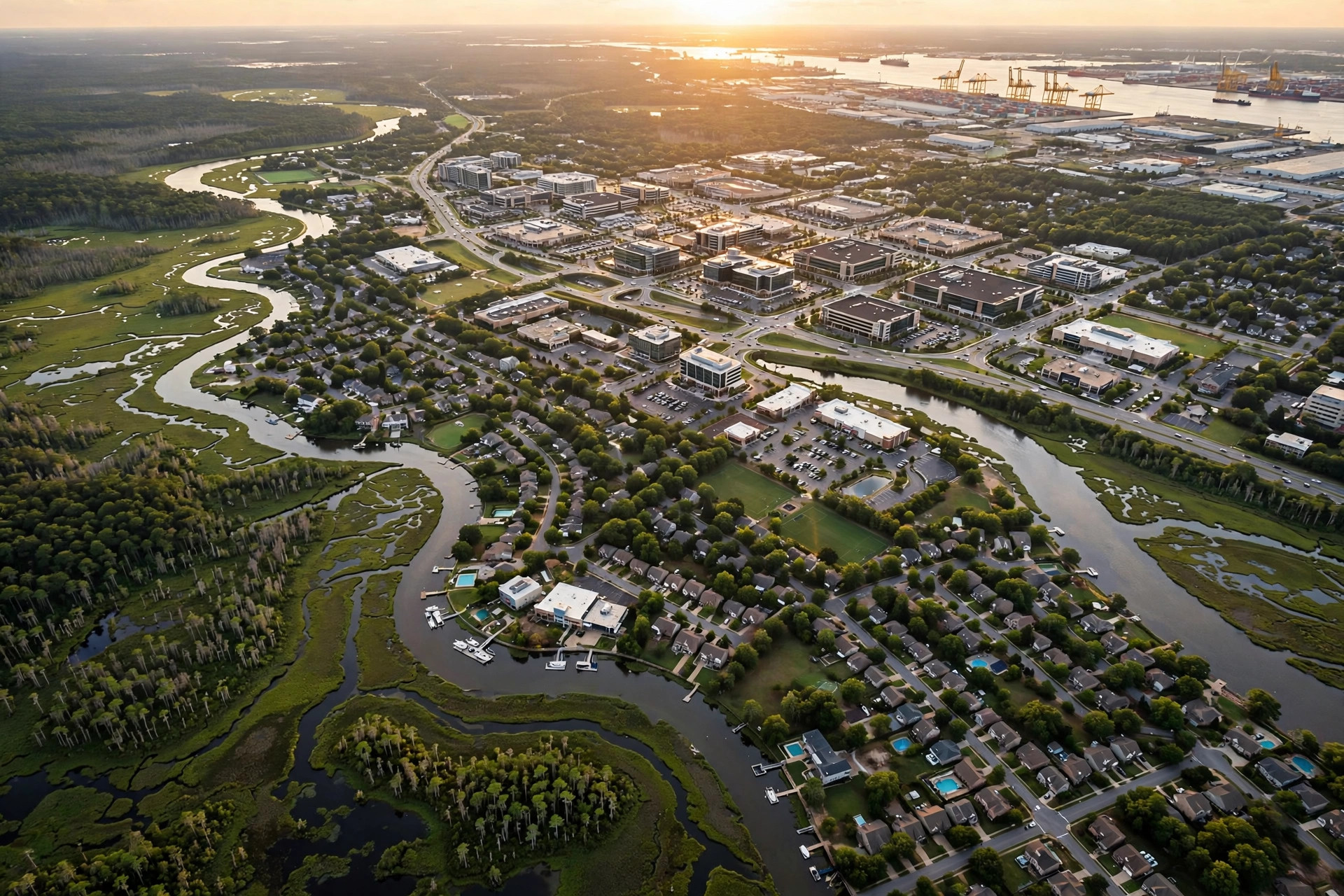
Key Takeaways
- Chesapeake is Virginia's 2nd-largest city at 255,332 people on July 1, 2025, per the Census Bureau's Vintage 2025 estimates, up 2.4 percent from the 2020 Census count of 249,422 — and the Virginia Beach–Chesapeake–Norfolk metro holds 1,797,213 people, the 37th-largest in the country. Median household income is $95,373, well above the state level, with a poverty rate of 9.4 percent and 36.9 percent of adults holding a bachelor's degree. Chesapeake is also Virginia's most spread-out major city — 338 square miles of land, so its density is only 737 people per square mile.
- Headquarters and logistics anchor the employer base. Chesapeake City Public Schools employs 6,977 people and the City of Chesapeake another 4,012, while Dollar Tree — headquartered at 500 Volvo Parkway — employs 1,826 and Amazon 1,624, up from 908 two years earlier. The underlying figures are the city's FY2025 financial report as transcribed in secondary form; the FY2023 report, read directly, confirms the same top ten with Schools at 6,577 and Dollar Tree at 1,984.
- The growth story is industrial and maritime. LS GreenLink broke ground in April 2025 on a $681 million, 750,000-square-foot submarine-cable plant on the Elizabeth River, creating 330-plus jobs, with Phase 1 targeted for the third quarter of 2027. Defense Maritime Solutions, headquartered in Chesapeake, announced a $30 million-plus expansion in August 2026, and the Port of Virginia processed 3.4 million TEUs in fiscal 2025 while the $35 million Greenbrier Commerce Center adds speculative warehouse space in the city itself.
- Funding demand here is documented, not guessed. Chesapeake borrowers took 207 SBA 7(a) approvals worth $103.2 million over FY2020–FY2026, with the biggest year FY2025 at 47 loans and $20.3 million. The largest single approval was a $5 million loan to Primrose School at Edinburgh Commons in FY2020, at the program maximum. The city's 5,867 employer establishments paid $5.55 billion in annual payroll in 2023, with retail sales of $5.05 billion in 2022.
- The cheapest money in Chesapeake is public and specific: the Virginia Small Business Financing Authority's Microloan Program lends up to $150,000 direct to the business, at 6 percent fixed per its 2025 application form (3 percent for veterans), for borrowers with a 650 credit score or higher; the Expand 757 program offers zero-interest, no-fee loans of $10,000 to $50,000 for established Hampton Roads businesses with coaching; and the Hampton Roads Small Business Development Center offers free one-on-one advising. The City itself runs a performance-based incentive program, not a direct small-business loan program — do not plan around the City as a lender.
Why Chesapeake borrows differently
Chesapeake is a city built by merger, and that is the first thing to understand about its funding market. It was formed in 1963 by consolidating the city of South Norfolk with the remnants of Norfolk County, and it still shows it: six boroughs — South Norfolk, Butts Road, Deep Creek, Pleasant Grove, Western Branch, and Washington — spread across 338 square miles, much of it suburban or rural, including a substantial portion of the Great Dismal Swamp National Wildlife Refuge. It is Virginia's second-largest city by population at 255,332 people on July 1, 2025, up 2.4 percent since the 2020 Census and 12.2 percent in the 2010s — but with a density of only 737 people per square mile, against Virginia Beach's far denser footprint and Norfolk's 53 square miles. There is no single dense downtown to anchor the funding story; there is the Greenbrier central business district, the Summit Pointe mixed-use development, and miles of waterfront industrial property on the Elizabeth River and the Atlantic Intracoastal Waterway. Funders read that as a market of affluent suburban households — median household income $95,373, poverty 9.4 percent, 74.4 percent owner-occupied homes, median home value $378,400 — plus a deep base of retail, logistics, trades, food-service, and defense-support small businesses.
The economy runs on four anchors. The first is headquarters: Dollar Tree, headquartered at 500 Volvo Parkway, operates more than 9,000 stores and 18 distribution centers with 153,000-plus associates company-wide and $19.4 billion in revenue in the fiscal year ended January 31, 2026. It completed the sale of its Family Dollar segment on July 7, 2025, for a $1,007.5 million base price, and is now a standalone Dollar Tree business headquartered in Chesapeake. The second is logistics and the port: Amazon's Chesapeake workforce grew from 908 to 1,624 in two years, the Port of Virginia processed 3.4 million TEUs in fiscal 2025 with 1,700 vessel calls, and five railroads pass through the city. The third is defense and maritime services: Chesapeake hosts two Navy bases — Naval Support Activity Hampton Roads–Northwest Annex and NALF Fentress — plus Oceaneering's Marine Services Division, which has operated in the city for more than 30 years, and General Dynamics, with 541 Chesapeake employees in the FY2023 report. The fourth is health care: Chesapeake Regional Medical Center, the city's third-largest employer at 2,058 people, is the only independent, community-based hospital in Hampton Roads and completed a $155 million expansion in 2025. The 2022 Economic Census put Chesapeake's retail sales at $5.05 billion, health-care receipts at $1.56 billion, accommodation and food services at $789 million, and transportation and warehousing receipts at $799 million.
The third Chesapeake is the one arriving now, and it is industrial. LS GreenLink, the U.S. subsidiary of South Korea's LS Cable & System, broke ground on April 28, 2025, on a $681 million, 750,000-square-foot high-voltage direct-current submarine cable plant at the Deep Water Terminal Site on the Elizabeth River — the first U.S. offshore-wind cable plant — with 330-plus jobs, a 660-foot tower, and its own pier, backed by a $99 million federal advanced-energy tax credit and a $13.2 million Commonwealth's Opportunity Fund grant. Phase 1 is targeted for completion in the third quarter of 2027 and full operation in the first quarter of 2028. Next to it, Defense Maritime Solutions — a naval propulsion manufacturer headquartered in Chesapeake since 1979 — announced on August 14, 2026, that it will invest more than $30 million to expand its Chesapeake manufacturing operations, creating 32 jobs. And in Greenbrier, the $35 million speculative Greenbrier Commerce Center completed its first 90,720-square-foot building in August 2025, with a second 98,280-square-foot building expected in early 2026. Every contractor, supplier, machine shop, staffing firm, and trucking company feeding those projects is a file a funder wants to see.
One thing to get straight before you borrow on a Chesapeake address: this is a headquarters-concentrated market, and funders know it. The top ten employers' headcounts sum to 21,596, and the public schools and the city government alone account for 10,989 of them — but the private anchor is one company, Dollar Tree, whose headcount moved from 1,984 to 1,826 between the FY2023 and FY2025 reports. A supplier whose revenue depends on one headquarters, one port tenant, or one defense contractor is a different file from ten customers at 6 percent each. Bring the contract, the payment history, and the plan for a second customer. A file that explains the concentration prices better than a file that leaves the funder to discover it. And one caution on the numbers themselves: the FY2025 employer figures in this post come from the city's FY2025 financial report as transcribed in secondary form — the city's own site was unreachable when they were gathered — so treat them as the best available, not as figures read from the primary PDF. The FY2023 figures, read directly from the report, are the anchor: Schools 6,577, City 3,944, Dollar Tree 1,984, Chesapeake Regional 1,980, and a total city employment of 125,788. Similarly, do not read the Sentara figure's move from 1,771 to 911 as a layoff — the two figures label different units, and the cause was not verified. The honest caution on timing: Chesapeake's only verified unemployment figure is the 2025 annual average of 3.3 percent — the September 2026 rate of 3.7 percent is a monthly snapshot, not an annual average. Do not let anyone quote you a Chesapeake annual rate for 2026; none has been published.
The Chesapeake funding map: which product fits which business
Funding is not one product. The right one depends on what the money is for, how fast it comes back, and what your revenue looks like month to month. Here is the map for Chesapeake:
Merchant cash advance — for card-heavy businesses with a short-term gap. Restaurants and bars in Greenbrier and Summit Pointe, retailers, and hospitality firms with steady card sales borrow against future receipts and repay daily or weekly as a share of sales. A $50,000 advance at an illustrative 1.20 factor rate repays $60,000 in total — $10,000 of cost — or about $2,308 a week over 26 weeks. The advance is fast, usually funded in 24 to 72 hours, and it fits a payroll gap or an inventory buy that pays back in a season. It is the most expensive money on this map, and it is the right call only when the money comes back within months. Read what actually happens if you default on an advance before you sign one, and read whether a merchant cash advance is legal for the state-by-state picture.
Term loan — for a known cost with a fixed payoff date. A restaurant build-out in a new ground-floor space at Summit Pointe, a second delivery van, a fit-out for a supplier's office in Greenbrier, a hire that pays for itself over a year. Fixed daily, weekly, or monthly payments over months to years, priced on a rate or a factor depending on the lender. If the spend has a clear return date, match the term to it — borrowing for 12 months to pay for something that returns in three is overpaying for speed you do not need.
Business line of credit — for the seasonal business. A contractor between draws on a build-out at the cable plant or the Commerce Center, a retailer stocking up before the holidays or a big summer weekend on the water, a restaurant between seasons, or a supplier waiting on a Net 45 invoice draws only what it needs and pays interest only on what it draws. The line is the right tool when the gap is timing — a contract 60 days out, a season that pays in December — rather than a single purchase. Draws after approval are usually same-day.
Equipment financing — for the thing itself. A commercial kitchen, a delivery fleet, a CNC machine for a precision shop serving the port and the ship-repair yards, medical equipment for a clinic. The equipment secures the loan, so the pricing is usually the cheapest money on this map for an asset purchase, and the term can run two to five years. If the money buys a thing, price the equipment product first. And if you already own the equipment outright, you can borrow against it instead — an equipment refinance or sale-leaseback turns a paid-off machine into working capital without taking it out of service.
Purchase-order and invoice financing — for the contract economy. A supplier with a signed purchase order from a defense contractor, a port tenant, or a health system, a staffing firm waiting on Net 45 payment, or a vendor with outstanding invoices can borrow against the order or the receivable instead of against future card sales. The advance is sized on the contract, not on last month's deposits, which is exactly the profile a contract business needs. Ask about it before you take a general-purpose advance.
SBA and guaranteed loans — for the cheapest money, if you can wait. SBA 7(a) loans run up to $5 million through SBA lenders, and SBA 504 loans run up to $5 million for owner-occupied real estate and long-life equipment. SBA microloans run up to $50,000. The underwriting is real and the clock runs in weeks, sometimes six to eight, but the rate is the lowest on this map — and Chesapeake businesses have actually used them: 207 SBA 7(a) approvals worth $103.2 million over FY2020–FY2026, with the biggest year FY2025 at 47 loans and $20.3 million. For the full comparison method, see which funding product fits which business.
Grants and loan programs: what actually exists in Chesapeake
Before you borrow, check the money that does not need repaying — and be honest about what is open right now. The public money that actually exists for Chesapeake businesses is state and regional, not a general city cash grant. The Hampton Roads Small Business Development Center offers free one-on-one advising, including business-plan help and loan-package assembly — start there before you apply anywhere else, because it costs nothing and it is the fastest way to a fundable file. And if your business is in Norfolk, just across the Elizabeth River, the same state programs apply — the difference is the local channel, not the state one.
The state channel is the Virginia Small Business Financing Authority. Its Microloan Program lends up to $150,000 direct to the business, with repayment terms of five years unsecured to seven years secured, at 6 percent fixed per the 2025 application form — 3 percent for veterans — for businesses operating in Virginia, in good standing with the State Corporation Commission, with a credit score of 650 or higher and meeting at least one size test. There is a $150 non-refundable application fee, and construction, non-owner-occupied real estate, and debt refinancing are ineligible uses. The Authority's Classic Loan Guaranty and Cash Collateral programs back bank loans instead, and its Capital Connect companion loans run up to $1 million or 40 percent of project cost, whichever is less. These work through lenders; they are not grants.
The regional channel is Expand 757, a LISC Hampton Roads program offering zero-interest, no-fee loans of $10,000 to $50,000 for established businesses across Hampton Roads, paired with coaching from the Hampton Roads SBDC — verify the current terms with the program before quoting them, because the published details come from a 2026 secondary guide. The City's own Economic Development Investment Program is performance-based, tying grants to capital investment and job creation, and the City's business resource directory lists 504 Capital Corporation, a Chesapeake-based SBA 504 lender for real estate and long-life equipment. The state's Virginia Jobs Investment Program and Virginia Investment Performance Grant supported Chesapeake projects directly — a $300,000 grant backed the Defense Maritime Solutions expansion, and a $13.2 million Commonwealth's Opportunity Fund grant backed LS GreenLink — but those are negotiated per project, not fixed percentages you can quote.
One honest note about grants: grants are slow and competitive, and none of them cover payroll next Friday. Use them for the project they fit, and borrow for the gap they leave — not the other way around. And one honest note about Chesapeake specifically: no city-run direct small-business loan program with published volume was verified — do not plan around the City as a direct lender. The free counseling at the Hampton Roads SBDC, the state microloan and guaranty programs, and the regional Expand 757 loans are the real local channels.
What to watch before you sign
There is no substitute for the total repayment in dollars, in writing, before you sign. Compare offers on that number, not on the headline rate or the monthly payment. If a funder will not put the total in writing, that is your answer about the funder.
The second thing to watch is the repayment rhythm. Daily debits against a restaurant's account in the slow weeks between summer weekends, or against a contractor's account between draws on a build-out at the cable plant, can drain the account before the next weekend or draw lands. If your revenue swings with the seasons or a construction schedule, ask for weekly payments instead of daily, and ask what happens if a debit fails. A funder that answers clearly is a funder that has done this before.
The third is concentration. Chesapeake's economy is anchored — the schools and the city government hold 10,989 jobs, and the private anchor is one headquarters company. Your business may be far more concentrated than the city is. A supplier with one headquarters customer at 60 percent of revenue, or a distributor living off one port tenant, is a different file from ten customers at 6 percent each. Bring the contract, the payment history, and the plan for a second customer. A file that explains the concentration prices better than a file that leaves the funder to discover it.
The fourth is stacking. A second advance taken to cover the first one's payments is how a manageable file becomes a default. If you already hold an advance, read how to refinance one before you stack another, and read how the early-payoff discount works if you are weighing paying one off early.
Frequently asked questions
How fast can a Chesapeake business get funded? A merchant cash advance typically funds in 24 to 72 hours after approval with three months of bank statements. Term loans run a similar clock, lines of credit decide in minutes to a day, equipment financing takes days to a couple of weeks, and SBA loans take weeks. The public programs run slower, because they move through review rounds and partner referrals.
What do I need to apply? Three months of business bank statements are the core document. A photo ID and a voided check are usually optional verification, not requirements — but having them ready removes stalls. Suppliers serving the defense contractors, the port tenants, or the health system should also bring the purchase orders and contracts; restaurants should bring the seasonal sales pattern, including summer-weekend spikes; contractors should bring the draw schedule.
Does the headquarters and port economy help or hurt my approval chances? It helps, if the file shows it. Funders underwrite your business, not the headline. A supplier or a restaurant with twelve months of deposits showing steady traffic from a 255,332-person city plus $5.05 billion in annual retail sales prices far better than a file that leaves the funder to guess — but headquarters and port revenue is contract revenue, so show the contracts and the payment history, not just the customer names, and name the concentration honestly.
Can a restaurant, retailer, or supplier get funded in Chesapeake? Yes — restaurants, retailers, and supply-chain suppliers are among the most common Chesapeake profiles, because the headquarters, the port, the Navy bases, and the hospitals keep them busy most of the year. An advance fits a short-term payroll or inventory gap; a line of credit fits the seasonal business; equipment financing is usually the cheapest route for a kitchen or a machine; and an SBA loan can fill a gap a bank will not cover on its own.
What if my revenue depends on one big customer? Say so up front, and show the concentration honestly. Funders price concentration risk — one customer at 60 percent of revenue is a different file from ten customers at 6 percent each — but a signed multi-year contract with a creditworthy buyer is also a strength. Bring the contract, the payment history, and the plan for a second customer. A file that explains the concentration prices better than a file that leaves the funder to discover it.
Ready to fund your Chesapeake business?
One application, competing offers, total cost in writing. Bank statements are the main document — gather three months before you start, and bring the full twelve months if your revenue is seasonal, or the purchase orders and contracts if you are a supplier or a contractor.
Apply Now or call (352) 809-3201
Ready to Get Funded?
Apply now and get a funding decision within hours. No hard credit pull for pre-approval — see your options risk-free.