Fast Business Funding in Lincoln, NE: 301,522 People, a 352,081 Metro & the $138.9M SBA Record (2026)
Lincoln held 301,522 people on July 1, 2025 — the capital of Nebraska and the second-largest city in the state, spread across 97.69 square miles on the plains of Lancaster County. Its economy runs on the state government and the University of Nebraska–Lincoln, on manufacturing that builds rail cars and Boeing 777X cargo doors, on the world's largest family-owned aircraft maintenance company, and on a homegrown finance and tech cluster. Lincoln borrowers took 369 SBA 7(a) approvals worth $138.9 million over FY2020–FY2026. Here is how business funding actually works in the Lincoln market: the product map by business type, real timelines, the public programs that exist, and how to compare offers.
Need funding fast? Apply in about 2 minutes — get a decision within hours, with no hard credit pull for pre-approval.
Apply Now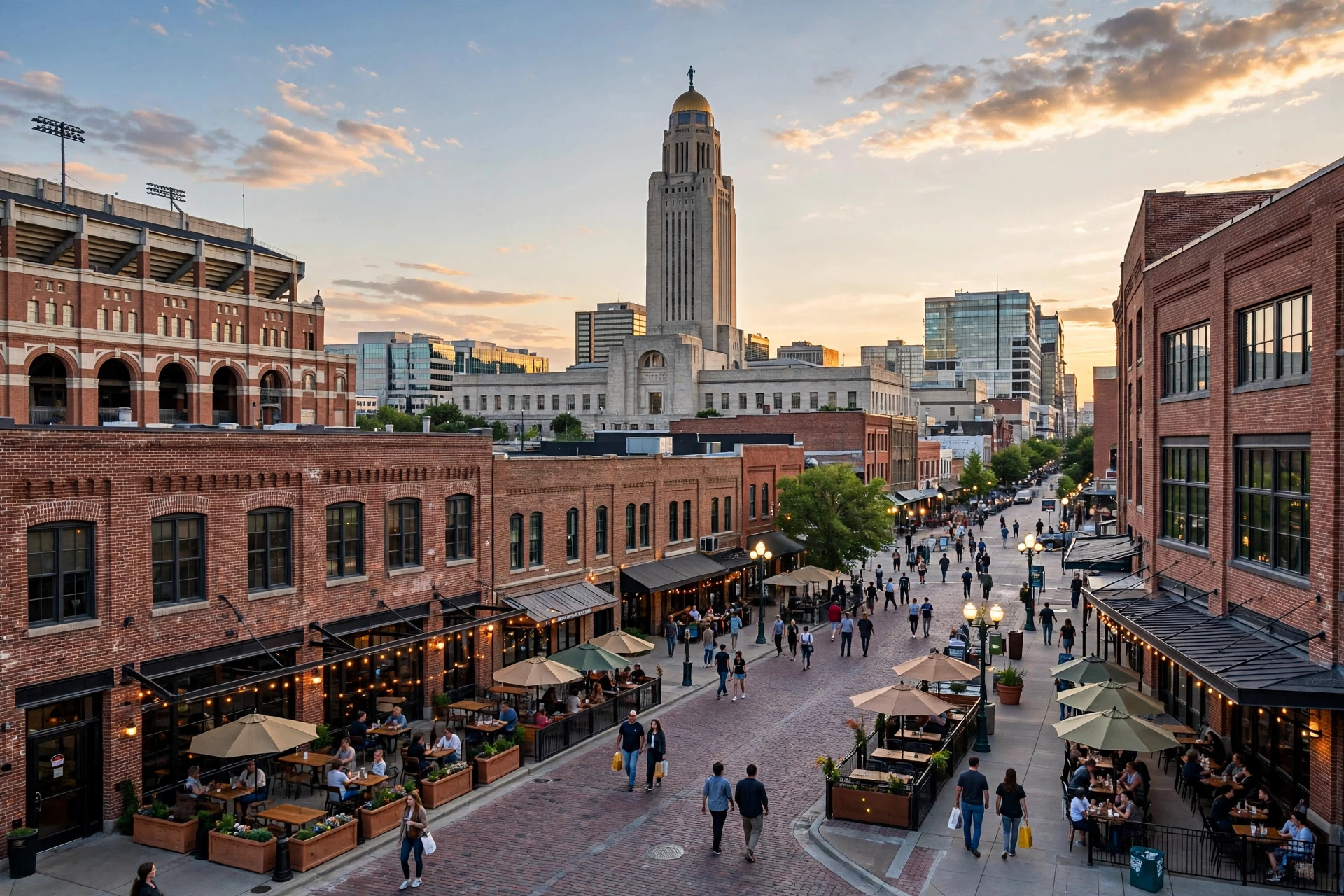
Key Takeaways
- Lincoln is the capital and second-largest city of Nebraska at 301,522 people on July 1, 2025, per the Census Bureau's Vintage 2025 estimates — up 3.5 percent since the 2020 estimates base of 291,351, after growing from 258,379 in the 2010 Census to 291,082 in 2020. It is spread across 97.69 square miles at a density of 2,979.7 people per square mile, and it anchors the Lincoln metro of 352,081 people, the 158th-largest metro in the country. Median household income in the city is $71,867, with a poverty rate of 12.7 percent, 122,623 households, a 56.1 percent owner-occupied rate, a $264,000 median home value, and median rent of $1,086. The city is 41.8 percent college-educated, 9.4 percent foreign-born, and 9.0 percent Hispanic, and 13.2 percent of residents speak a language other than English at home.
- Government and the university are the twin pillars, and they set the weekday rhythm. Government is the metro's largest sector at 42,900 jobs in September 2026, and education and health services is second at 34,600 jobs, up 2.1 percent year over year. The University of Nebraska–Lincoln enrolled 23,954 students in fall 2025 — 19,378 undergraduates and 4,734 first-time freshmen — at a land-grant flagship chartered in 1869 that plays in the Big Ten. The metro's largest employers are the University of Nebraska at 8,473 people, the State of Nebraska at 7,264, Lincoln Public Schools at 4,773, Bryan Health at 4,230, and the U.S. Government at 3,348. Metro unemployment was 2.3 percent in September 2026, one of the lowest rates in the country, and the metro ranked 21st of 364 U.S. metros for lowest unemployment.
- Manufacturing is the third pillar, and it is heavier than most people outside Nebraska realize. Kawasaki's Lincoln plant employs about 3,000 people — the largest manufacturer in Nebraska — building ATVs, UTVs, and Jet Ski watercraft, plus passenger rail cars and cargo doors for Boeing's 777X, and it completed its 3,500th rail car in 2025. Duncan Aviation is headquartered in Lincoln and is the largest family-owned aircraft maintenance, repair, and overhaul facility in the world, with about 2,800 team members worldwide and its main facility at Lincoln Municipal Airport. Manufacturing holds 14,400 metro jobs, and mining, logging, and construction is the metro's fastest-growing sector at 12,200 jobs, up 8.0 percent year over year. Health care is the fourth pillar: health care and social assistance receipts inside the city were $3.67 billion in 2022, against $6.61 billion in retail sales and $970.0 million in accommodation and food services.
- The city and the metro are close in income, and that is the honest read. Metro median household income is $75,049 against the city's $71,867 — a small gap, not the two-to-one split of a city like Hartford. But the wage level is the thing to price honestly: the average weekly wage in the Lincoln area was $1,193 in the first quarter of 2026 against $1,654 nationally. Lincoln is stable and low-unemployment, not high-wage, and a funder should read the file on the metro's steady payrolls rather than on big-city salary numbers. A Lincoln borrower may bank, hire, and sell across the whole metro, from Seward and Waverly to Crete — price the file on the metro, not just the city limits.
- Funding demand here is documented, not guessed. Lincoln borrowers took 369 SBA 7(a) approvals worth $138.9 million over FY2020–FY2026, excluding 61 approvals that were later cancelled, with the biggest year by count and dollars FY2024 at 64 loans and $28.2 million. The largest live approval was the $4,565,000 to Momentum Lincoln, LLC, an amusement and recreation business, in August 2026, and Union Bank and Trust Company made 62 of the city's recent SBA loans — nearly 40 percent of them. The cheapest money in Lincoln is public and specific: the Nebraska Growth Loan Fund puts state money into a second loan of up to $5,000,000 beside a bank loan, the Nebraska Enterprise Fund makes direct loans of $5,000 to $150,000, and SBA microloans run up to $50,000. What does not exist is a general state cash grant for an ordinary for-profit business — so do not plan a closing date around grant money that is not there. And Nebraska has no commercial financing disclosure law, so the total-repayment-in-writing ask is on you, not on the statute.
Why Lincoln borrows differently
Lincoln is a city that was chosen, not grown — and that is the first thing to understand about its funding market. It began in 1856 as the village of Lancaster, a settlement of about 30 people on the salt flats of Salt Creek, and in 1867 the state chose it as the capital and renamed it for the assassinated President Abraham Lincoln. Nebraska became the 37th state on March 1, 1867, and Lincoln was incorporated on April 1, 1869. The Capitol that anchors downtown today was completed in 1932: a 400-foot limestone tower, the second-tallest state capitol in the nation, a National Historic Landmark since 1976. The state government never left, and neither did the university chartered in 1869. A funder should read the address, not just the city name: a Haymarket restaurant, a machine shop in Air Park, a trucking firm off the interstate, a retailer at SouthPointe, and a contractor in Fallbrook are five different files.
The economy runs on four pillars, and no single employer dominates any one of them. The first is government and the university. Government is the metro's largest sector at 42,900 jobs in September 2026, and the University of Nebraska–Lincoln enrolled 23,954 students in fall 2025 at a Big Ten land-grant flagship with 1,840 faculty. The Capitol, the university, Lincoln Public Schools, and the federal government together employ more than 23,000 people in the metro, and they create a dense business-to-business service economy around them — caterers and facilities firms, IT and data vendors, staffing and professional services, the printers, cleaners, and couriers that keep a capital city running — plus a deep base of students and state workers who eat lunch and shop downtown. Funders read that as a market of contract-backed vendor revenue, and the file that shows the state contract and the payment history prices far better than the file that leaves the funder to guess. The second pillar is manufacturing. Kawasaki's Lincoln plant, open since 1974 on 335 acres, has grown to 3.4 million square feet and about 3,000 people — the largest manufacturer in Nebraska — building ATVs, UTVs, and Jet Ski watercraft alongside passenger rail cars and cargo doors for Boeing's 777X. Duncan Aviation, headquartered in Lincoln since 1967, is the largest family-owned aircraft maintenance, repair, and overhaul facility in the world, with its main facility at Lincoln Municipal Airport. The third pillar is health care and higher education. Education and health services is the metro's second-largest sector at 34,600 jobs, health care and social assistance receipts inside the city were $3.67 billion in 2022, and Bryan Health is the metro's fourth-largest employer at 4,230 people. The fourth pillar is the homegrown finance and tech cluster: Hudl is headquartered in the Historic Haymarket, Nelnet is headquartered downtown, Ameritas is a Lincoln company, and Crete Carrier Corporation — which celebrated 60 years in Lincoln in September 2026 — is headquartered here too, with a new headquarters due in December 2027.
The second thing to understand is that Lincoln is a stable, low-unemployment city with modest wages, and the funding demand reflects that honestly. Median household income in the city is $71,867, per capita income is $39,672, and 12.7 percent of residents live in poverty — a middle-income profile, not a distressed one, and a funder who quotes big-city salary numbers for a Lincoln file is quoting the wrong city. The metro tells the other half of the story: the average weekly wage in the Lincoln area was $1,193 in the first quarter of 2026 against $1,654 nationally, while metro unemployment was 2.3 percent in September 2026, down 0.4 points year over year. Lincoln is 41.8 percent college-educated, 9.4 percent foreign-born, and 9.0 percent Hispanic, with 13.2 percent of residents speaking a language other than English at home. The city is 56.1 percent owner-occupied with a $264,000 median home value and $1,086 median rent, and the mean travel time to work is 18.4 minutes. A Lincoln borrower may bank, hire, and sell across the whole metro, from Seward and Waverly to Crete. And the metro is growing: 352,081 people in 2025, up 3.3 percent since 2020, with 2,402 homes permitted in 2025, up 18.0 percent on the year before. Do not let anyone quote you a Lincoln business count; the Census Bureau publishes no city-level count of employer establishments at all.
The third anchor is the calendar itself, and it is the most visibly changing part of the city. Memorial Stadium, completed in 1923, seats about 85,000 and is home to the Nebraska Cornhuskers and the Sea of Red — on game days the stadium holds more people than most Nebraska cities, and the town practically shuts down. The Historic Haymarket is a 30-block district between Memorial Stadium and O Street with more than 200 businesses — restaurants, bars, galleries, and retail in converted warehouses — and it is where Husker fans gather after home games. Pinnacle Bank Arena opened in 2013 with a 15,000 capacity and is home to the university's men's and women's basketball teams, and Haymarket Park opened in 2001. The Antelope Valley Project, finished in 2012 at $246 million, protected downtown from flooding and built a greenbelt through the city center. But the honest number sits next to the renewal story: leisure and hospitality employment in the metro was 21,200 in September 2026, up 5.5 percent year over year — growing, but from a small base in a city of 301,522. The restaurant economy here is event-driven — Husker home games, arena concerts, and the university calendar — on top of steady state-government and student lunch trade. A restaurant that shows only a good football Saturday is showing the funder a fiction; show the twelve-month pattern, the weekday lunch trade, the game-day spikes, and the summer trough when students leave, and the plan for all of them. A line of credit fits the gaps between the seasons better than a fixed daily debit that keeps pulling on a quiet January week.
The Lincoln funding map: which product fits which business
Funding is not one product. The right one depends on what the money is for, how fast it comes back, and what your revenue looks like month to month. Here is the map for Lincoln:
Merchant cash advance — for card-heavy businesses with a short-term gap. Restaurants in the Haymarket and downtown, retailers serving 301,522 city residents and the metro's 352,081 people, and food-service firms with steady card sales borrow against future receipts and repay daily or weekly as a share of sales. A $50,000 advance at an illustrative 1.20 factor rate repays $60,000 in total — $10,000 of cost — or about $2,308 a week over 26 weeks. The advance is fast, usually funded in 24 to 72 hours, and it fits a payroll gap or an inventory buy that pays back in a season. It is the most expensive money on this map, and it is the right call only when the money comes back within months. Read what actually happens if you default on an advance before you sign one, and read whether a merchant cash advance is legal for the state-by-state picture.
Term loan — for a known cost with a fixed payoff date. A second location at SouthPointe or in Fallbrook, a build-out in a new ground-floor space downtown, a hire that pays for itself over a year, a down payment on a small warehouse near the airport. Fixed daily, weekly, or monthly payments over months to years, priced on a rate or a factor depending on the lender. If the spend has a clear return date, match the term to it — borrowing for 12 months to pay for something that returns in three is overpaying for speed you do not need.
Business line of credit — for the lumpy-revenue business. A restaurant bridging the summer trough after the students leave, a manufacturer waiting on a large customer's Net 45 payment, a contractor waiting on a milestone payment, or a medical supplier bridging the gap between a hospital system's payment cycle and payroll draws only what it needs and pays interest only on what it draws. The line is the right tool when the gap is timing — a signed order 60 days out, a season that pays in December — rather than a single purchase. Draws after approval are usually same-day. In a city where the restaurant calendar runs on the Husker schedule and the university calendar, and the industrial base runs on Net 45, the line of credit is the product that fits the calendar best.
Equipment financing — for the thing itself. A CNC machine and precision tooling for a machine shop supplying Kawasaki or Duncan Aviation, a kitchen line and POS system for a Haymarket restaurant, a truck or trailer for a carrier in the Crete ecosystem, lab and production gear for a medical supplier, vans and tools for a contractor. The equipment secures the loan, so the pricing is usually the cheapest money on this map for an asset purchase, and the term can run two to five years. If the money buys a thing, price the equipment product first. And if you already own the equipment outright, you can borrow against it instead — an equipment refinance or sale-leaseback turns a paid-off machine or truck fleet into working capital without taking it out of service.
Purchase-order and invoice financing — for the contract economy. A machine shop with a signed order from a manufacturer, a medical supplier with a signed order from a hospital system, a caterer with a signed engagement from a state agency, a staffing firm with a signed order from the university, a food distributor with a signed order from a grocery chain, or a supplier waiting on Net 45 payment from a large buyer can borrow against the order or the receivable instead of against future card sales. The advance is sized on the contract, not on last month's deposits, which is exactly the profile a contract business needs. Lincoln has more of these businesses per capita than most cities its size — and Nebraska's Prompt Payment Act puts state agencies on a 45-day clock, so a state receivable is a dated asset, not a hope. Ask about it before you take a general-purpose advance.
SBA and guaranteed loans — for the cheapest money, if you can wait. SBA 7(a) loans run up to $5 million through SBA lenders, and SBA 504 loans run up to $5 million for owner-occupied real estate and long-life equipment. SBA microloans run up to $50,000. The underwriting is real and the clock runs in weeks, sometimes six to eight, but the rate is the lowest on this map — and Lincoln businesses have actually used them: 369 SBA 7(a) approvals worth $138.9 million over FY2020–FY2026, excluding 61 approvals that were later cancelled, with the biggest year by count and dollars FY2024 at 64 loans and $28.2 million. The largest live approval was the $4,565,000 to Momentum Lincoln, LLC, an amusement and recreation business, in August 2026, and Union Bank and Trust Company made 62 of the city's recent SBA loans. For the full comparison method, see which funding product fits which business.
Grants and loan programs: what actually exists in Lincoln
Before you borrow, check the money that does not need repaying — and be honest about what is open right now. The public money that actually exists for Lincoln businesses is state-level, run through the Nebraska Department of Economic Development, plus free advising. The Nebraska Business Development Center, hosted by the University of Nebraska at Omaha, provides confidential, no-cost counseling to new and established businesses across Nebraska — business planning, access to capital, financial analysis, marketing. It does not lend money, and that is the point: start there before you apply anywhere else, because it costs nothing and it is the fastest way to a fundable file. The SBA Nebraska District Office covers the whole state from Omaha, and SCORE mentors work statewide. And if your business is in Omaha, Des Moines or Kansas City, the same kind of state programs apply across the region — the difference is the local channel, not the idea: free advising first, then the money.
The state channel with the clearest terms is the Nebraska Growth Loan Fund, State Small Business Credit Initiative money run by the Nebraska Department of Economic Development. The lender makes the senior loan and the Department makes a second loan of up to $5,000,000, with at least a 1:1 match from a qualified lender and most loans expected at or below 25 percent participation. It is administered by the Nebraska Enterprise Fund and Omaha 100, and the application period is open cycle. It is a second loan beside a bank loan, not a grant — but for a Lincoln business that is close to bankable, state money in the second position is what gets the file closed. Alongside it, the Nebraska Enterprise Fund makes direct loans from $5,000 to $150,000 plus training, mentoring, and loan guarantees, from a $35 million loan fund built over decades of lending to underserved entrepreneurs. And SBA microloans run up to $50,000, averaging about $13,000 with terms up to 6 years, through local nonprofit intermediaries — in Lincoln, Community Development Resources on South 68th Street and the Nebraska Enterprise Fund, plus the Center for Rural Affairs statewide. The ImagiNE Nebraska Act offers tax credits for qualifying projects. The Small Business Assistance Act has been repealed and Business Innovation Act programs are paused, so do not plan around either.
One honest note about Nebraska specifically: there is no general state cash grant for an ordinary for-profit business. The state's active channels are loans, tax credits, and free advising — each with an application, a review, and a wait. A business that needs payroll next Friday should not plan on grant money that does not exist.
One more honest note about Lincoln specifically: the expensive part of doing business here is labor, and it just got more expensive. Nebraska's minimum wage is $15.00 an hour in 2026, the final step of the voter-approved schedule from Initiative 433 in 2022, which stepped the wage from $9.00 to $10.50 to $12.00 to $13.50 to $15.00. The Legislature's LB 258, passed in February 2026, kept $15.00 for 2026 but replaced future cost-of-living indexing with a flat 1.75 percent annual increase from 2027, and set a $13.50 youth wage for 14- and 15-year-olds. A restaurant or retailer prices payroll first — a crew of twenty at $15.00 is a real monthly number before a single table turns. Neither is a funding program, and neither should be sold as one, but both belong in the file a funder reads: a borrower who has priced labor, the lease, and the tax picture is a borrower who has done the math.
What to watch before you sign
There is no substitute for the total repayment in dollars, in writing, before you sign. Compare offers on that number, not on the headline rate or the monthly payment. If a funder will not put the total in writing, that is your answer about the funder. In Nebraska, the law is not on your side of that ask: the state has no commercial financing disclosure law, and its 2026 disclosure changes cover consumer installment loans only — no Nebraska statute requires MCA-specific disclosures or registration, unlike neighboring Kansas and Missouri, which both have disclosure laws. So the disclosure is yours to demand, not the statute's to deliver. Get the total in writing anyway, and slow down if it does not come.
The second thing to watch is the repayment rhythm — and in Lincoln the rhythm is the university calendar and the Net 45 invoice. Daily debits against a restaurant's account in a quiet January week, when students are gone and the Huskers are months away, or against a manufacturer's account while a large customer's invoice is still 30 days out, can drain the account before the next settlement or the next payroll lands. If your revenue arrives in lumps, ask for weekly payments instead of daily, and ask what happens if a debit fails. A funder that answers clearly is a funder that has done this before. One timing fact works in your favor: under Nebraska's Prompt Payment Act, state agencies pay within 45 calendar days after the later of receipt of the goods or services or receipt of the bill, so a state receivable has a dated value — price invoice financing on that date, not on the hope the state pays early.
The third is concentration. Lincoln's pillars are deep — one state government, one university, one rail-car plant, one aircraft maintenance company — and your business may be far more concentrated than the city is. A machine shop with one big buyer, a caterer living off one state contract, or a supplier with one hospital system at 60 percent of revenue is a different file from ten customers at 6 percent each. Bring the contract, the payment history, and the plan for a second customer. A file that explains the concentration prices better than a file that leaves the funder to discover it. And remember where a funder files its claim: UCC-1 filings go to the Nebraska Secretary of State, which moved to a new UCC and farm-product filing system in December 2025 — a funder will search that index on your exact legal name before it funds, so make sure your legal name and your trade name match the file.
The fourth is stacking. A second advance taken to cover the first one's payments is how a manageable file becomes a default. If you already hold an advance, read how to refinance one before you stack another, and read how the early-payoff discount works if you are weighing paying one off early.
Frequently asked questions
How fast can a Lincoln business get funded? A merchant cash advance typically funds in 24 to 72 hours after approval with three months of bank statements. Term loans run a similar clock, lines of credit decide in minutes to a day, equipment financing takes days to a couple of weeks, and SBA loans take weeks. The public programs run slower, because they move through review rounds and community-lender underwriting — and the Nebraska Growth Loan Fund runs through its own application and underwriting, so do not plan a closing date around it.
What do I need to apply? Three months of business bank statements are the core document. A photo ID and a voided check are usually optional verification, not requirements — but having them ready removes stalls. State and university vendors should also bring the signed service contracts and the payment history; manufacturers should bring the signed orders and the contract backlog; restaurants should bring the card-sales history and the twelve-month pattern showing the weekday lunch trade, the Husker home games, and the summer trough; contractors should bring the job pipeline and the milestone schedule; trucking firms should bring the fleet list and the maintenance records.
Does the government and university base help my approval chances? It helps, if the file shows it. Funders underwrite your business, not the headline. A supplier or a contractor with twelve months of deposits showing steady work from a 352,081-person metro plus $3.67 billion in annual health-care receipts prices far better than a file that leaves the funder to guess — but government and hospital revenue is contract revenue, so show the contracts, the payment history, and the twelve-month pattern, not just the customer names, and name the concentration honestly.
Can a restaurant, retailer, manufacturer, or contractor get funded in Lincoln? Yes — restaurants, retailers, manufacturers, and trades are among the most common Lincoln profiles, because the Capitol, the university, the plants, the 122,623 households, and the $6.61 billion retail market keep them busy most of the year. An advance fits a short-term payroll or inventory gap; a line of credit fits the gaps between seasons or the wait on a Net 45 invoice; equipment financing is usually the cheapest route for a kitchen, a CNC machine, a truck, or a van; and an SBA loan can fill a gap a bank will not cover on its own. See business funding for restaurants, business loans for contractors, and business funding for medical practices for the profile-by-profile detail.
What if my revenue depends on one big customer? Say so up front, and show the concentration honestly. Funders price concentration risk — one customer at 60 percent of revenue is a different file from ten customers at 6 percent each — but a signed multi-year contract with a creditworthy buyer is also a strength. Bring the contract, the payment history, and the plan for a second customer. A file that explains the concentration prices better than a file that leaves the funder to discover it. And if you are still weighing the advance against a loan, read merchant cash advance vs. business loan and how much business loan you can get before you apply.
Ready to fund your Lincoln business?
One application, competing offers, total cost in writing. Bank statements are the main document — gather three months before you start, and bring the full twelve months if your revenue follows the Husker schedule, the arena calendar, or the university calendar, or the signed orders and backlog if you are a supplier, a manufacturer, or a contractor.
Apply Now or call (352) 809-3201
Ready to Get Funded?
Apply now and get a funding decision within hours. No hard credit pull for pre-approval — see your options risk-free.